Airplane routes often appear curved rather than straight when viewed on a map. This observation may seem puzzling at first, but the reason lies in the very nature of our planet’s shape and the principles of geometry used to optimize air travel.
The Earth’s Shape: A Sphere, Not a Plane
The Earth is not flat; it’s a three-dimensional sphere. While a straight line is the shortest distance between two points on a flat surface, this rule does not apply to a spherical object. On a globe, the shortest path between two locations is a curved line known as a geodesic.
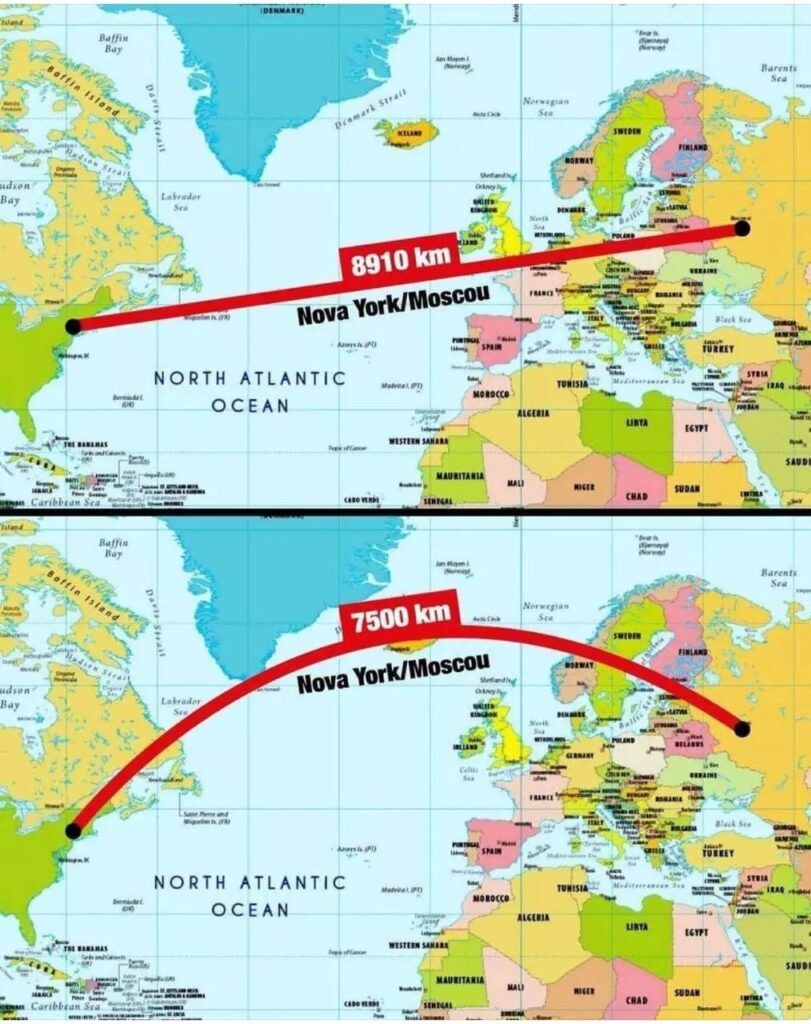
Geodesics are a concept from Riemannian geometry, which deals with curved surfaces. When plotting flight paths, airline planners rely on this type of geometry to calculate the most efficient routes. These curved trajectories save both time and fuel, making them crucial for modern aviation.
How Geodesic Routes Work
Imagine stretching a string tightly between two points on a globe. The path the string follows is a geodesic, representing the shortest route between those points. On a flat map, this same path appears curved due to the map’s projection.
Most maps use the Mercator projection, which distorts the relative size and distance of areas as you move away from the equator. This distortion is why flights between continents, particularly those near the poles, appear curved on a two-dimensional map.
Benefits of Curved Flight Paths
The advantages of following geodesic routes are significant:
- Time Efficiency: Flying along a geodesic reduces travel time, ensuring passengers reach their destinations faster.
- Fuel Conservation: Shorter distances mean less fuel consumption, benefiting both airlines and the environment.
- Safety Considerations: Air routes often avoid hazardous weather conditions, restricted airspace, or geographic obstacles like mountains or oceans. While geodesics guide the general path, real-time adjustments ensure safety and efficiency.
Real-Life Examples of Curved Flight Paths
- Transatlantic Flights: Routes between North America and Europe often follow a curve over the North Atlantic, called the great circle route. For instance, a flight from New York to London will arc over Canada and Greenland rather than follow a straight eastward path.
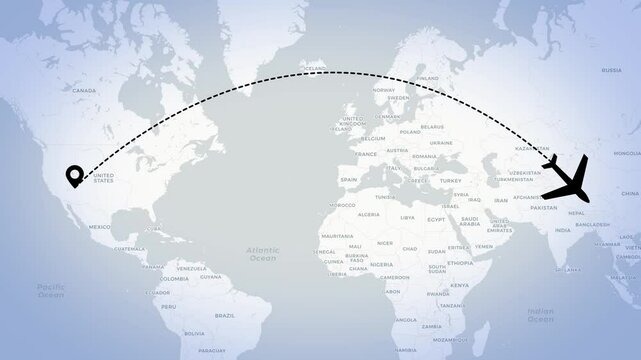
- Pacific Crossings: Flights from the United States to Asia, such as Los Angeles to Tokyo, follow a similar arc over the northern Pacific, taking advantage of the Earth’s curvature.
Debunking Flat Earth Myths
The curved appearance of flight paths has fueled misconceptions, including claims by flat-Earth theorists. However, the principles behind geodesic routes are well-understood and mathematically proven. These paths confirm the Earth’s spherical shape and the importance of using accurate geometrical models for navigation.
Airplane routes are curved, not because of technical limitations, but as a direct response to the Earth’s spherical shape. These geodesic paths represent the shortest, most efficient routes in three-dimensional space. By understanding the science and geometry behind flight planning, we gain a deeper appreciation for the ingenuity of modern aviation and its reliance on the natural curvature of our planet.
Leave a Reply