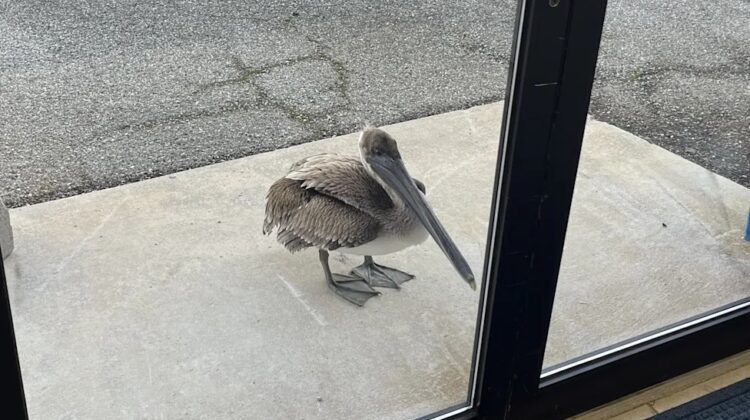
A quiet morning at a Florida marine research facility was interrupted by an unmistakable sound: tapping at the back door. When a biologist went to check, what he found waiting outside wasn’t a colleague or a delivery — it was an injured brown pelican.
An Unexpected Visitor
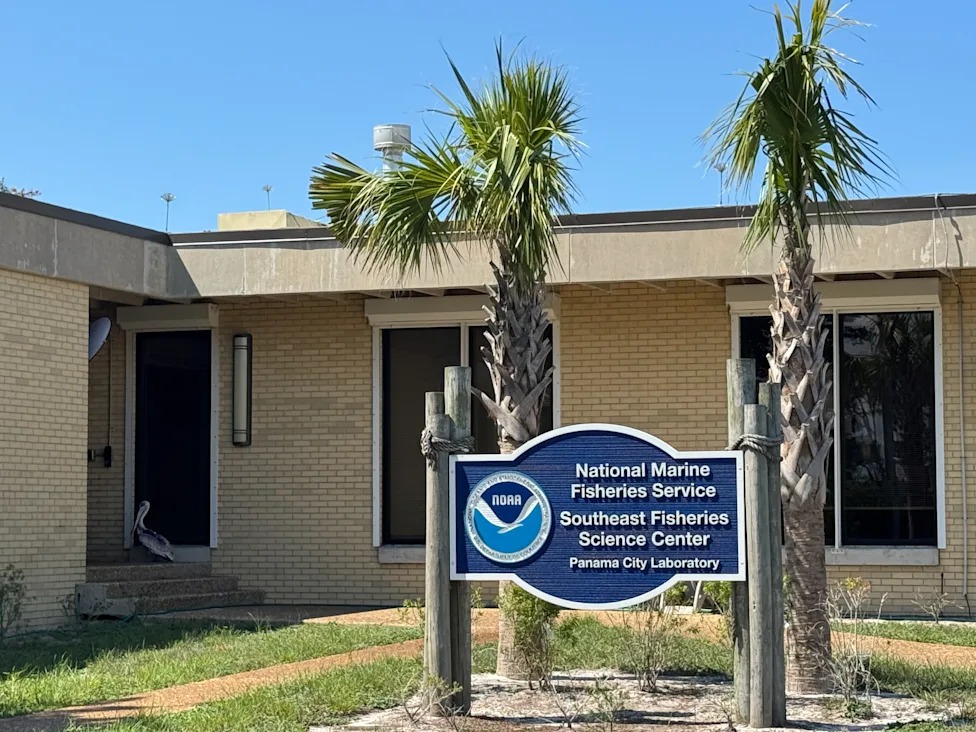
The pelican was standing at the door of NOAA Fisheries’ Southeast Fisheries Science Center laboratory in Panama City, Florida, pecking patiently at the glass with its long beak, almost as if it understood exactly where it had ended up. A closer look revealed why: heavy-duty fishing line was wrapped around its right wing, with a double-barbed treble hook embedded in the wing itself, severely limiting its ability to fly. About a dozen cactus spines were also lodged in its left foot.
Annsli Hilton, a University of Miami research associate working at the NOAA facility, initially assumed someone had brought the injured bird in. She was stunned to learn the pelican had arrived entirely on its own.
“I always kind of thought in my head — and liked to think that — animals would know to either come to me for help or to come to the lab for help,” Hilton said. “But I never thought it would happen.”
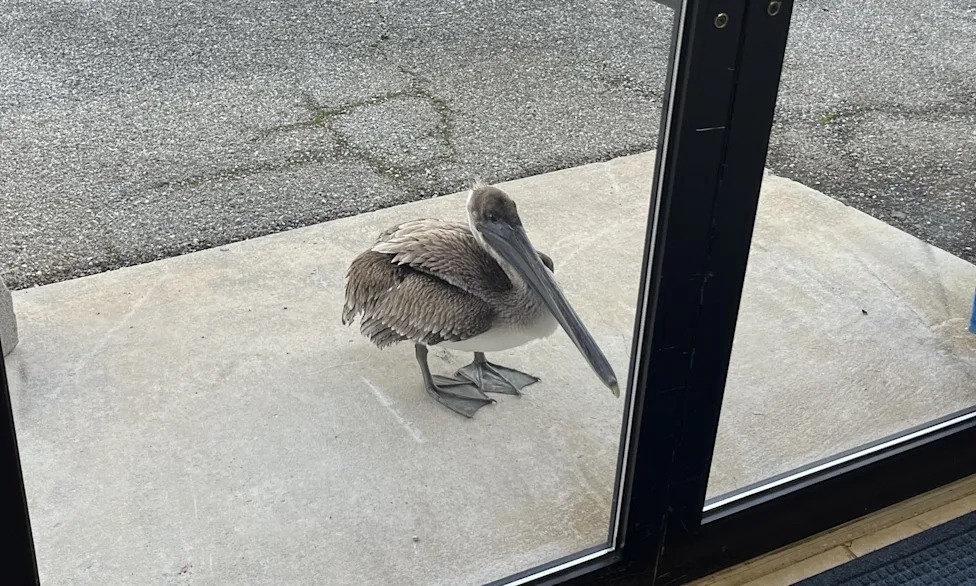
Hilton estimated the bird likely walked roughly a quarter-mile from a basin on St. Andrew Bay, where pelicans commonly gather, to reach the laboratory.
A Team Better Known For Sharks Steps In
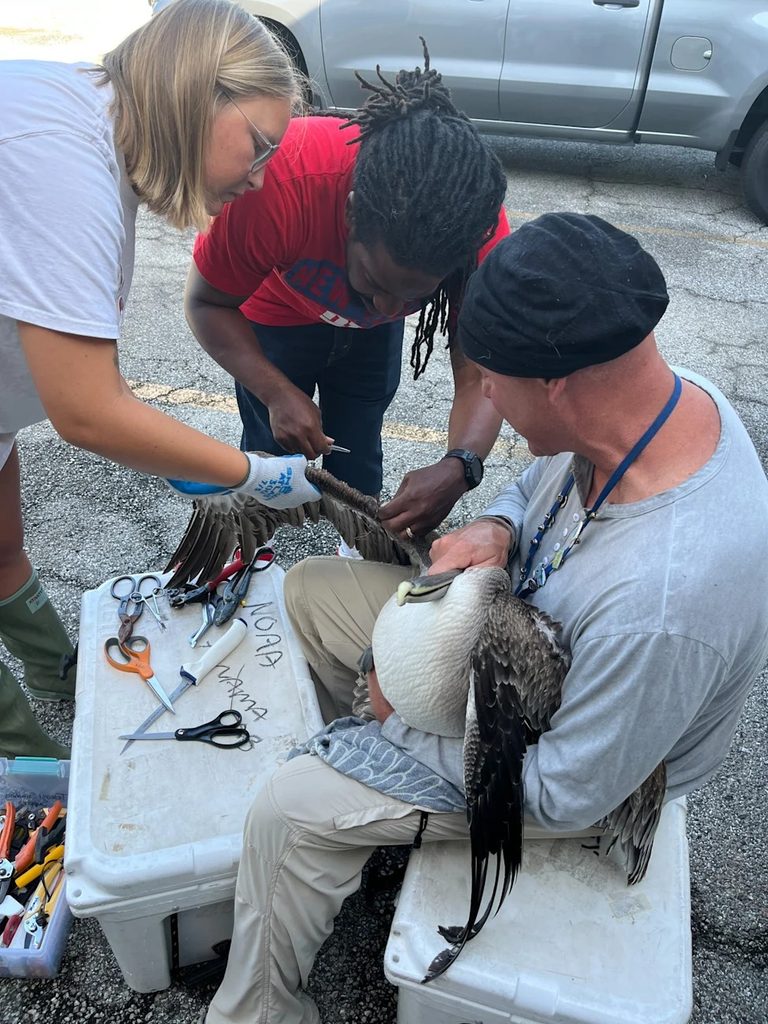
The facility’s scientists typically work with fish and sharks, not seabirds, but on September 8, they shifted focus without hesitation. One biologist carefully picked up the pelican by its abdomen and secured its beak, allowing the team to work safely without injuring the bird or risking a bite.
Hilton, 26, had never treated a pelican before, but relied on techniques she normally uses while tagging smalltooth sawfish. As a colleague held the pelican’s wing steady, Hilton cut through roughly six feet of tangled fishing line, and a co-worker snapped the treble hook with wire cutters. A small barb remained lodged in the bird’s wing bone, which Hilton carefully extracted with forceps before removing the cactus spines from its foot — likely picked up from cacti growing near the facility.
The entire procedure took about five minutes, though Hilton said it felt considerably longer given how unusual the situation was. The pelican, notably, stayed calm throughout — as NOAA’s own account of the incident put it, “almost as if it knew it was in good hands.”
Free Again
Once treatment was finished, a researcher carried the pelican to the nearby basin. After stretching and flapping its wings for a few minutes, it took off and flew away — a moment that, without the team’s intervention, likely wouldn’t have happened at all.
“A pelican that couldn’t fly probably wouldn’t live very long,” said Deborah Jaques, founder of the nonprofit Pelican Science, noting that brown pelicans rely on dramatic dives from as high as 65 feet to hunt fish. Without the ability to fly, Jaques said, the bird would likely have starved or fallen prey to a predator.
How Did It Know Where To Go?
The bigger mystery, for Hilton and the wider scientific community, was how the pelican ended up at the lab’s door in the first place — particularly since the facility is gated off from the road, making it unlikely a person had simply brought the bird there.
Gerald Hough, a bird behavior researcher at Rowan University, offered one theory: the pelican may have previously seen staff carrying fish in and out of the building and, in its distress, returned hoping to find food. Pelicans commonly associate people and docks with an easy meal, Hough explained, so a hungry, injured bird gravitating toward a place linked to people wouldn’t be entirely surprising.
“They are pretty good at taking advantage of their environments,” Hough said. “So if they got in trouble, they probably went where they knew people were in the hopes that somebody might be able to help them.”
Marine scientist Juliet Lamb, who studies seabirds, added that young pelicans — like this one, identifiable as a bird from that year based on its brown plumage — tend to be far less wary of people than older pelicans that may have previously been chased off or injured by humans.
As for the pecking at the glass specifically, Hough suggested the bird may have mistaken its own reflection for another pelican, or simply been drawn to the shaded doorway as a place to escape the sun.
A Rare, Memorable Encounter
While pelicans aren’t typically regarded as being as cognitively sophisticated as crows, parrots, or ravens, Hough noted this wasn’t an entirely isolated case — other injured wild animals, including a cormorant, a dolphin, and a manta ray, have previously been reported approaching humans in apparent search of help.
Whatever the pelican’s actual reasoning, Hilton said she was simply glad to have been there when it counted.
“This is kind of just a once-in-a-lifetime experience,” she said, “to have a bird knock at your door and ask for help.”
Frequently Asked Questions
What injuries did the pelican have when it arrived at the lab? The bird had heavy-duty fishing line wrapped around its right wing, a double-barbed treble hook embedded in the wing, and about a dozen cactus spines lodged in its left foot.
How did researchers treat the pelican without professional bird-handling experience? The team relied on restraint and fine-motor techniques they normally use for tagging sharks and smalltooth sawfish, safely immobilizing the bird’s beak and wing while removing the fishing line, hook, and spines in about five to ten minutes.
Why do experts think the pelican came to the lab on its own? Researchers believe the pelican may have associated people and the facility with food, having possibly seen staff carrying fish in the past, and sought out a familiar human presence while injured and in distress.
Would the pelican have survived without help? Unlikely. Experts noted that brown pelicans rely on flight to dive for fish, and a bird unable to fly due to injury would likely have starved or been taken by a predator within a short time.
How can people help prevent injuries like this? NOAA Fisheries recommends disposing of fishing line properly, using secure containers or designated recycling bins, and switching to barbless hooks, which are easier and safer to remove if wildlife becomes entangled.
Sources: The Washington Post and NOAA Fisheries (via Action News Jax/Cox Media Group), cited above.
Leave a Reply