
Another creationist myth has been debunked, but this is unlikely to stop it from being spread in the future. Under the watchful eyes of researchers able to closely examine it, a new species emerged faster than anyone had anticipated. It seems fitting that the species is a Galapagos finch, one of the subfamilies essential to Darwin’s revolutionary discovery.
Finches have evolved varied-shaped beaks and different body proportions as a result of the diversity of the Galapagos Islands, allowing them to take advantage of the variety of food sources available. Even so, Darwin himself questioned whether evolution would proceed quickly enough for us to observe it in real time. Before the hand of time has traced the passage of ages, he said, “We see nothing of these sluggish changes in progress.”
Microbiologists can actually observe the emergence of new species since bacteria evolve so quickly, but vertebrate zoologists are rarely that fortunate. As a result, when renowned finch trackers Drs. Peter and Rosemary Grant of Princeton University discovered something novel on the island of Daphne Major, they were incredibly reluctant to conclude that what they were witnessing was anything other than a subspecies of an already existing species.
Three years ago, the idea that the Grants may have described a new species as it appeared spread to the general public thanks to the audacity of other scientists. In a paper now released, the Grants report what they had previously deemed “extremely unlikely”: the emergence of a self-contained community on Daphne Major in just two generations as a result of the presence of a single stray bird. The incidents also seem to be considerably more unexpected than was initially thought.
An abnormally huge male with a unique beak came on Daphne Major in 1981, sparking the start of the tale. “He didn’t fly in over the water for us to see, but we soon became aware of him. We knew he didn’t hatch from an egg on Daphne Major since he was so unique from the other birds “In a statement, Peter Grant said. Genetic sequencing has now revealed the newcomer was a Geospiza conirostris from Espaola island, 100 kilometers (60 miles) away, contrary to earlier speculation that it was a hybrid of two other species from a nearby island.
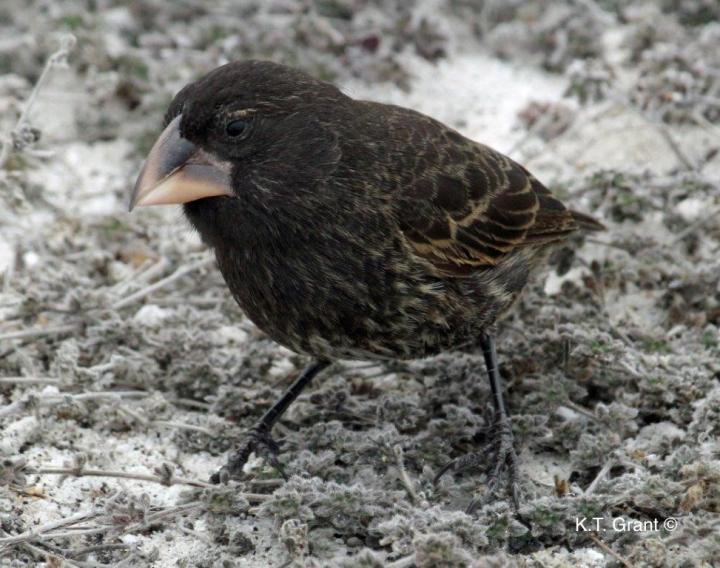
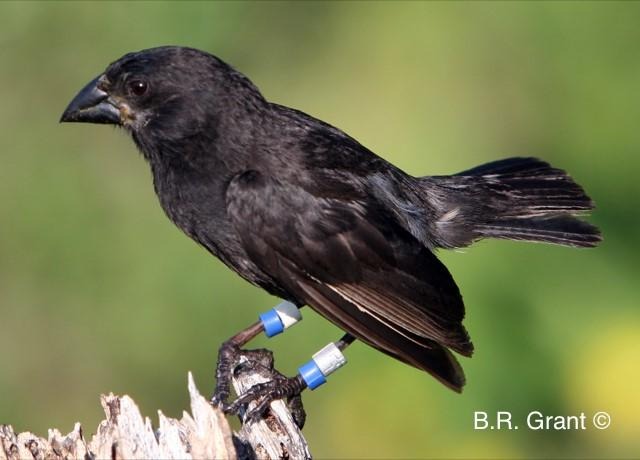
The doctoral student who first observed him gave him the nickname “Big Bird,” and after winning over a local female medium ground finch (Geospiza fortis), he created a hybrid family. While many finches are only able to eat large or small Tribulus seeds, their offspring’s uniquely shaped beaks showed suitable for both ingesting cactus nectar that only a few other species can access as well as Tribulus seeds of all sizes.
Galapagos finches select partners in part depending on the size and shape of their beaks, but it appears that the majority of Daphne Major’s other inhabitants didn’t find anything alluring about such varied mouthparts.
Furthermore, despite the fact that Big Bird’s partner reportedly enjoyed his offshore accent, other ladies of her species did not. As a result, the pair’s descendants reproduced almost exclusively with other individuals of their own species rather than the island’s three other species.
“This lineage would have been identified as one of the four species on the island by a naturalist who visited Daphne Major without knowing that this lineage was quite recent. This amply underlines the importance of ongoing field research, “said Uppsala University, Sweden professor Leif Andersson. The Grants and Andersson jointly published the findings of the genome sequencing of Big Bird and several of his offspring in Science, establishing that it only took two generations for a new species to emerge.
We have a record of every Big Bird ancestor’s mating history thanks to Daphne Major’s diminutive stature and the Grants’ extraordinary attention to detail. But up until recently, the Grants weren’t sure if the birds they saw satisfied the criteria for being classified as a new species as opposed to merely a subspecies of an existing one. Nevertheless, the family is carving out a prosperous niche for itself, having expanded to eight breeding pairs and 23 members after six generations.
The new lineage’s survival is still in danger. Before a few terrible seasons, the population reached a peak of 36 in 2010. The smallest population might likely be the first to go extinct if climate change or new species make Daphne Major less favorable for finches in general. The Grants, however, are currently privy to the emergence of a species that was previously only observed in butterflies and outside of the animal realm.
Leave a Reply