Estimates for chemical energy inside the icy moon have gone up!
Recent estimates have significantly increased the likelihood of finding alien life on Saturn’s moon Enceladus. The icy moon, known for its deep ocean, hydrothermal activity, and complex chemistry, has long been considered a potential hotspot for the emergence of life. Now, a fresh analysis has added more optimism to the prospect, suggesting that there may be more chemical energy within Enceladus than previously believed.
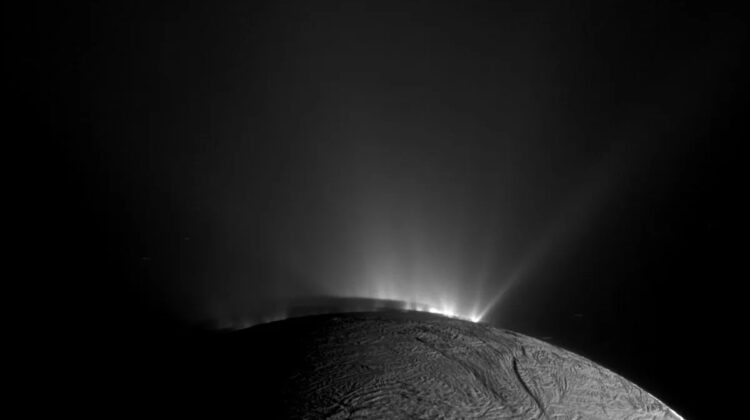
Enceladus, observed through plumes released into space, had its mysteries unveiled by the now-retired Cassini spacecraft. Even after Cassini’s scheduled fiery demise in Saturn’s atmosphere a few years ago, the data it collected is still being scrutinized, revealing surprises about the possible molecules present and how they might have originated in Enceladus’ ocean.
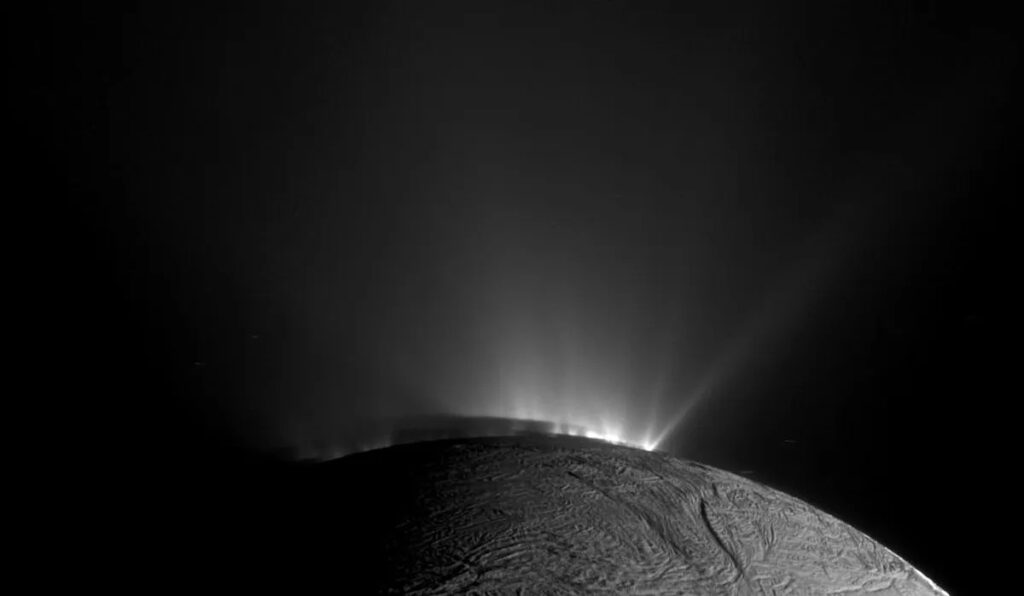
Image Credit: NASA/JPL-Caltech/Space Science Institute
The latest research has unveiled the detection of several previously unknown molecules, with hydrogen cyanide standing out among them. Beyond its potential excitement for murder mystery enthusiasts, hydrogen cyanide plays a pivotal role in the formation of amino acids—the essential building blocks of proteins.
Lead author Jonah Peter, a doctoral researcher at Harvard, formerly associated with NASA’s Jet Propulsion Laboratory (JPL), expressed the significance of this discovery, stating, “The discovery of hydrogen cyanide was particularly exciting because it’s the starting point for most theories on the origin of life. The more we tried to poke holes in our results by testing alternative models, the stronger the evidence became. Eventually, it became clear that there is no way to match the plume composition without including hydrogen cyanide.”

Previous analyses had linked the chemical energy available in Enceladus’ ocean to methane production or methanogenesis. The observed molecules in the plumes are consistent with oxidation, suggesting that if oxidation is occurring, a substantial amount of chemical energy is being released.
Kevin Hand, a co-author of the study and principal investigator of the team behind the new results at JPL, provided an analogy: “If methanogenesis is like a small watch battery in terms of energy, then our results suggest the ocean of Enceladus might offer something more akin to a car battery, capable of providing a large amount of energy to any life that might be present.”
Despite limited data from Cassini on Enceladus’ plumes, researchers employ statistical analysis to deduce their composition without overfitting the data. While the new findings don’t conclusively guarantee the existence of life on Enceladus, they open doors for laboratory testing of the exact conditions required for these molecules to appear in plumes. Additionally, they provide insights into the suitability of these conditions for sustaining life.
Jonah Peter concluded, “Our work provides further evidence that Enceladus is host to some of the most important molecules for both creating the building blocks of life and for sustaining that life through metabolic reactions. Not only does Enceladus seem to meet the basic requirements for habitability, but we now have an idea about how complex biomolecules could form there and what sort of chemical pathways might be involved.” The exploration of Enceladus continues to be a captivating journey into the potential for extraterrestrial life within our own solar system.
Leave a Reply