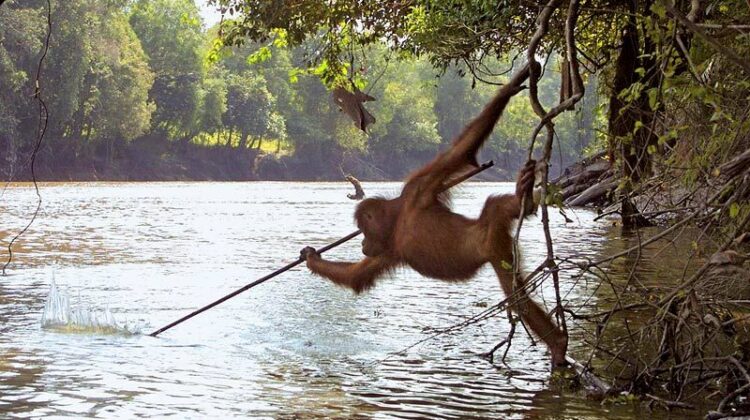
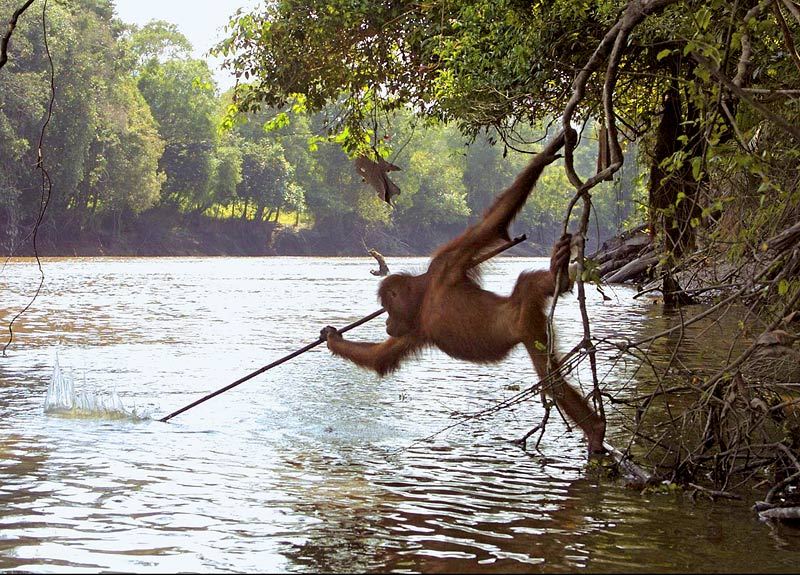
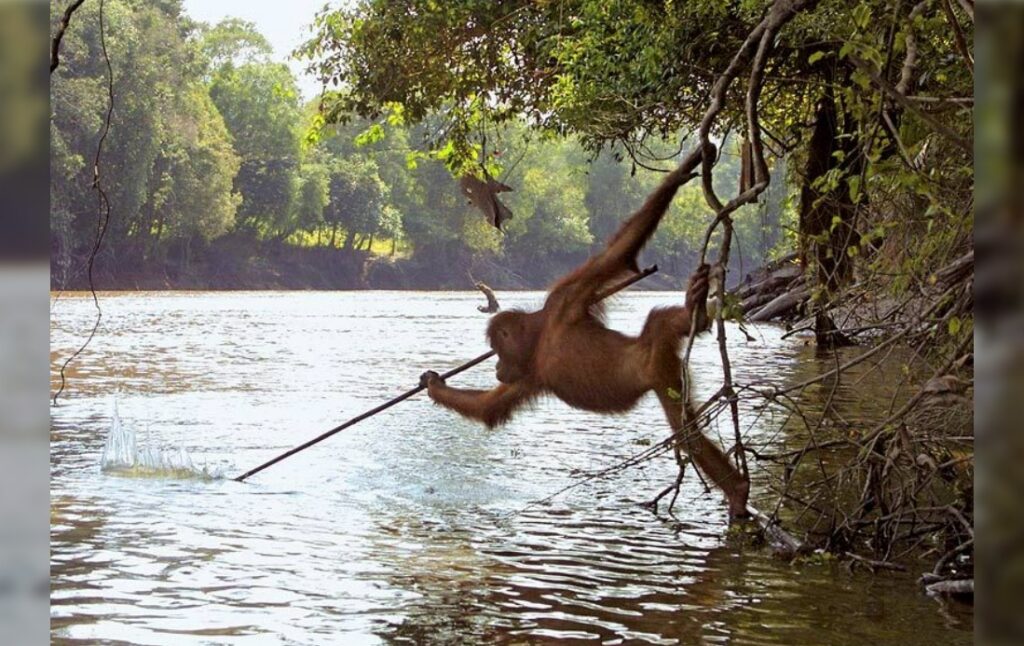
A photograph taken on the Indonesian island of Kaja, off Borneo, captured a moment few people ever get to witness: a wild male orangutan, braced against overhanging branches above a river, using a wooden pole to try to spear fish swimming below.
The image was taken by wildlife photographer Gerd Schuster, co-author of the 2008 book Thinkers of the Jungle: The Orangutan Report. According to Schuster’s account, the orangutan hadn’t been trained or prompted by researchers — it had simply been watching local fishermen work the Gohong River with spears, and decided to try the technique itself. The full method proved too difficult for the animal to master outright, but it adapted anyway, using the pole to snag fish that were already caught in nearby fishing lines rather than spearing them directly.
Not the First Sign of Orangutan Intelligence
This wasn’t an isolated case. Tool use in wild orangutans was first formally documented back in 1982, when primatologist Biruté Galdikas observed a Bornean orangutan in Tanjung Puting National Park snap a branch in half and use it to scratch its own back — one of the earliest recorded instances of tool use by the species. Researchers have since documented Sumatran orangutans using sticks to pry open spiky fruit pods too dangerous to handle bare-handed, and footage from Camp Leakey in Borneo has shown orangutans mimicking human tasks like washing laundry.
Kaja Island itself is part of a rehabilitation program for orangutans that have been displaced by logging and palm oil expansion — animals that, in some cases, are still killed or injured in conflicts with plantation workers when they wander into cultivated land. Seeing one adapt so resourcefully to a completely different, human-taught skill is a reminder of just how cognitively flexible the species is, even as their forest habitat keeps shrinking.
Why It Matters
Findings like this add to a growing body of research showing that great apes don’t just use tools instinctively — they observe, adapt, and improvise based on what they see other species (including humans) do. Orangutans share about 97% of their genetic makeup with humans, which researchers say helps explain their unusual capacity to pick up on human behavior through simple observation rather than direct teaching.
Kaja Island, where the photo was taken, functions as part of a broader rehabilitation effort for orangutans displaced by logging and palm oil expansion across Borneo. Many of the animals housed there arrived after being pushed out of native forest that had been cleared for plantations, and some rescued individuals have suffered violent encounters with plantation workers when their shrinking habitat brought them into conflict with agricultural land. Seen against that backdrop, a moment like this one is more than a curiosity — it’s a glimpse of how resourceful these animals can be even as the forest they depend on keeps disappearing.
Other researchers have documented similar ingenuity elsewhere. In Sumatra’s Gunung Leuser National Park, primatologist Carel van Schaik observed wild orangutans using sticks to safely pry open fruit pods covered in irritating, needle-like hairs — a separate, independently developed example of tool use driven by necessity rather than imitation of humans. Together, these observations have reshaped how scientists think about primate cognition, showing that tool use in the wild isn’t a rare fluke but a recurring, adaptable skill across orangutan populations.
Frequently Asked Questions
Is the spearfishing orangutan photo real? Yes. It was taken by wildlife photographer Gerd Schuster and published in the 2008 book Thinkers of the Jungle: The Orangutan Report. Despite skepticism that circulated online after it went viral, the photo itself is authentic, though the orangutan was never confirmed to have actually caught a fish with the spear.
Did the orangutan learn this behavior on its own? It appears to have learned by observation rather than direct teaching. According to Schuster’s account, the orangutan had been watching local fishermen spear fish on the Gohong River and adapted the technique itself, eventually using the pole to retrieve fish already caught in nearby lines rather than spearing them outright.
When was tool use in wild orangutans first documented? In 1982, when primatologist Biruté Galdikas observed a wild Bornean orangutan in Tanjung Puting National Park use a broken branch as a back-scratcher — one of the earliest confirmed cases of tool use in the species.
Do orangutans use tools anywhere else in the wild? Yes. Sumatran orangutans have been observed using sticks to pry open fruit pods covered in irritating hairs, and orangutans at rehabilitation centers like Camp Leakey have been filmed mimicking human tasks such as washing laundry.
Leave a Reply