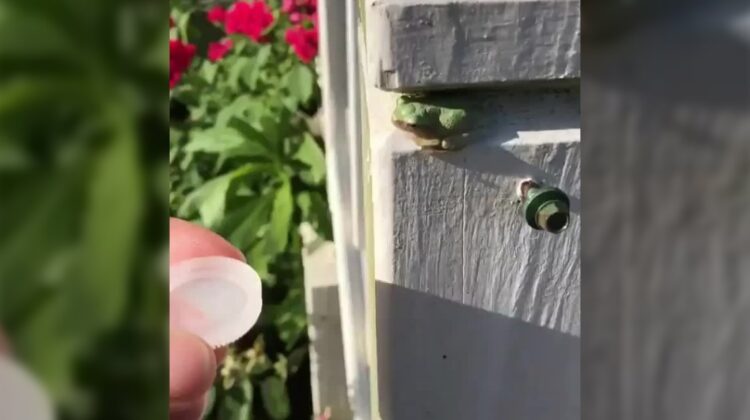
Set a bowl of water in front of a frog on a hot day, and it won’t do what you might expect. Instead of lapping it up, the frog is more likely to simply sit down in it — and within moments, its body will pull in all the moisture it needs without a single swallow.
That’s exactly what one Reddit user, going by FootLoosePickleJuice, captured on video: a pet frog settling into a shallow dish of water on a warm day, soaking rather than drinking. The clip is a perfect illustration of one of the more unusual adaptations in the animal kingdom — frogs don’t drink water through their mouths at all.
The “Drinking Patch”
Frogs absorb water directly through their skin, and much of that absorption happens through a specialized region on their belly and the underside of their thighs, sometimes called the “drinking patch” or “seat patch.” In some terrestrial frog species, this small patch — making up roughly a tenth of the animal’s total skin surface — accounts for more than 70% of its total water uptake. Frogs will often press this area flat against a wet surface, like damp soil or a puddle, to maximize contact and absorb moisture as efficiently as possible.
This is why a frog crouching low with its belly pressed to the ground isn’t just resting — it may well be drinking.
Skin That Breathes, Too
The same permeable skin that lets frogs absorb water also lets them absorb oxygen, in a process called cutaneous respiration. A dense network of blood vessels sits just beneath the surface of a frog’s skin, close enough that oxygen from the surrounding air or water can pass directly into the bloodstream, while carbon dioxide passes back out.
Frogs do have lungs, and use them regularly on land. But cutaneous respiration isn’t a backup system — it runs constantly, even while the lungs are working, and becomes essential when a frog is submerged or hibernating through winter, when breathing through the mouth and lungs isn’t an option. Some species rely on skin-based respiration almost entirely during these periods. For it to work, though, the skin has to stay moist at all times, which is why frogs are covered in mucus-secreting glands that keep the surface wet — a dry-skinned frog is a frog in trouble.
A Double-Edged Adaptation
Skin this permeable comes with a serious downside: whatever passes through it isn’t limited to water and oxygen. Pesticides, heavy metals, and other pollutants in soil or water can be absorbed by a frog just as readily as moisture can, with no real way to filter them out. This is a major reason amphibians as a group are considered unusually sensitive environmental indicators — a decline in local frog populations is often one of the earliest visible signs of water or soil contamination in an ecosystem.
It’s also why moving a wild frog with sunscreen, insect repellent, or even just hand lotion on your skin can harm the animal; substances that are harmless to human skin can be absorbed at damaging concentrations through a frog’s.
Frequently Asked Questions
Do frogs ever drink water with their mouths? No — frogs absorb virtually all the water they need through their skin, primarily through the “drinking patch” on their belly and thighs, rather than swallowing it.
How do frogs breathe underwater? Through cutaneous respiration: oxygen dissolved in the water diffuses directly through their skin into blood vessels just beneath the surface, allowing them to survive submerged for extended periods.
Why are frogs considered sensitive to pollution? Because their skin absorbs substances from their environment as easily as it absorbs water and oxygen, frogs can take in pesticides and other pollutants directly through their skin, making local frog populations a useful early warning sign of environmental contamination.
Is it safe to touch a frog with sunscreen or lotion on your hands? No — chemicals that are harmless to human skin, including sunscreen, insect repellent, and hand lotion, can be absorbed through a frog’s permeable skin and may harm the animal.
Leave a Reply