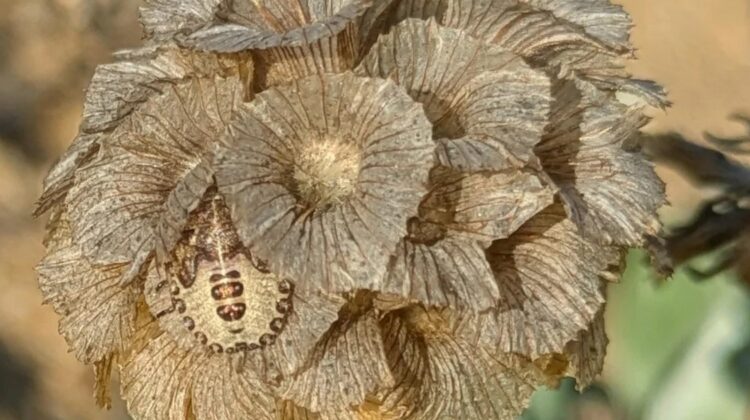
Just beyond a line of trees in Hertfordshire, the M25 and M1 rumble past. On the near side, in a one-acre former orchard, golden grasses sway and seed heads tremble in the breeze. Somewhere among them, young shieldbugs are hoping nobody looks too closely.
A Garden Built for People and Wildlife
This is the Serge Hill Project for Gardening, Creativity and Health, founded by landscape designer Tom Stuart-Smith and his wife, psychotherapist Sue Stuart-Smith. The not-for-profit opened in 2024 as a resource for local schools, youth groups, and charities, including the Sunnyside Rural Trust, which offers horticultural training to people with learning disabilities. Its centerpiece is the Apple House, designed by their son Ben, and its living Plant Library, where roughly 2,000 herbaceous plants and low shrubs, plus about 500 kinds of bulb, are laid out in a grid for people to study.
The library also doubles as an experiment. Many of its plants are drought-tolerant Mediterranean species, grown to test what a climate-resilient landscape might look like. Reports from the site describe plants thriving in a layer of sharp sand through a hot summer without being watered.
Nymphs in the Seed Heads
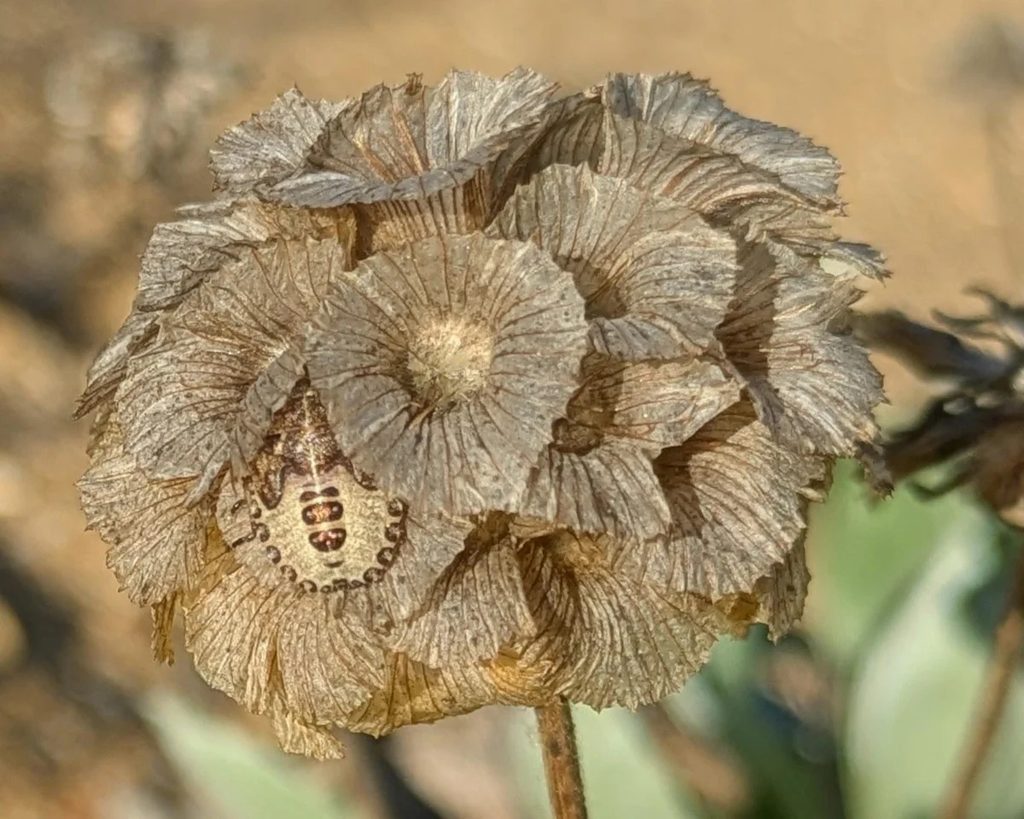
Among those Mediterranean plants is Crete scabious, whose pale lilac flowers turn into round, papery seed heads by autumn. Tucked into the ridged, funnel-like cups of those seed heads, a recent visitor found hairy shieldbug nymphs.
The young bugs blend in remarkably well. Bands of golden brown across the abdomen and along the body’s edge break up their oval outline, and their color matches the dried seed heads almost exactly. Adults are easier to spot, with black-and-white banded antennae and a chequered border around the rear of the body. Elsewhere in the garden, adults and juveniles were seen gathering on sunflower stems and dark red dahlias.
Meet the Hairy Shieldbug
The hairy shieldbug (Dolycoris baccarum) is a large, common species across much of the UK, measuring 10 to 13 millimeters. It gets its name from the fine pale hairs covering its body, and it’s also called the sloe shieldbug because it often feeds on blackthorn fruits. Using piercing mouthparts, it drinks from the leaves, seeds, and fruits of many plants.
Adults spend the winter sheltered away, then emerge in spring to mate. Females lay clumps of barrel-shaped eggs that stick firmly to a plant. The nymphs, smaller and rounder than adults and still hairy, grow through several stages before maturing in late summer or early autumn.
A Small Sign of a Healthy Garden
Recording at the Plant Library has turned up almost 350 invertebrate species, including five kinds of shieldbug. That is encouraging for a project testing how gardens can handle a warmer climate, and a reminder that wildlife will move into planted spaces that offer food and cover, even just a mile from Britain’s busiest motorway.
Frequently Asked Questions
Why are shieldbugs called stink bugs?
When threatened, they release a strong-smelling fluid as a defense, which is why shieldbugs are sometimes nicknamed stink bugs.
Are hairy shieldbugs garden pests?
They feed on plant sap, seeds, and fruits, but gardeners rarely report significant damage, and they are considered a normal part of the garden community.
How can you tell a hairy shieldbug nymph from an adult?
Nymphs are smaller and rounder, still hairy, and lack fully developed wings. Their coloring is often more camouflaged than the adults’ bold banding.
What is the Serge Hill Project?
It is a not-for-profit garden in Hertfordshire that uses gardening to support wellbeing, offering programs for schools, community groups, and people recovering from illness, alongside its research-focused Plant Library.
Sources: Gardenista; Gardens Illustrated; Tom Stuart-Smith Studio; The Dirt; Two Good Gardeners podcast; Wildlife Watch.
Leave a Reply