• Skip to main content
  • Skip to primary sidebar
  • Skip to footer
  • Home
  • About Us
  • Copyright Report
  • Submit Content
  • Terms
  • Privacy Policy
  • Legal Disclaimer

Hasan Jasim

Hasan Jasim is a place where you may get entertainment, viral videos, trending material, and breaking news. For a social generation, we are the largest community on the planet.

Take a Look Inside the Batagaika Crater, the Largest Scar on Earth

by Hasan Jasim Editorial Team Leave a Comment

ShareTweet

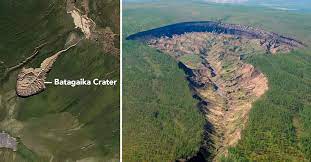
The Batagaika megaslump provides a glimpse into Siberia’s ancient past and uncertain future.

The Batagaika megaslump is a massive crater in the Siberian taiga, in the Republic of Sakha (Yakutia) in Russia. It is also known as the “gateway to hell” or the “scar on the planet” because of its enormous size and eerie appearance. The crater is about one kilometer long and 100 meters deep, and it is growing rapidly due to climate change and human activity.
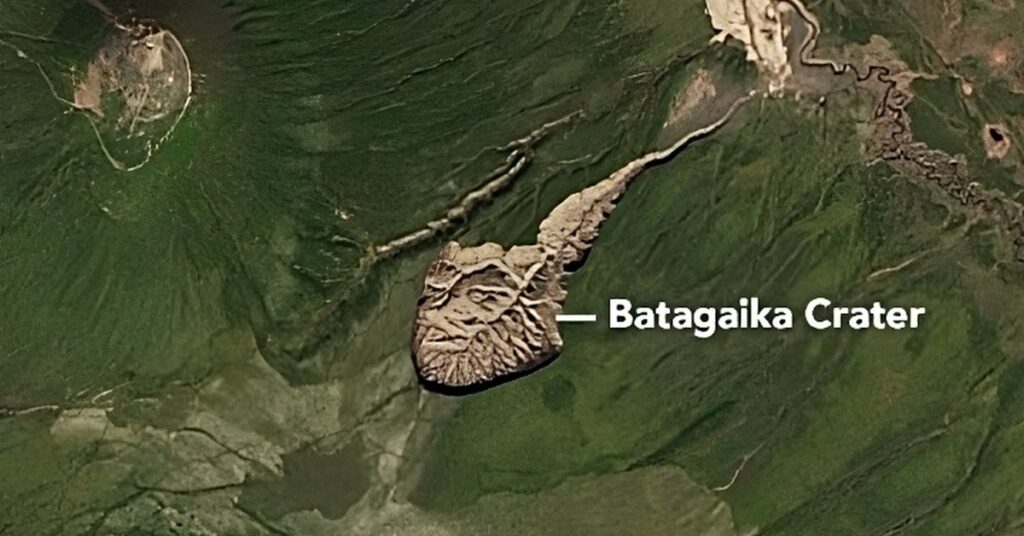
The Batagaika crater is the largest megaslump on earth. Image credit: NASA

The crater was formed by a process called thermokarst, which occurs when permafrost (permanently frozen ground) thaws and collapses, creating a depression in the landscape. The Batagaika megaslump started to form in the 1960s, after a nearby forest was cleared for road construction, exposing the permafrost to direct sunlight and warmer temperatures. Since then, the crater has been expanding by up to 10 meters per year, as more permafrost melts and erodes away.
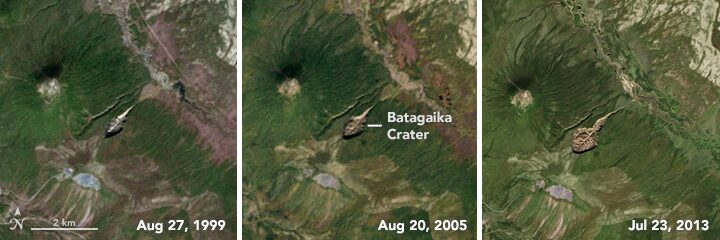
Batagaika crater evolution 1999-2013 (click to enlarge and zoom in). Image credit: NASA

The Batagaika crater is not only a striking example of the effects of global warming on the Arctic, but also a unique window into the region’s geological and biological history. The exposed layers of ice and soil along the crater’s walls contain up to 200,000 years of climate records and ancient fossils. Researchers have found remains of extinct animals such as Pleistocene horses, steppe bison, cave lions, woolly rhinos, cave bears and wolves (or dogs?), as well as evidence of past vegetation such as spruce and pine forests. The oldest permafrost layer in the crater is estimated to be about 650,000 years old, making it the oldest known permafrost in Eurasia.
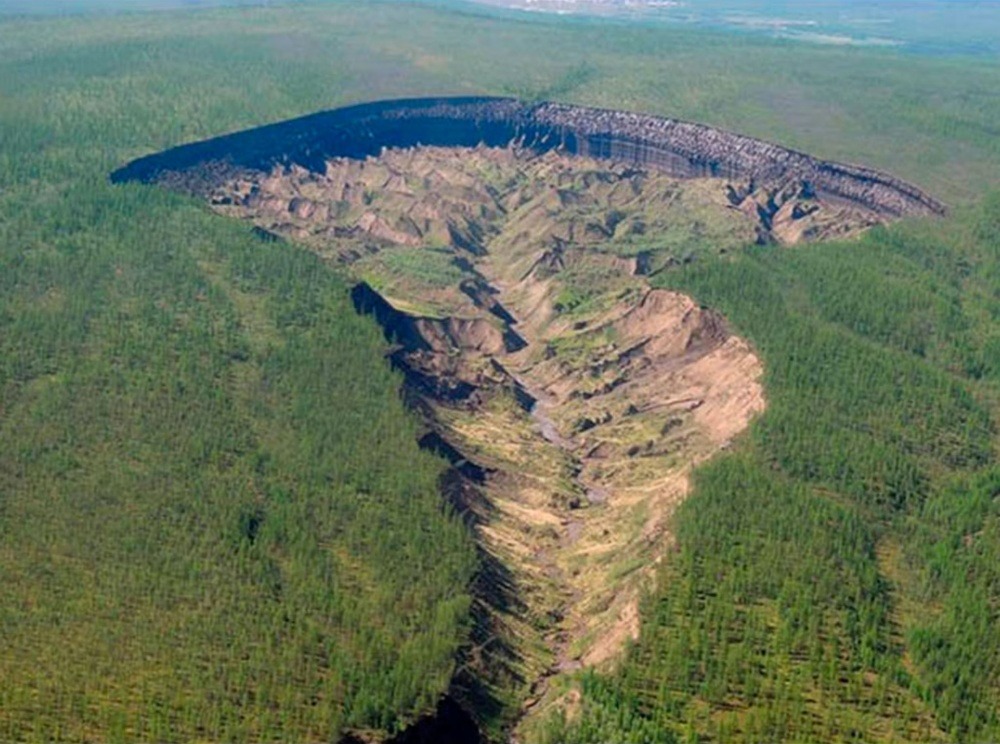
The Batagaika megaslump exposed extinct animals such as Pleistocene horses, steppe bison, cave lions, and wolves, as well as evidence of past vegetation. Source

The Batagaika megaslump is also a potential source of greenhouse gases, such as carbon dioxide and methane, that are trapped in the permafrost and released into the atmosphere when it thaws. This could create a positive feedback loop, where more warming leads to more thawing, which leads to more emissions, which leads to more warming. Scientists are monitoring the crater’s gas fluxes and microbial activity to better understand its impact on the global carbon cycle.

According to a recent report by Reuters, explorers ventured into the Batagaika mega slump and returned with awe-inspiring footage of their journey, capturing the view of the crater from the inside.

The Batagaika megaslump is one of many permafrost craters that have appeared across Siberia in recent years, but it is by far the largest and most impressive. It is a natural laboratory for studying the past and present dynamics of the Arctic environment, as well as a warning sign of the future challenges posed by climate change.

Filed Under: Trends Worldwide Tagged With: batagaika, crater, earth, inside, largest, look, scar, take, trends, worldwide

Reader Interactions

Leave a Reply Cancel reply

Your email address will not be published. Required fields are marked *

Primary Sidebar

More to See

Motherly Love on Display: A Majestic Elephant Shows the World the Power of Nurturing

By Hasan Jasim Editorial Team

Dog runs off after car crash — runs to get help in an unexpected place

By Hasan Jasim Editorial Team

Are 2 year olds still babies?

By Hasan Jasim Editorial Team

I had no clue what this was, do you?

By Hasan Jasim Editorial Team

Dog kept on chain his whole life gets to see ocean for the first time ever – catches rescuer off guard with his reaction

By Hasan Jasim Editorial Team

Finally, an answer to a mystery surrounding these 1,000-year-old trees

By Hasan Jasim Editorial Team

The Largest Solar Power Plant In The World Just Got Switched On

By Hasan Jasim Editorial Team

Footer

ABOUT HASANJASIM.ONLINE

Hasanjasim.online is a digital platform dedicated to publishing well-researched articles about the animal kingdom, nature, and the environment. Our editorial team works to source stories from credible outlets, scientific research, and verified reports, aiming to inform as much as we entertain. From wildlife conservation and animal behavior to natural wonders and environmental science, we cover the topics that help readers better understand and appreciate the natural world. Whether you're a lifelong nature lover or simply curious about the planet we share, Hasanjasim.online aims to be a trustworthy destination for stories worth reading — and worth citing.

Recent

  • Euphorbia Hirta (“Asthma-Plant”): What Traditional Use and Real Research Actually Show
  • A Mystery Animal Has Been Randomly Attacking People in New Hampshire — Here’s What We Know
  • A Woman Was Filmed Sharing Her Ice Cream With Her Dog — Here’s What Vets Actually Say About It
  • Dolphin Calf Incident in Ceuta Sparks Outrage After Disturbing Beach Footage Emerges
  • Lactuca Serriola Root: Traditional Uses of Prickly Lettuce (Wild Lettuce) Root
  • The Puppy a Firefighter Couldn’t Leave Behind — and the Story Didn’t End There
  • A Mother Dog Dove Into Floodwater Again and Again — Until All 7 of Her Puppies Were Safe

Search