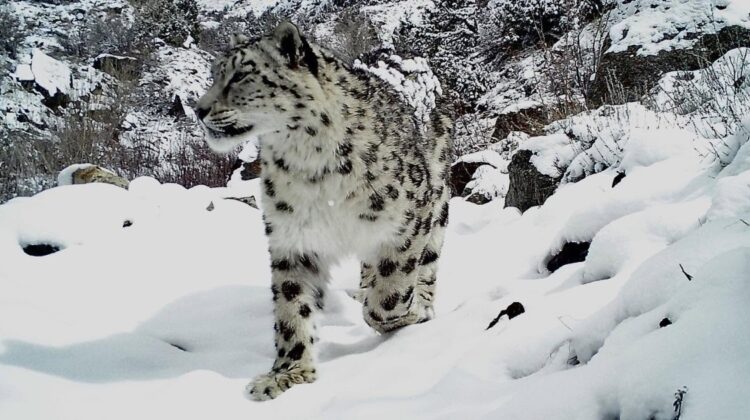
Watch a snow leopard leap mid-hunt and it looks less like an animal moving and more like a piece of engineering doing exactly what it was designed for. Every part of its skeleton and musculature — from its hind legs to the length of its tail — has been shaped by evolution to solve one specific problem: launching, steering, and landing safely across the steep, broken terrain of Central Asia’s highest mountain ranges.
Hind Legs Built Like Compressed Springs
A snow leopard’s power comes almost entirely from its hind limbs, which are noticeably longer and more heavily muscled than its front legs. According to the Snow Leopard Trust, this asymmetry allows the cat to launch itself roughly 30 feet (about 10 meters) in a single leap — several times its own body length. The main muscle groups doing the work are the quadriceps, which drive the explosive knee extension at takeoff, and the gluteal muscles, which stabilize the hips through both the launch and the landing. Research cited by the Snow Leopard Trust has found these hind-leg muscles are significantly more developed in snow leopards than in other big cats — a direct adaptation to a habitat where a missed jump can mean a fatal fall.
A Tail That Doubles as a Rudder
At close to 100 cm (about 40 inches) — nearly the length of the cat’s entire body — the snow leopard’s tail is proportionally the longest of any big cat. In flight, it functions as a counterbalance and steering mechanism, letting the cat make fine adjustments to its trajectory mid-air rather than committing to a fixed, uncontrolled arc. The same tail also serves a second, unrelated purpose back on the ground: snow leopards wrap it around their bodies like a scarf while resting, using it as extra insulation against temperatures that can drop below -40°F (-40°C) in their high-altitude range.
Short Front Legs and Snowshoe Paws for the Landing
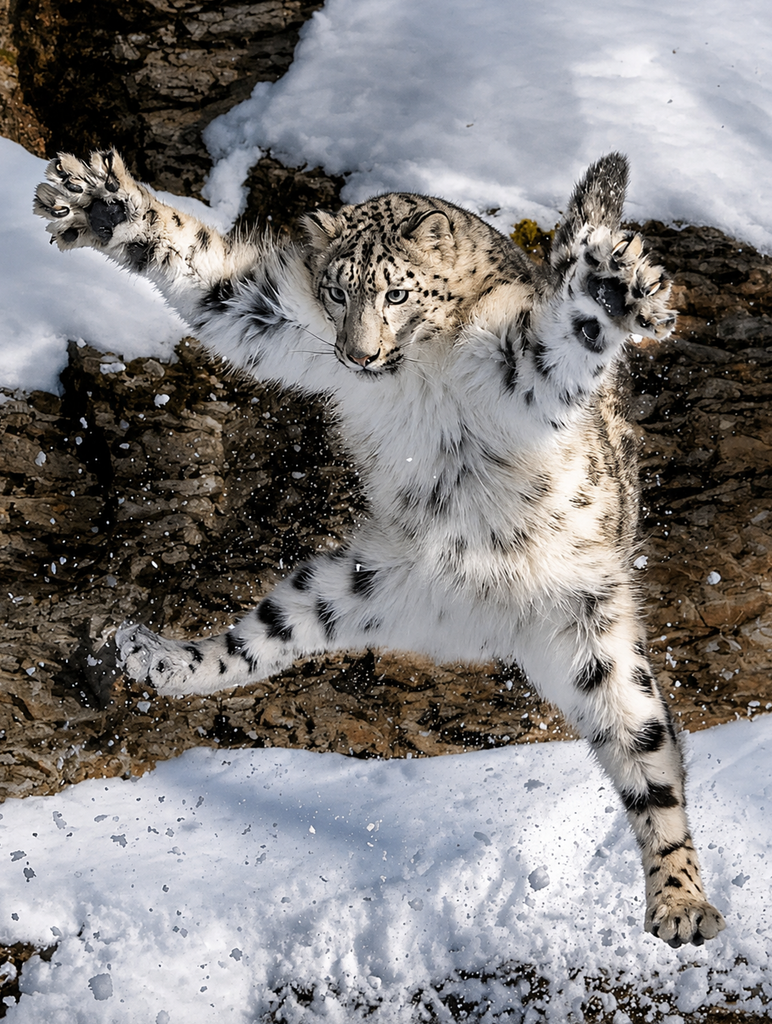
Where the hind legs generate power, the front legs and paws are built to absorb it. Shorter and more compact than the hind limbs, the front legs give the cat a lower, more stable base to land on when it comes down on uneven rock or ice. The oversized, fur-covered paws spread the cat’s weight the way a snowshoe does, preventing it from sinking into deep snow, while thick padding underneath protects against sharp, frozen rock. Together, these features let a snow leopard stick a landing that would injure most other predators.
A Flexible Spine Ties It All Together
None of these adaptations work in isolation. A snow leopard’s spine is unusually flexible for a big cat, allowing it to twist, arch, and adjust its body position mid-leap — a critical ability when a jump target shifts, such as prey suddenly moving or a foothold turning out to be less stable than expected. That flexibility, combined with the powerful hind-leg launch and the tail’s steering ability, is what allows the cat to change direction in the air rather than simply following a ballistic arc to wherever its jump happened to send it.
Why It Had to Evolve This Way
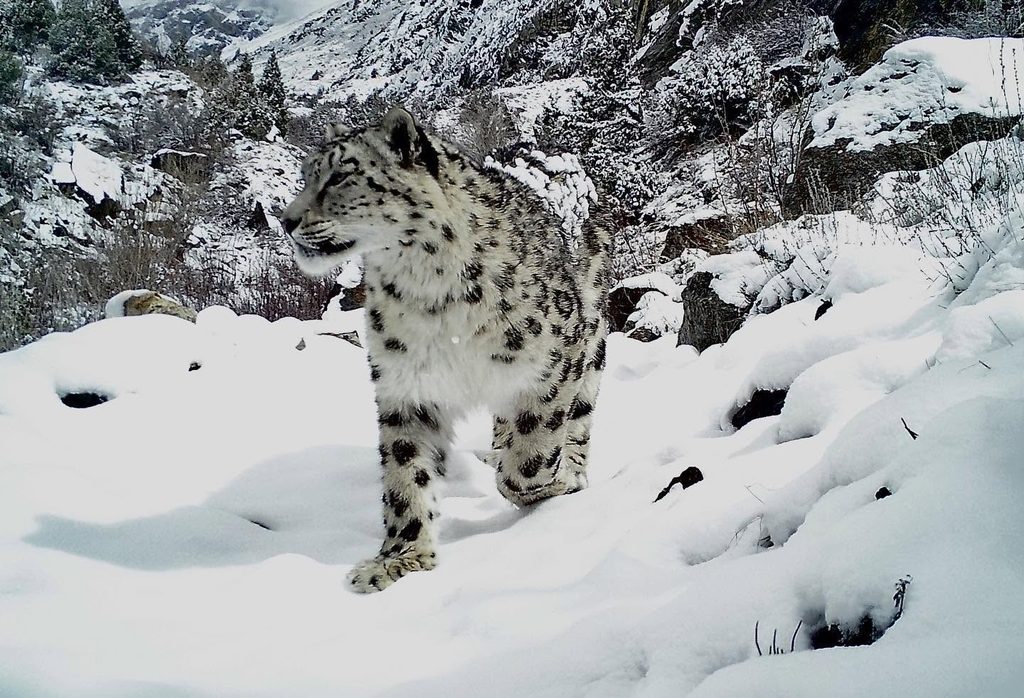
Snow leopards live across roughly a dozen countries in Central and South Asia, from the mountains of Afghanistan through the Himalayas, typically at elevations between 3,000 and 5,500 meters. Hunting prey like blue sheep and ibex across near-vertical, broken terrain doesn’t leave much room for a cautious approach — closing the distance on prey, or escaping a dangerous fall, often depends entirely on a single well-executed leap. Every adaptation described above exists because, in this environment, there usually isn’t a second option.
Frequently Asked Questions
How far can a snow leopard actually jump? Conservation organizations including the Snow Leopard Trust and WWF cite roughly 30 feet (9-10 meters) horizontally in a single leap — some sources cite even greater distances, though the more conservative, research-backed figures come from these two organizations.
Why is the snow leopard’s tail so long? It serves two purposes: acting as a counterbalance and rudder during leaps, and functioning as insulation the cat wraps around its body for warmth while resting.
How many snow leopards are left in the wild? WWF estimates there may be as few as 4,000 snow leopards remaining in the wild, with habitat loss, human-wildlife conflict, and poaching among the leading threats to the species.
Do snow leopards’ paws work like snowshoes? Yes. Their large, fur-covered paws distribute body weight across snow and provide grip and insulation on icy or rocky surfaces.
Sources consulted: Snow Leopard Trust – Physical Features, WWF – Top 10 Facts About Snow Leopards.
Leave a Reply