• Skip to main content
  • Skip to primary sidebar
  • Skip to footer
  • Home
  • About Us
  • Copyright Report
  • Submit Content
  • Terms
  • Privacy Policy
  • Legal Disclaimer

Hasan Jasim

Hasan Jasim is a place where you may get entertainment, viral videos, trending material, and breaking news. For a social generation, we are the largest community on the planet.

Whales Have Arm, Wrist, and Finger Bones in Their Front Fins

by Hasan Jasim Editorial Team Leave a Comment

ShareTweet

When we think of whales, we often imagine them as these huge, majestic creatures swimming through the oceans with their long, sleek bodies and powerful tails. However, what most people don’t know is that whales actually have arm, wrist, and finger bones in their front fins.

This fact may come as a surprise to many, but it’s true. Whales are mammals, which means they are warm-blooded, breathe air, and nurse their young. Like humans and other mammals, they have a skeletal system that includes bones, including those in their fins.
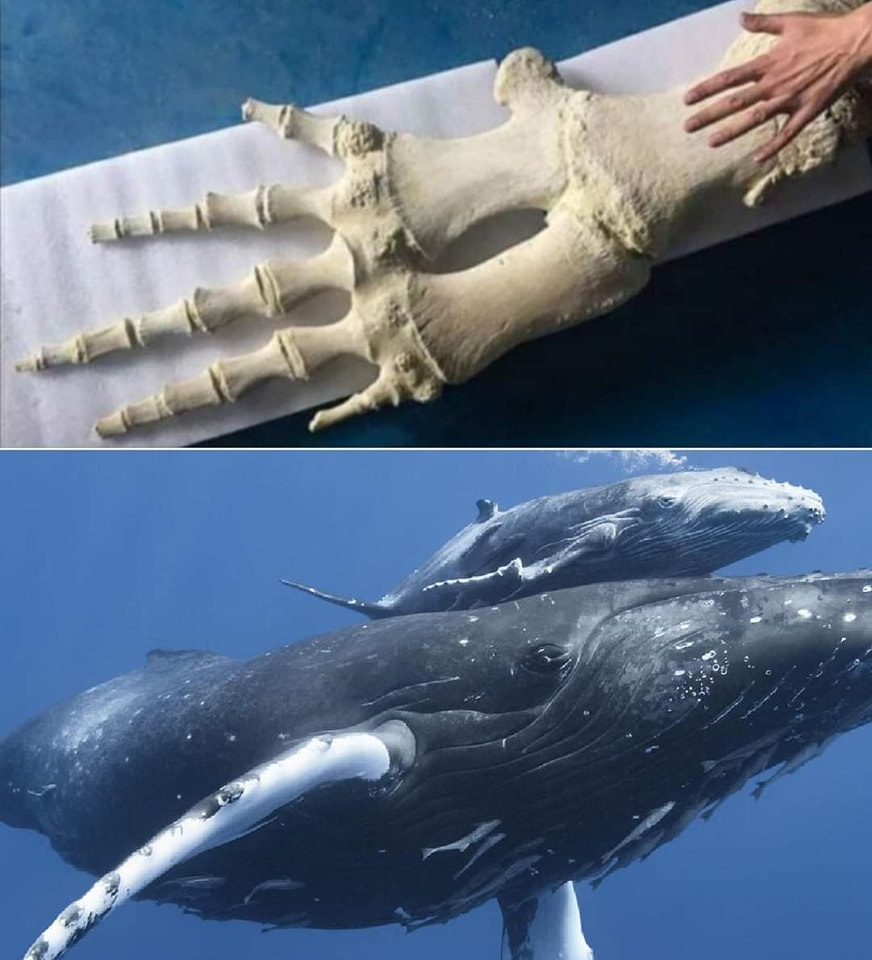
If you take a closer look at the front fins of a grey whale, for example, you’ll see that they have a structure that’s similar to a human arm. There are several bones that make up the front fins, including the humerus, radius, ulna, carpals, metacarpals, and phalanges. In other words, whales have the same basic bone structure in their front fins as humans have in their arms and hands.

But why do whales have arm and hand-like bones in their fins? The answer lies in their evolution. Whales are believed to have evolved from land animals that eventually made their way into the water. Over time, these animals adapted to their aquatic environment, developing traits that allowed them to swim and dive more efficiently.

One of these adaptations was the development of flippers. Flippers are essentially modified arms and hands that have been streamlined for swimming. Inside those flippers are the bones that resemble a human hand, with a thumb included.

While all cetaceans (whales, dolphins, and porpoises) and pinnipeds (seals, sea lions, and walruses) have flippers, the bone structure inside those flippers is slightly different in each species. For example, dolphin flippers have a more elongated shape and fewer bones than whale flippers, while seal flippers are more similar to hands than to fins.

In addition to allowing whales to swim more efficiently, their front fins also play a role in communication and social behavior. Some species of whales, such as humpback whales, use their fins to slap the water, creating loud noises that can be heard over long distances. Other species, such as orcas, use their fins to signal to one another, with different movements and postures conveying different messages.

In conclusion, while it may be surprising to learn that whales have arm, wrist, and finger bones in their front fins, it’s just one of the many fascinating adaptations that these incredible creatures have developed over millions of years of evolution. And while their fins may look very different from human arms and hands, they serve a similar purpose in allowing whales to navigate their watery world with grace and efficiency.

Filed Under: Trends Worldwide Tagged With: Advanced imaging techniques, Cetacean evolution, Comparative skeletal studies, Dolphin flipper bones, Eco-tourism industry, Evolutionary biology breakthroughs, Evolutionary health implications, Global climate impact, Marine animal intelligence, Marine biology degrees, Marine conservation funding, Marine mammal biology, Ocean Conservation, Scientific innovation grants, Seal flipper adaptations, STEM education insights, Sustainable ocean management, Underwater acoustics, whale anatomy, Whale communication, Whale flipper structure, Wildlife research funding

Reader Interactions

Leave a Reply Cancel reply

Your email address will not be published. Required fields are marked *

Primary Sidebar

More to See

NASA explains how it would alert the public of an apocalyptic asteroid strike

By Hasan Jasim Editorial Team

A population of hard-to-eradicate ‘super pigs’ in Canada is threatening to invade the US

By Hasan Jasim Editorial Team

Chernobyl’s Mutant Wolves Have Evolved Anti-Cancer Abilities

By Hasan Jasim Editorial Team

From Segregation to the Stars: The Inspirational Journey of Ronald McNair

By Hasan Jasim Editorial Team

Five Peaks of the Cascade Volcanic Arc: A Majestic Aerial View of Mt. Jefferson, Mt. Hood, Mt. Adams, Mt. St. Helens, and Mt. Rainier

By Hasan Jasim Editorial Team

Man Immediately Recognizes a Dog in Need When He Sees a Tiny Speck on a Cliff in the Distance

By Hasan Jasim Editorial Team

The Sherpa People of the Himalayas Have Evolved to Be Superhuman Mountain Climbers

By Hasan Jasim Editorial Team

Footer

About hasanjasim.online

Hasanjasim.online is a digital platform dedicated to publishing diverse articles and content, with a strong focus on topics related to the animal kingdom, nature, and the environment. The website offers engaging stories and visual content aimed at raising awareness about animal welfare and showcasing the wonders of the natural world, making it a great destination for nature lovers and curious readers alike.

Recent

  • When Her Nonverbal Son’s Communication Device Died at Dinner, This Mom Found a Backup That Never Runs Out of Battery
  • Lamb’s Quarters: The Wild “Weed” That Outperforms Spinach in Nutrition
  • A Restaurant Put Up One Simple Sign for Its Teenage Staff — and It Says Everything We Forget to Say
  • Bees Can Smell 50 Times Better Than Dogs — Here’s How
  • Elderly Mushroom Picker Dies in Suspected Bear Attack in Japanese Forest
  • Don’t Throw Away Those Watermelon Rinds: Make Crunchy Homemade Pickles
  • Under an Active Volcano: The Ancient Art of Sun-Drying Tomatoes at Mount Etna

Search