That’s as fast as a bullet train in Japan.
Researchers believe that the way an elephant manipulates its trunk to eat and drink might lead to better robots.
According to a new study, elephants expand their nostrils to create more room in their trunks, allowing them to hold up to 5.5 liters (1.45 gallons) of water.
The researchers discovered that they can suck up three liters (0.79 gallons) every second, which is 30 times quicker than a human sneeze (150 meters per second/330 mph).
The researchers hoped to learn more about the mechanics of how elephants move and control air, water, food, and other items using their trunks. They also wanted to see if the physics might be used to inspire the development of more efficient robots that employ air motion to grip and move objects.
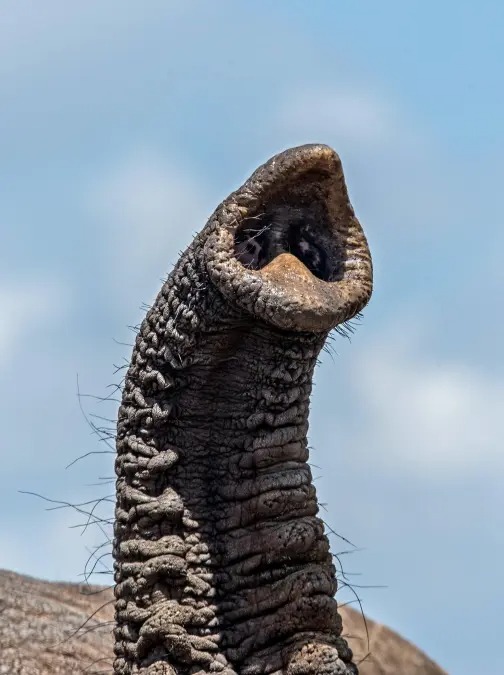
While octopuses propel themselves with water jets and archer fish shoot water above the surface to catch insects, elephants are the only animals that can suction both on land and underwater.
“An elephant consumes over 400 pounds of food every day, but nothing is known about how they utilize their trunks to pick up lightweight food and drink for 18 hours, every day,” explains lead author Andrew Schulz, a mechanical engineering PhD student at Georgia Institute of Technology. “It turns out that their trunks function like luggage, with the ability to expand when necessary.”
Grabbing tortilla chips without breaking them
Schulz and his colleagues observed elephants eating various diets while working with vets at Zoo Atlanta. The animal, for example, grabbed and gathered huge rutabaga cubes. Before transporting the veggies to its mouth, it sucked up smaller cubes and created a loud sucking sound, similar to a human slurping noodles.
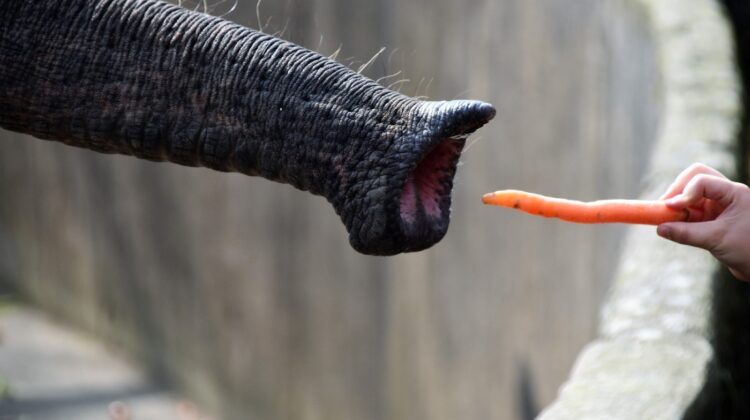
To understand more about suction, the researchers fed a tortilla chip to elephants and recorded the force applied. The animal would sometimes press down on the chip and breathe in, hanging the chip on the tip of its trunk without shattering it, similar to how a person might inhale a piece of paper into their mouth. At other instances, the elephant used suction to pull the chip to the edge of its trunk from a distance.
Elephants inhale at speeds equivalent to Japan’s bullet trains, which travel at speeds of up to 300 miles per hour.
“An elephant utilizes its trunk like a Swiss Army knife,” explains David Hu, a professor of Georgia Tech’s School of Mechanical Engineering and Schulz’s advisor. “It can sense odors and pick up objects.” Other times, it blasts items away like a leaf blower or vacuums them in.”
The team was able to time and quantify volume by observing elephants inhale liquid from an aquarium. The trunk scooped up 3.7 liters (just shy of 1 gallon) in 1.5 seconds, the equivalent of 20 toilets flushing at the same time.
Elephant conservation and soft robotics
The researchers utilized an ultrasonic probe to measure the trunk wall and examine how the trunk’s inner muscles functioned. The animal dilates its nostrils by up to 30% by engaging those muscles. This reduces nasal wall thickness and increases nasal capacity by 64%.
“It didn’t make sense at first: an elephant’s nasal path is rather narrow, and it was breathing more water than it should,” Schulz explains. “We didn’t comprehend how they achieved it until we viewed the ultrasonographic photos and watched the nostrils grow.” The animal’s walls are opened by air, and it can hold significantly more water than we previously expected.”
Schulz and his colleagues hypothesize that elephants breath at rates equal to Japan’s 300-mph bullet trains based on the forces exerted.
According to Schulz, these distinct traits have potential in soft robotics and conservation initiatives.
“By studying the mechanics and physics of trunk muscle motions, we can utilize the physical mechanisms—combinations of suction and grasping—to discover new approaches to make robots,” Schulz explains.
“In the meanwhile, the African elephant has been designated as endangered due to poaching and habitat degradation.” Its trunk distinguishes it as a species worth studying. We can better protect elephants in the wild if we learn more about them.”
The study was published in the Journal of the Royal Society Interface. The work was financed by the US Army Research Laboratory and the US Army Research Office 294 Mechanical Sciences Division, Complex Dynamics and Systems Program. Any opinions, results, conclusions, or recommendations stated in this material are solely those of the authors and do not necessarily reflect the views of the sponsoring organization.
Source: Georgia Tech