
• Skip to main content
  • Skip to primary sidebar
  • Skip to footer
  • Home
  • About Us
  • Copyright Report
  • Submit Content
  • Terms
  • Privacy Policy
  • Legal Disclaimer

Hasan Jasim

Hasan Jasim is a place where you may get entertainment, viral videos, trending material, and breaking news. For a social generation, we are the largest community on the planet.

Ad example

Humans Spent 2 Million Years as the Top Predators as “Hypercarnivores”

by Stephen King Leave a Comment

Facebook172TweetPinLinkedInShares172

New research has shed light on the surprising dietary habits of our ancestors. For millions of years, humans were apex predators, primarily consuming meat. This revelation challenges the common perception that early humans were primarily omnivores, diversifying their diets with plants.

Hypercarnivorous Humans

The study, published in the American Journal of Physical Anthropology, examined the trophic level of ancient humans during the Pleistocene epoch. By analyzing various sources of evidence, researchers concluded that multiple species of the Homo lineage engaged in “hypercarnivory” for approximately 2 million years.

Challenging Previous Assumptions

Previous studies often relied on comparisons with modern hunter-gatherer societies to infer the dietary habits of ancient humans. However, these comparisons can be problematic due to the significant changes in the biological landscape and human preferences over time.

The Role of Megafauna

The extinction of megafauna, such as mammoths and other large animals, played a crucial role in shifting human diets. As these resources became less abundant, populations that incorporated more plants into their diets had a higher chance of survival.

Genetic and Morphological Evidence
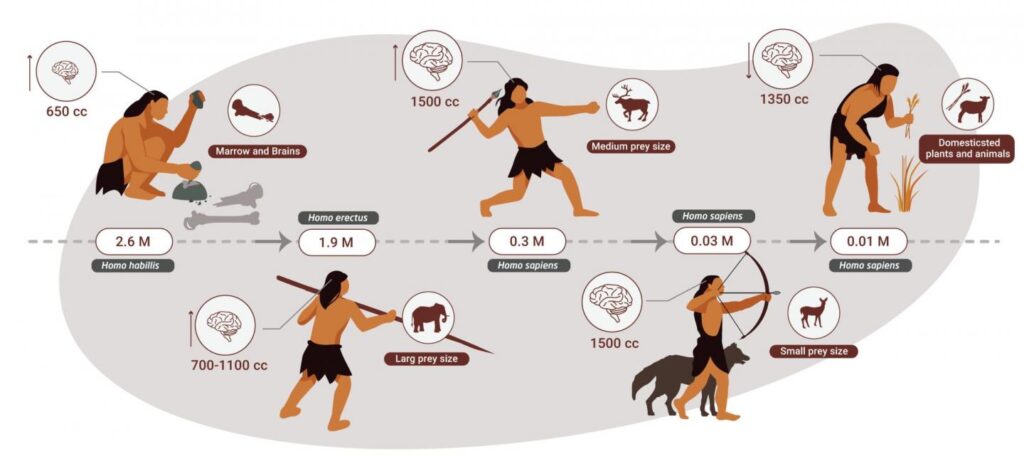
How the diet of ancient humans changed as our brains evolved. Image credit: Dr Miki Ben Dor

The study examined genetic evidence, finding that human genome expression of genes related to plant digestion did not become widespread until late in the Pleistocene. Additionally, morphological adaptations in ancient hominids, such as Homo erectus, suggest a focus on hunting and consuming meat.

The Transition to Omnivory

While humans were primarily carnivorous for millions of years, the shift to a more omnivorous diet occurred towards the end of the Pleistocene. This transition was likely driven by the scarcity of animal resources and the need to adapt to changing environmental conditions.

The Impact on Agriculture

The researchers argue that the late shift to a more omnivorous diet played a significant role in the development of agriculture. As humans began to rely more on plants, they developed new tools and techniques for processing them.

The study’s findings challenge the traditional understanding of ancient human diets. For millions of years, humans were apex predators, primarily consuming meat. It was not until the late Pleistocene that humans began to diversify their diets and eventually develop agriculture. This new research provides valuable insights into the evolution of human dietary habits and our place in the food chain.

Facebook Comments Box
Facebook172TweetPinLinkedInShares172

Filed Under: Trends Worldwide Tagged With: agriculture, ancient human diet, ancient humans, archaeology, carnivorous diet, DIET, Genetics, human evolution, hunter-gatherer diet, hunter-gatherers, hypercarnivorous humans, hypercarnivory, megafauna, metabolism, morphology, paleontology, plant-based diet, pleistocene, Pleistocene era, stone tools

Reader Interactions

Leave a Reply Cancel reply

Your email address will not be published. Required fields are marked *

Primary Sidebar

More to See

More Birds Bring More Happiness, According to Science

By Stephen King

Magical Mini Mushroom: A Vibrant Discovery in Taipei

By Stephen King

While Waiting to see The Veterinarian, a Sleeping Calf Softly Snores on His Human’s Lap

By Stephen King

Elephant Ear Plant: A Bold and Beautiful Addition to Your Garden

By Stephen King

Stray dog had a box stuck on his head for nearly a year — a recent rescue changed everything

By Stephen King

The Enchanting Snowy Owl: A Majestic Arctic Beauty

By Stephen King

Man unexpectedly finds tiny creatures hiding in his car engine — rescue leads to heartwarming reunion

By Stephen King

Footer

Home and Garden: Timeless Beauty and Smart Investment

Your home and garden reflect your personality and values, offering both emotional and financial worth. A well-maintained space enhances your life and withstands market changes.

Hasan Jasim emphasizes the lasting value of homes and gardens, from beautiful gardens that boost curb appeal to interiors that create sanctuary. These spaces are more than assets—they are legacies.

Incorporating health-boosting elements like dates, known for their energy, heart health, and gut benefits, supports your well-being. Whether for diabetes, weight loss, or skin health, dates are a smart, natural choice.

By prioritizing quality materials and timeless design, your home and garden remain valuable investments for years to come.

Recent

  • What Is It and Why Is It Called “Nature’s Most Terrifying Things”?
  • The Plant You See in the Picture Is One of the Most Miraculous Plants in the World
  • Army dog was separated from his owner – 3 years later, the best friends finally meet again
  • He thinks it’s just a rock, but when he approaches he discovers a frostbit animal
  • Lost dog found 2,000 miles away after five years
  • A couple took this mirror portrait 100 years ago in Japan
  • If you own this plant, you’re lucky: here’s why it’s worth pure gold at home

Search

Contact us

Hasan Jasim LLC is proudly based in the United States, delivering professional and reliable services. You can reach us by phone at +1 (914) 575-5957 or visit our office at 1234 Block Blvd., San Francisco, CA 94120. We are always here to assist you with any inquiries and provide the support you need promptly and efficiently.

Copyright © 2025 · Magazine Pro on Genesis Framework · WordPress · Log in