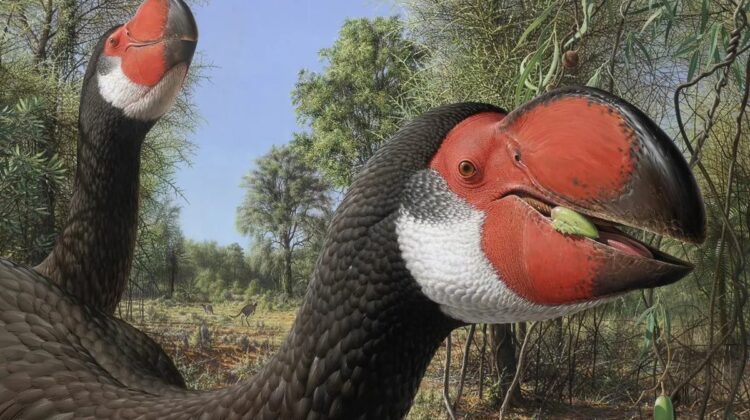
Despite being possibly the largest birds of all time, the time it took them to reach maturity made them ill-equipped to handle human arrival.
The Dromornis stirtoni, possibly the largest bird to have ever existed, went extinct 7 million years ago, but its bones have revealed the fatal flaw that doomed its descendants: they took too long to mate.
Australia used to be home to birds that were up to four times larger than ostriches, the largest living bird, before they became extinct some 50,000 years ago. The biggest of these was probably Dromornis stirtoni. Dromornis, sometimes known as “devil ducks of doom,” were mihirungs, which are related to chickens and ducks. They could reach heights of 3 meters (10 feet) and weights of 500 kilograms (1,100 pounds).
The growth trends found in the bones of D. stirtoni and Genyornis newtoni, the final mihirung to go extinct, were compared in a study published in the Anatomical Record. Although D. stirtoni grew quite quickly for the first two years, after that, they slowed down and took much longer to reach breeding size. Although Genyornis reached its full size faster, it nevertheless carried the big ancestor’s late breeding traits, rendering it unable of coping with the introduction of humans as a new species of predator.
According to Dr. Trevor Worthy of Flinders University, Australia had a radically different environment 8 million years ago, with rainforests in the center of the continent. Three different species of mihirungs lived in these woodlands, including the biggest one, D. stirtoni.
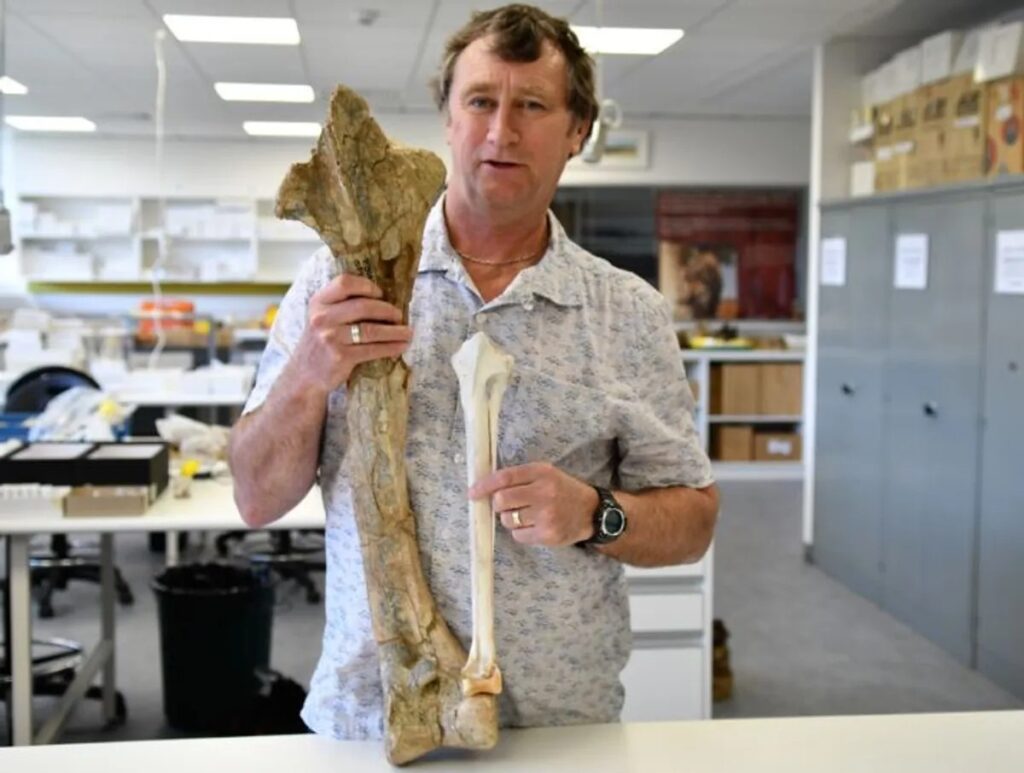
Dromornis bones from the northern Flinders Ranges and close to Alice Springs that appear more like those of a dinosaur than a giant duck were examined by Worthy and co-authors for the paper.
“In order to determine the biological signals contained within, we examined microscopic thin slices of the fossilized bones of these thunder birds. When they attained sexual maturity, how long it took them to reach adult size, and even when the females were ovulating can all be determined from the microscopic structure of their bones, according to professor Anusuya Chinasamy-Turan of the University of Capetown.
These demonstrate that D. stritoni did not reproduce before to the age of ten. Who still seems early by human standards, and birds that commonly lived to be 60 had lots of opportunities to reproduce in the future. But ultimately the mihirungs were forced to contend with emus, which may breed as early as two years old.

D. stritoni and two lesser species of mihirungs perished as the rainforest dried up, but their offspring—including the 240 kilogram monster Genyornis—continued to be important components of Australia’s ecosystem.
They actually remained together through a number of significant environmental and climatic changes, according to Worthy. Genyornis, however, was still a slow-growing and slow-breeding bird in comparison to the emu, despite being more adapted than its ancestors and living through two million years of the Pleistocene when arid and drought conditions were the norm. The article discloses that Genyornis reached its full size within two years, although it took them a while after that to begin reproducing.
For species that thrive in stable conditions, such as the rainforests where the mihirungs originated, such sluggish reproduction is typical. In Australia’s boom-bust economy, it is more of a challenge, yet Genyornis made it work. Then people showed up. Genyornis vanished 50,000 years ago, roughly.
It is still strongly debated whether humans contributed to the loss of Australia’s megafauna. But in this instance, Worthy is certain. He told IFLScience that human arrivals “would have done three things.” They “would have eaten the eggs, hunted them, and burned the habitat, which would have eliminated a lot of Genyornis’ food.”
Genyornis would not have been able to rebound from even slight losses if it had not been for the fact that it took so long to reproduce.
Worthy compared the mihirungs to the kkp of New Zealand, which may live for about a century but only reproduces around every five years when its preferred fruit has a bumper crop. Despite their enormous popularity, Worthy noted that this makes it difficult for conservation initiatives that operate on a one-year cycle to promote kkps. It would be as frustrating for those responsible for maintaining the species’ survival if any mihirungs had persisted.
Leave a Reply