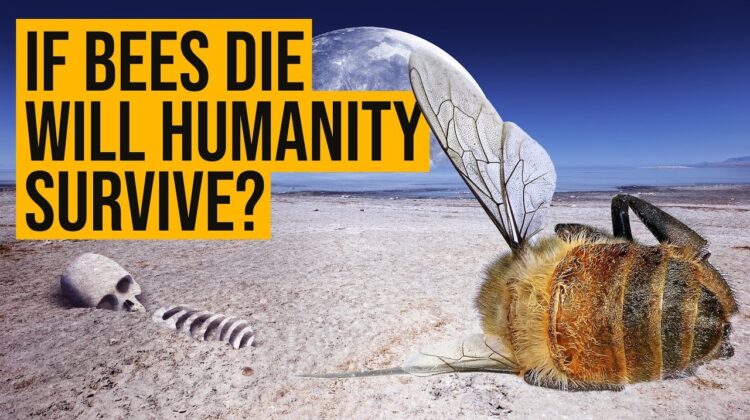
Estimating our chances of surviving in the absence of the extraordinary pollinator.
Last week, there was more bad news regarding honeybees. According to a U.S. Department of Agriculture report, this year saw a 42 percent loss of honeybees in managed colonies, the kind that beekeepers rent to farmers.
The majority of the headlines focused on that figure, but there was more troubling information below the fold. 18.7% is the beekeeper’s “magic number.” If population declines remain below that point, the colony can survive; if they increase, however, the colony will eventually go extinct. Surprisingly, two-thirds of beekeepers in the USDA survey reported losses above the cutoff, raising concerns for the pollination sector.
The USDA reported more losses in the summer than in the winter for the first time. Experts are at a loss to explain the reversal, especially in light of the epidemic of colony collapse disorder that peaked a few years ago appearing to be in remission. The cause of the summertime losses could be a single, unidentified factor or a combination of known, aggravating factors like pesticides or mites.
Today, the White House released its long-awaited plan to support the preservation and expansion of the pollinator population in response to the USDA report. This plan includes creating pollinator gardens close to government structures and rehabilitating public lands in a manner that supports bees. It’s a wise starting point.
According to a quote attributed to Albert Einstein, “Man would only have four years to live if the bee disappeared from the earth’s surface.” Einstein saying that is highly improbable. First of all, there is no proof that he actually said it. Another issue is that the claim is inaccurate and exaggerated (and Einstein was rarely wrong). However, there is a grain of truth in the well-known misquote.
Agriculture and Bees
Together, bees and humans have experienced a lot. According to the late and renowned melittologist Eva Crane, beekeeping dates back to 20,000 BCE. (Yes, a melittologist is someone who studies bees.) When compared to today, the average global temperature was over 35 degrees Fahrenheit lower 22,000 years ago, and much of North America was covered by ice sheets. Beekeeping likely existed before agriculture, which first appeared around 12,000 years ago, and likely enabled agriculture.
How crucial are bees to modern agriculture? If you ask that question to ten reporters, you will receive 11 responses. According to some accounts, bees pollinate more than two thirds of our most significant crops, but other accounts place the number closer to one third. A spread that wide suggests that there isn’t enough reliable scholarship available on the subject. The literature review I conducted indicates the same.
Back in 2007, an international group of agricultural scholars reviewed the significance of animal pollinators, including bees, to farming. This was the most comprehensive and informative study to date. Their findings might support both the minimizers and the alarmists in the field of bee observation. Only 28 crops can thrive without the help of animal pollinators, according to the study’s findings, whereas 87 crops do so globally. Those are alarming numbers considering that honeybees are indisputably the most significant animal pollinators.
However, if you examine the data in a different way, it becomes evident why the incorrectly attributed Einstein quote is a little exaggerated. Around 60% of the total amount of food grown globally is not dependent on animal pollination. Among the 28 crops that don’t need bees’ assistance are many common foods like wheat, rice, and corn. Either they self-pollinate or the wind aids in the process. These foods account for a significant portion of the global calorie intake for people.
The degree to which plants require animal pollinators varies, even among the 87 crops that do. 30 more plants are “highly dependent” on animal pollination, while only 13 absolutely need it. Without bees, production of the remaining crops would probably continue, albeit with marginally lower yields.
OK, So Can We Live Without Bees?
The truth is that even if honeybees vanished completely, humans would probably still exist (at least not solely for that reason). However, our diets would still suffer a great deal. Food selection would be less diverse, and prices for some goods would rise. For many years, the California Almond Board, for instance, has waged a campaign to protect bees. According to the group, almonds “simply wouldn’t exist” without bees and their ilk. Without bees, we would still have coffee, but it would be expensive and in short supply. Only three or four days are necessary for pollination of the coffee flower. The plant won’t be pollinated if there isn’t an insect nearby during that brief window.
There are numerous other examples, including the significant pollination dependence of apples, avocados, onions, and several kinds of berries on bees. Those foods would become scarce if honeybees disappeared or even experienced a significant decline in their population. Although our dinners would become significantly less interesting, humanity would survive.
Leave a Reply