• Skip to main content
  • Skip to primary sidebar
  • Skip to footer
  • Home
  • About Us
  • Copyright Report
  • Submit Content
  • Terms
  • Privacy Policy
  • Legal Disclaimer

Hasan Jasim

Hasan Jasim is a place where you may get entertainment, viral videos, trending material, and breaking news. For a social generation, we are the largest community on the planet.

Whales Have Arm, Wrist, and Finger Bones in Their Front Fins

by Hasan Jasim Editorial Team Leave a Comment

ShareTweet

When we think of whales, we often imagine them as these huge, majestic creatures swimming through the oceans with their long, sleek bodies and powerful tails. However, what most people don’t know is that whales actually have arm, wrist, and finger bones in their front fins.

This fact may come as a surprise to many, but it’s true. Whales are mammals, which means they are warm-blooded, breathe air, and nurse their young. Like humans and other mammals, they have a skeletal system that includes bones, including those in their fins.
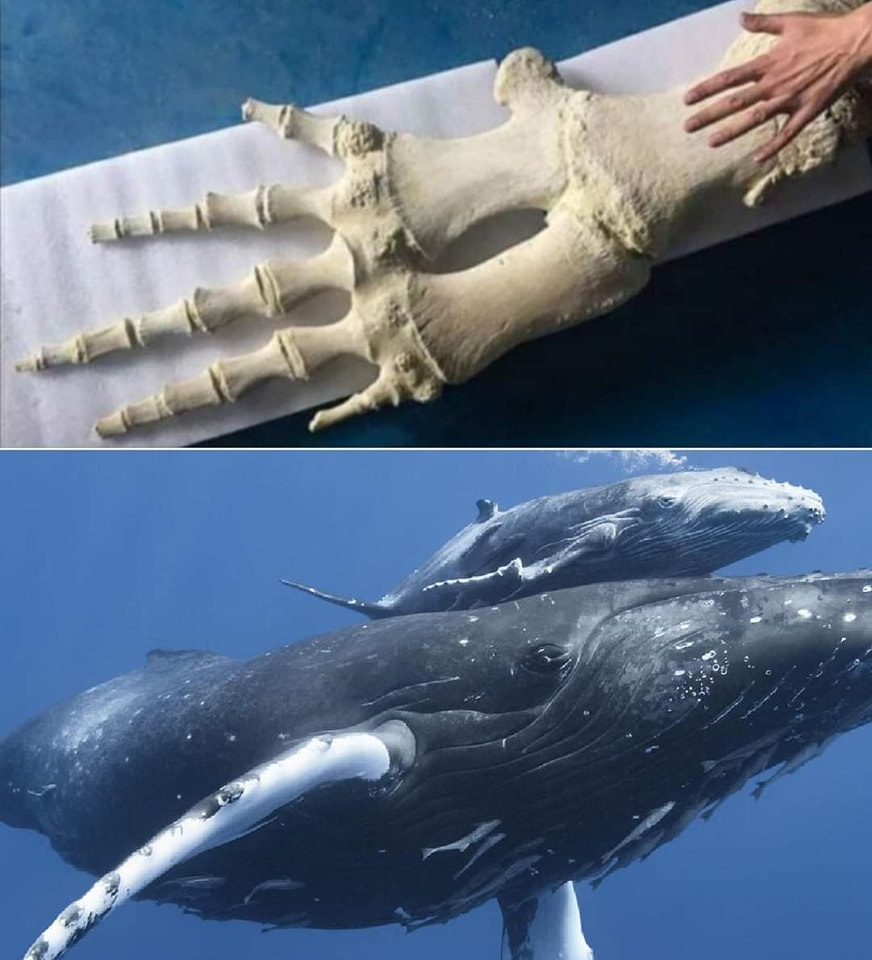
If you take a closer look at the front fins of a grey whale, for example, you’ll see that they have a structure that’s similar to a human arm. There are several bones that make up the front fins, including the humerus, radius, ulna, carpals, metacarpals, and phalanges. In other words, whales have the same basic bone structure in their front fins as humans have in their arms and hands.

But why do whales have arm and hand-like bones in their fins? The answer lies in their evolution. Whales are believed to have evolved from land animals that eventually made their way into the water. Over time, these animals adapted to their aquatic environment, developing traits that allowed them to swim and dive more efficiently.

One of these adaptations was the development of flippers. Flippers are essentially modified arms and hands that have been streamlined for swimming. Inside those flippers are the bones that resemble a human hand, with a thumb included.

While all cetaceans (whales, dolphins, and porpoises) and pinnipeds (seals, sea lions, and walruses) have flippers, the bone structure inside those flippers is slightly different in each species. For example, dolphin flippers have a more elongated shape and fewer bones than whale flippers, while seal flippers are more similar to hands than to fins.

In addition to allowing whales to swim more efficiently, their front fins also play a role in communication and social behavior. Some species of whales, such as humpback whales, use their fins to slap the water, creating loud noises that can be heard over long distances. Other species, such as orcas, use their fins to signal to one another, with different movements and postures conveying different messages.

In conclusion, while it may be surprising to learn that whales have arm, wrist, and finger bones in their front fins, it’s just one of the many fascinating adaptations that these incredible creatures have developed over millions of years of evolution. And while their fins may look very different from human arms and hands, they serve a similar purpose in allowing whales to navigate their watery world with grace and efficiency.

Filed Under: Trends Worldwide Tagged With: Advanced imaging techniques, Cetacean evolution, Comparative skeletal studies, Dolphin flipper bones, Eco-tourism industry, Evolutionary biology breakthroughs, Evolutionary health implications, Global climate impact, Marine animal intelligence, Marine biology degrees, Marine conservation funding, Marine mammal biology, Ocean Conservation, Scientific innovation grants, Seal flipper adaptations, STEM education insights, Sustainable ocean management, Underwater acoustics, whale anatomy, Whale communication, Whale flipper structure, Wildlife research funding

Reader Interactions

Leave a Reply Cancel reply

Your email address will not be published. Required fields are marked *

Primary Sidebar

More to See

Over Iceland, The Northern Lights Take on The Appearance of The Famous Bird

By Hasan Jasim Editorial Team

The 50-Year “Whisky War” Comes To An End With The Establishment Of The First Land Border Between Canada And Europe

By Hasan Jasim Editorial Team

Three crocodiles swim up to stray dog in the water — what they do next surprised everyone

By Hasan Jasim Editorial Team

Building Hope: Amish Volunteers Bring Shelter and Compassion to Hurricane-Stricken Families in North Carolina

By Hasan Jasim Editorial Team

Can you believe this house was built 4003 meters above the clouds in 1915?

By Hasan Jasim Editorial Team

Scientists Accidentally Discover New Organ Inside The Human Head

By Hasan Jasim Editorial Team

New satellite images catch world’s worst polluters red-handed: ‘Now we really know exactly where it’s coming from’

By Hasan Jasim Editorial Team

Footer

ABOUT HASANJASIM.ONLINE

Hasanjasim.online is a digital platform dedicated to publishing well-researched articles about the animal kingdom, nature, and the environment. Our editorial team works to source stories from credible outlets, scientific research, and verified reports, aiming to inform as much as we entertain. From wildlife conservation and animal behavior to natural wonders and environmental science, we cover the topics that help readers better understand and appreciate the natural world. Whether you're a lifelong nature lover or simply curious about the planet we share, Hasanjasim.online aims to be a trustworthy destination for stories worth reading — and worth citing.

Recent

  • Scientists Found Ancient Americans Living Where No Humans Should Have Been
  • This African Bird Wears Sunflowers Around Its Eyes — Meet the White-Crested Helmetshrike
  • 25 Animals You’ve Probably Never Heard Of — From a Cuban Land Snail to a Marsupial That Mates Itself to Death
  • Woman finds cow’s tooth in takeout taco. The chain says it can happen
  • Healthy Senior Dog Spared After Family Asked Veterinarians to Euthanize Her, Georgia Rescue Says
  • How People Around the World Write Laughter Online
  • The Disturbing Story Behind This Award-Winning Photojournalism Image

Search