
In the 17th century, artists in Italy began embracing an increasingly elaborate style. Known as the Baroque movement, this shift toward an ornate, over-the-top aesthetic is evident in both the art and architecture of the time, with master of materials Gian Lorenzo Bernini at the forefront. In addition to designing St. Peter’s Basilica (one of Italy’s most important monuments), Bernini was a celebrated sculptor, with The Rape of Proserpina among his most treasured creations.
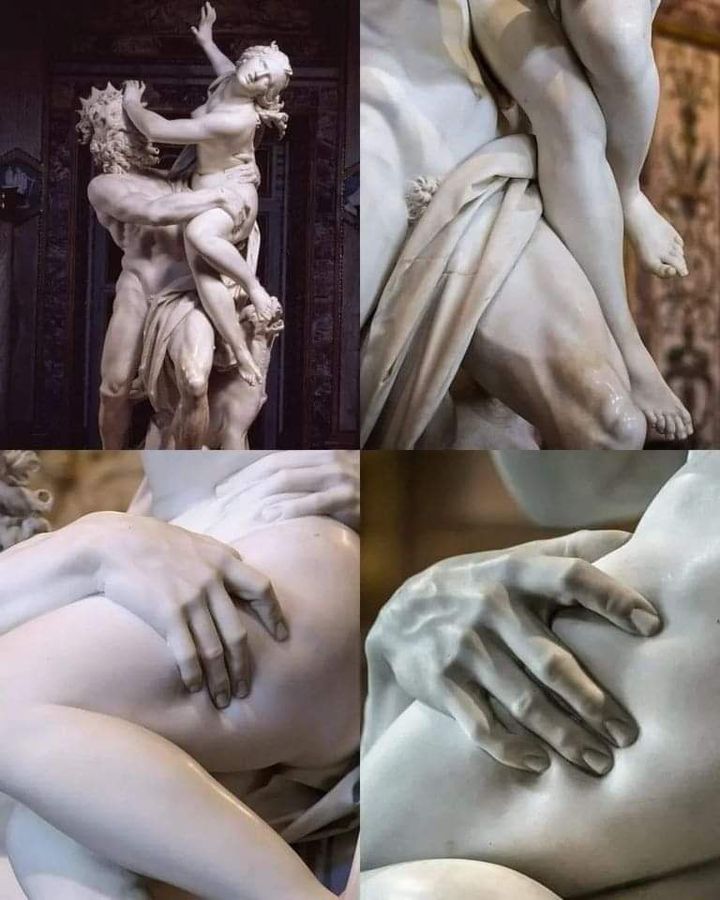
Crafted in the early 17th century, this marble sculpture illustrates several of Bernini’s strong suits, including his mastery of anatomy and ability to evoke both dynamism and drama. While these achievements continue to garner praise for the sculptor today, its unsavory subject matter has cast a controversial shadow over the work—though it remains a quintessential highlight of both the Baroque era and of marble sculpture as a whole.
Bernini’s The Rape of Proserpina
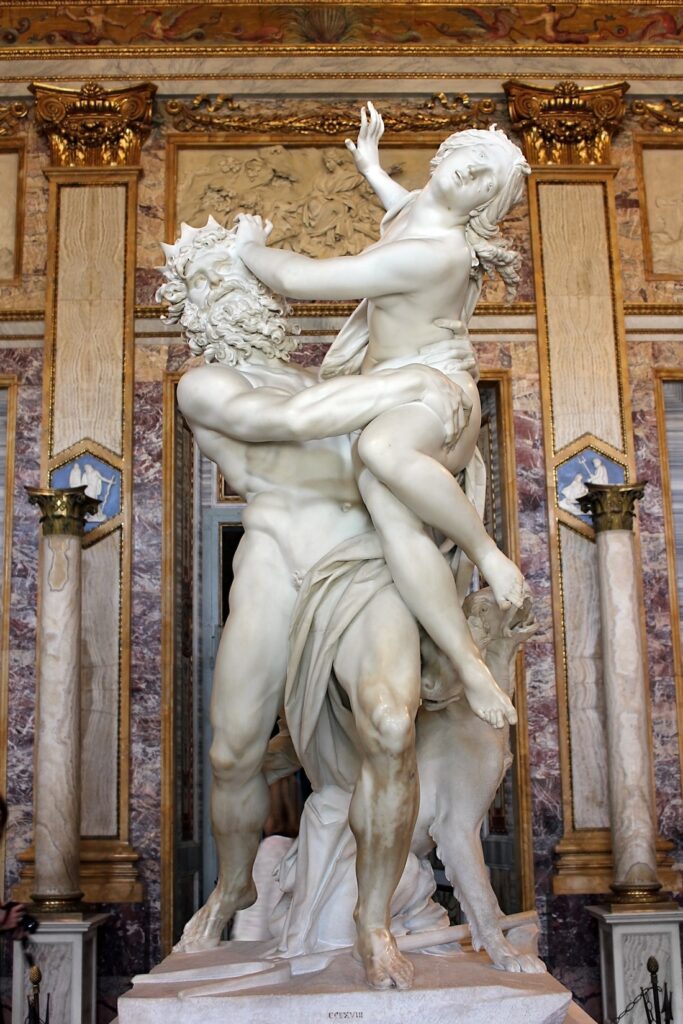
Bernini completed The Rape of Prosperina between 1621 and 1622. Though the Naples-born artist was just 23 years old at the time, he was already seeing success as a budding artist. While he wouldn’t complete his architectural masterpiece, St. Peter’s Basilica, for over 40 years, he had already carved out a name for himself in the early 1620s as a celebrated sculptor with four masterpieces: David; Aeneas, Anchises, and Ascanius; Apollo and Daphne; and, of course, The Rape of Proserpina.
Measuring nearly 7.5 feet tall, the piece is carved from Carrara marble, a material derived from Tuscany and historically used by ancient Roman builders and, more recently, by Mannerist and Renaissance artists. The softness of this high-quality marble lended itself to Bernini’s craft, as he “prided himself on being able to give marble the appearance of flesh.”
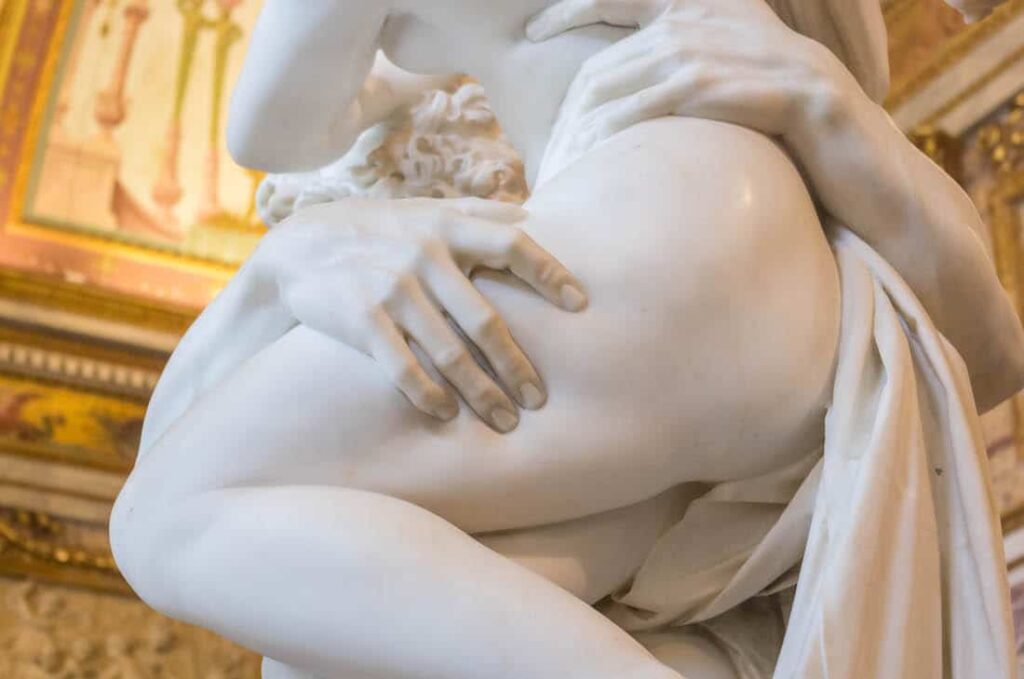
This interest in transforming stone into skin is particularly evident in The Rape of Proserpina, a piece intended to portray a dramatic abduction (in the case of its title, the term “rape” refers to the act of kidnapping). “Pushed to the point of grazing the physical limits of marble,” Bernini’s attention to detail and interest in realism is evident in the work’s anatomical details. As the hand of Pluto (the sculpture’s male subject) grabs the thigh of Proserpina (the female figure), his grasping fingers appear to sink into her seemingly soft skin. Similarly, straining to overpower her, the muscles in his bent legs and tense arms protrude, while her flowing hair and twisting drapery suggest movement.
Like many of Bernini’s earlier works, The Rape of Proserpina was commissioned by Cardinal Scipione Borghese, an avid art collector and devoted patron of both Bernini and fellow Baroque artist Caravaggio. On the heels of the High Renaissance, people remained interested in reviving a Classical approach to art—including subjects inspired by Ancient Greek and Roman mythology.
The Myth of Pluto and Proserpina
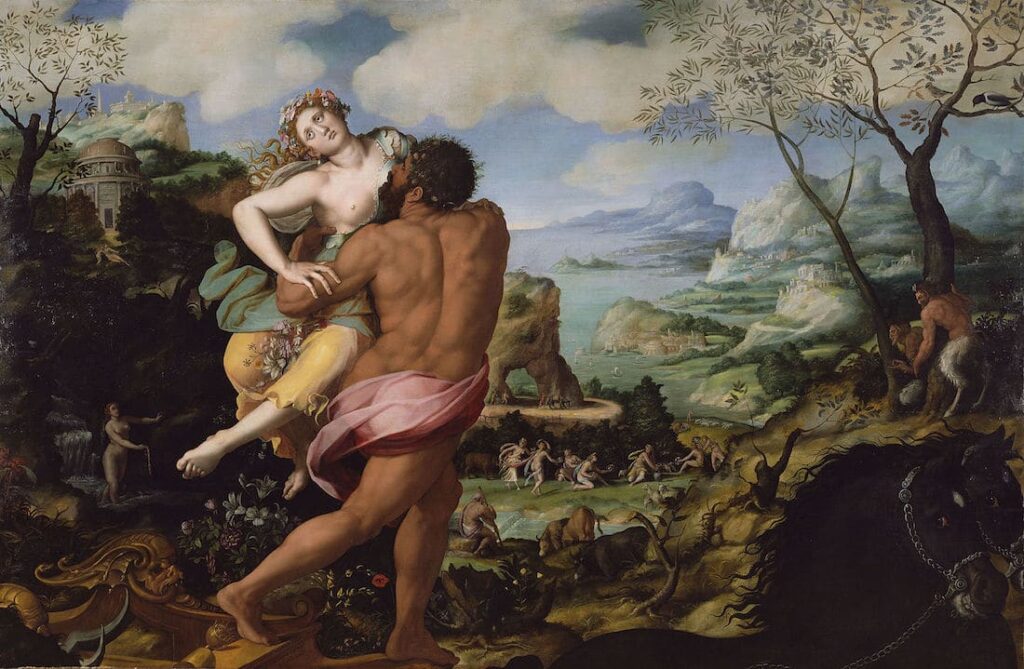
This piece portrays a moment from the myth of Pluto and Proserpina (also known as Proserpine), a tale present in both Metamorphoses by Ovid, a Roman poet from the 1st century CE, and De raptu Proserpinae, a piece written 400 years later by the Latin writer Claudian.
This story revolves around the abduction of Proserpina, the daughter of Jupiter (Zeus in Greek mythology) and Ceres, the Roman goddess of agriculture. While picking flowers, Proserpina was attacked by an enamored Pluto, the god of the dead, who burst from the earth in a chariot pulled by four black horses. While Ceres heard her daughter scream while being dragged into the underworld, she was unfortunately too late.
However, “once she realized that Pluto had abducted Proserpine,” the Getty explains, “she became angry and caused the earth to dry up, and the harvests to fail. Jupiter saw from the heavens that the earth was barren and dead. He decided to intervene, and eventually a deal was made: Proserpine would spend half of the year with her mother and half of the year in the underworld with Pluto.”
Contemporary Interpretations and Legacy
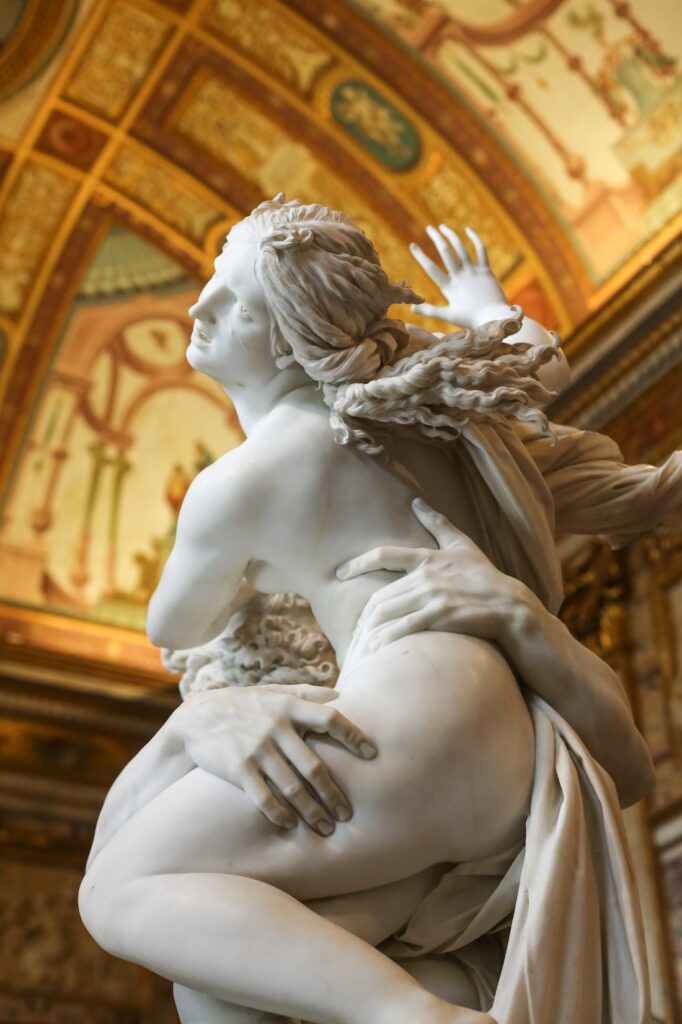
Given the grim nature of this story, it comes as no surprise that Bernini’s sculpture has caused a stir over the last few centuries. Shortly after its completion, Bernini’s depiction of such an unsavory scene was mostly met with praise (the artist’s son and biographer called it “an amazing contrast of tenderness and cruelty”), but celebrating a scene depicting a violent abduction can be troublesome in today’s context.
Recently, for example, Thomas Campbell, the director the Fine Arts Museums of San Francisco, praised the “compelling, hypnotizing, even inspiring” elements of the piece. “And yet . . . ” he added, “I am now struggling to recalibrate my thoughts on this work because a subject that I used to regard almost as an academic premise for virtuoso sculpture—abduction scenes are, after all, common in renaissance and baroque art—seems much less academic two years after the start of the ‘Me Too’ movement.”
Today, discussions about potentially problematic works of art—and even artists—are taking center stage. In the case of The Rape of Proserpina, however, contextualizing the subject matter through both a classical and contemporary lens allows us to appreciate the artistry while remaining critical of what is depicted.
Leave a Reply