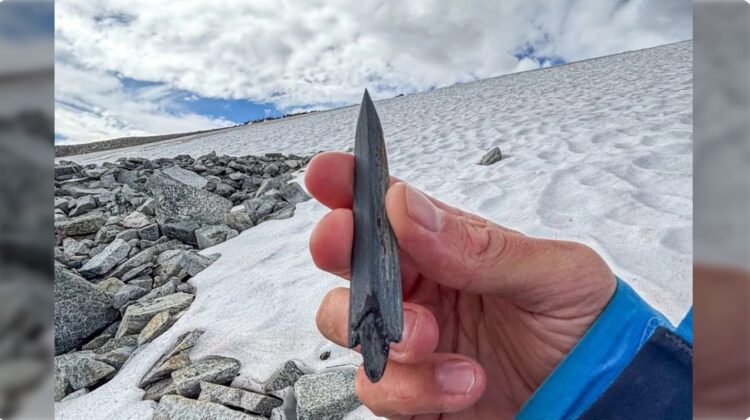
After three weeks in Norway’s Jotunheimen mountains, a team of glacier archaeologists has come back with some of its oldest finds yet, including Stone Age arrows with their wooden shafts and bindings still attached. The same ice that preserved them for thousands of years is now retreating fast enough that the team says it may be gone from many sites within two decades.
Three Weeks On The Ice
The team, part of the Secrets of the Ice program run by Innlandet County Municipality in collaboration with the Museum of Cultural History in Oslo, spent the 2026 field season surveying ice patches beside the Langfonne, Storfonne and Handklefonne glaciers in the Kvitingskjølen area, according to Smithsonian Magazine. Researcher Espen Finstad summarized the results in a post on the program’s website.
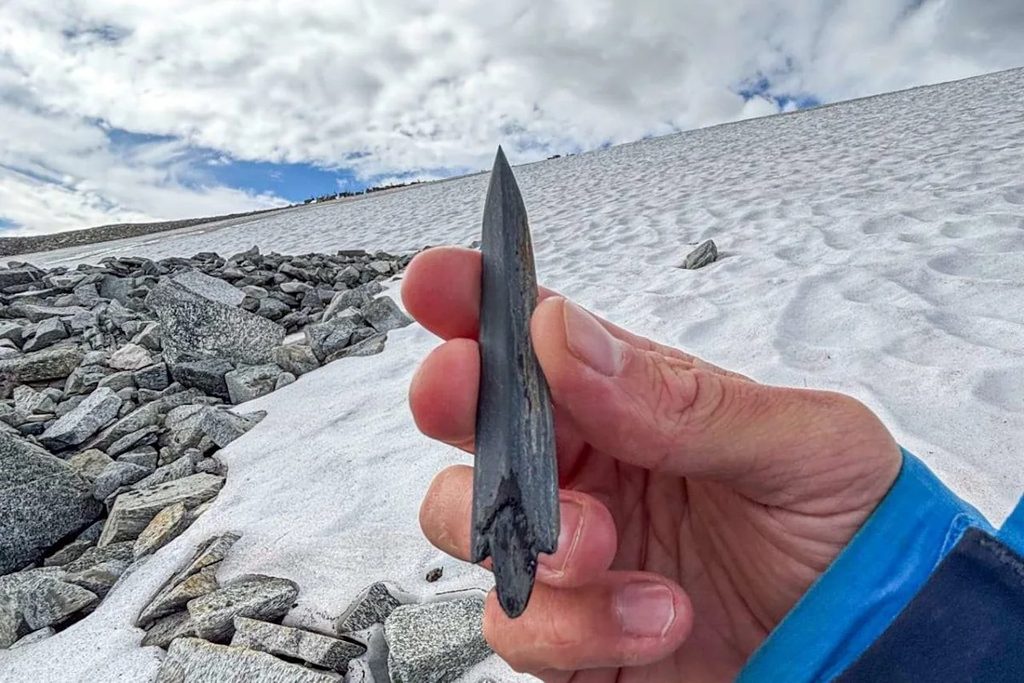
Among the finds is an arrow estimated to be 5,000 to 6,000 years old. Several of the other arrowheads recovered this season are made of bone, and one is iron, Smithsonian reported.
The Finds Keep Getting Older
When the program began its rescue work in 2006, after the first big melt hit the mountains, most of what emerged from the ice was under 2,000 years old, and much of it dated to the Viking Age. Anything older was rare.
Finstad wrote that this has changed dramatically. Artifacts older than 2,000 years are now turning up regularly, many from the Stone Age and Bronze Age, with the oldest passing 6,000 years. The reason is simple: as the upper layers of ice thin out, older layers underneath are exposed.
By the team’s latest count, as reported in the post, the program has recorded 73 ice sites and recovered more than 5,000 artifacts, from arrows, bows and other hunting gear to clothing, shoes and evidence of packhorses. An earlier tally, reported by Hyperallergic, stood at 66 sites and roughly 4,000 finds, which shows how quickly the collection is growing.
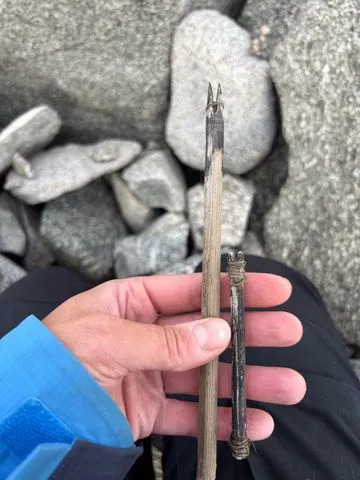
Credit: Åsa Rommetveit Celius, Innlandet County Municipality, Secrets of the Ice.
A Record Of Reindeer Hunting
Many of the artifacts point to the same activity: hunting wild reindeer. Archaeologists say hunters would wait until animals came within about 10 to 20 meters before standing up to shoot, Lars Pilø, co-director of the program, told Live Science, as relayed by Outdoor Life.
Finstad has noted that the oldest finds at Kvitingskjølen are around 6,000 years old, which means people were hunting there for at least that long, per Science Norway. The ice patch there is what the team calls black ice, old ice that may date back to the Stone Age and is only now emerging because newer ice on top is melting away.
A Race Against Decay
The same warming that exposes these objects also destroys them. Once an arrow or a piece of clothing leaves the ice, it starts to decay quickly, so the team has to reach sites in time. Finstad says every field season counts.
The long-term outlook is stark. Finstad told Science Norway that ice has been present at these sites for 6,000 to 7,000 years, and the team believes the ice at many of its archaeological sites could be completely gone within about 20 years.
“We have been at the edge of the ice,” Finstad wrote, according to The Debrief. The team’s work, he said, makes them witnesses to a rapidly changing archaeological landscape.

Credit: Espen Finstad, Innlandet County Municipality, Secrets of The Ice.
Frequently Asked Questions
Where were the arrows found? In ice patches in the Kvitingskjølen area of Norway’s Jotunheimen mountains, in Innlandet County, beside the Langfonne, Storfonne and Handklefonne glaciers.
How old are they? The newest highlighted arrow is estimated at 5,000 to 6,000 years old, and the oldest objects the program has found are more than 6,000 years old.
Who is behind the discoveries? The Secrets of the Ice program, a collaboration between Innlandet County Municipality and the Museum of Cultural History in Oslo.
Why is melting ice revealing older artifacts? As newer ice layers thaw, older layers beneath them are exposed, bringing up objects that were frozen thousands of years ago.
How many artifacts have been recovered? According to the team’s latest update, more than 5,000 artifacts from 73 ice sites since 2006.
Why is there urgency? Objects begin to decay soon after they leave the ice, and the researchers say many of their sites could lose their ice entirely within about 20 years.
Sources: Smithsonian Magazine, Science Norway, The Debrief, Hyperallergic, Outdoor Life (citing Live Science), PEOPLE, and the Secrets of the Ice website.
Leave a Reply