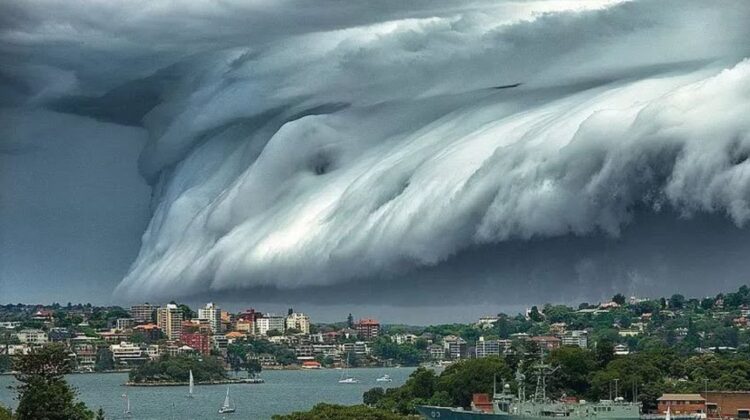
A wall of swirling gray and white cloud towers over a harbor, with sailboats below and apartment buildings along the shore, looking like a giant wave about to break over the city. Pictures like this spread quickly online under names such as “cloud tsunami.” The real phenomenon behind them is a shelf cloud, and it is just as dramatic as it looks. This guide explains what shelf clouds are, why they appear, what to do when one approaches and how to judge whether a spectacular cloud photo is genuine.
What Is a Shelf Cloud?
A shelf cloud is a type of arcus cloud, a low, horizontal, wedge-shaped cloud that forms along the leading edge of a thunderstorm or cold front. It is attached to the base of the parent storm cloud. Its front edge often looks smooth and rises, while its underside can appear turbulent and torn by wind.
The Met Office notes that a related formation, the roll cloud, is a horizontal tube-like column that is separated from the storm cloud, while a shelf cloud is attached to it. Both are arcus clouds, and both are popularly called “tsunami clouds.”
Why Do They Form?
Thunderstorms produce cool, dense air that rushes downward and spreads out along the ground. At the front of that outflow, the cool air pushes under warmer, moist air, forcing it upward. As it rises, the moisture condenses into a long band of cloud, which can stretch for kilometers and sit very low over land or water.
The Famous Sydney “Cloud Tsunami”
The best-known example appeared over Sydney’s coast, where a shelf cloud several kilometers long rolled in off the ocean toward Bondi Beach and across the city. Photos and videos flooded social media, and people described it as an apocalyptic sight. The country’s weather agency issued warnings for large hailstones, heavy rain and strong winds.
A Sydney photojournalist told Sky News that shelf clouds themselves are fairly common, but ones so large and so close to the city appear only a couple of times a year. He also pointed out that with severe storms, flash flooding is often the real danger, not just the dramatic cloud. Weather outlets confirmed that the pictures showed a real, unedited weather phenomenon.

Is This Particular Photo Real?
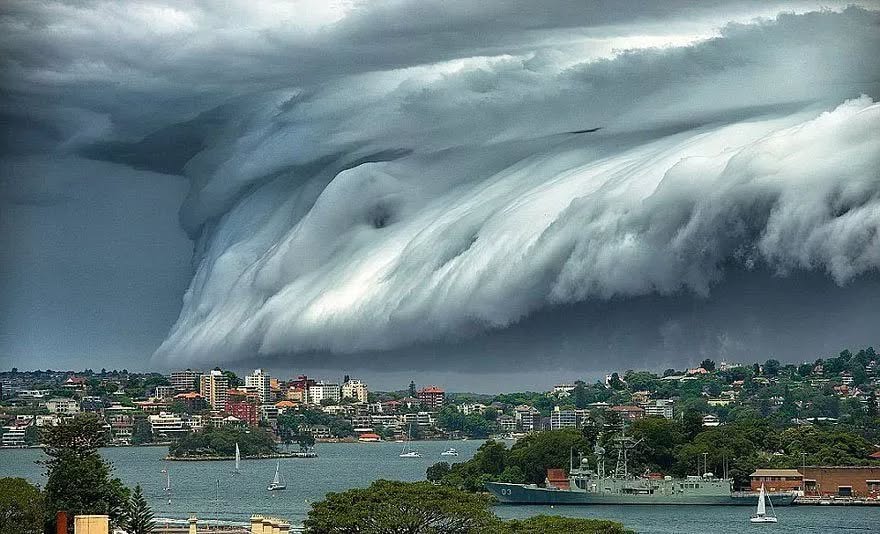
The image that inspired this article shows a cloud with a smooth, sculpted swirl and a dark circular opening, above a harbor that resembles Sydney’s. Its origin isn’t known, and it isn’t possible to verify it here. Compared with verified photos of real shelf clouds, which usually show wedge-shaped layers, horizontal bands and rough, wind-torn undersides, the shape is unusually smooth and almost symmetrical. That could mean heavy editing, a composite or an image created by artificial intelligence, although a genuine photograph can’t be ruled out without the original file.
To be safe, treat spectacular, uncredited weather images with caution.
How to Check a Dramatic Cloud Photo
- Find the source. Real photos usually have a named photographer, a date and a location.
- Use reverse image search. Tools such as Google Lens or TinEye can show where an image first appeared.
- Look for odd details. Perfectly smooth textures, repeating patterns, warped buildings or boats and inconsistent lighting can be warning signs.
- Check weather reports. If the cloud was real and severe, local forecasters and news outlets usually reported it.
- Be careful with captions. Viral posts often attach dramatic labels or the wrong location to images.
What to Do If a Shelf Cloud Approaches
A shelf cloud is not a tornado, but it can signal strong winds, heavy rain, lightning, hail and sometimes flash flooding. Safety agencies generally advise:
- Go indoors early. Move to a sturdy building or a hard-topped vehicle.
- Stay off the water and away from beaches, piers and jetties.
- Keep away from trees, power lines and loose objects that high winds could throw.
- Never drive through floodwater.
- Follow official warnings from your national weather service.
What This Article Doesn’t Cover
Shelf clouds vary widely in size and in the weather they bring, and the severity of a storm can’t be judged from the cloud’s appearance alone. Always rely on official forecasts and warnings.
Storm-Watching Safely
Weather enthusiasts often keep a weather radio and a home weather station, photograph storms from a safe distance with a wildlife and landscape camera and telephoto lens mounted on a tripod, and buy travel insurance and home insurance that covers storm damage.
Frequently Asked Questions
What is a “tsunami cloud”? A popular name for a shelf cloud or roll cloud, which are types of arcus clouds that form along the leading edge of a storm.
Is a shelf cloud a tornado? No, but it can come with strong winds, heavy rain and hail.
Are shelf clouds rare? They are fairly common, but very large ones close to cities are less frequent.
How can I tell if a cloud photo is fake? Check the photographer, search the image’s origin and look for unnaturally smooth shapes or inconsistent details.
Sources: Time, CNN, Sky News, Met Office, AccuWeather