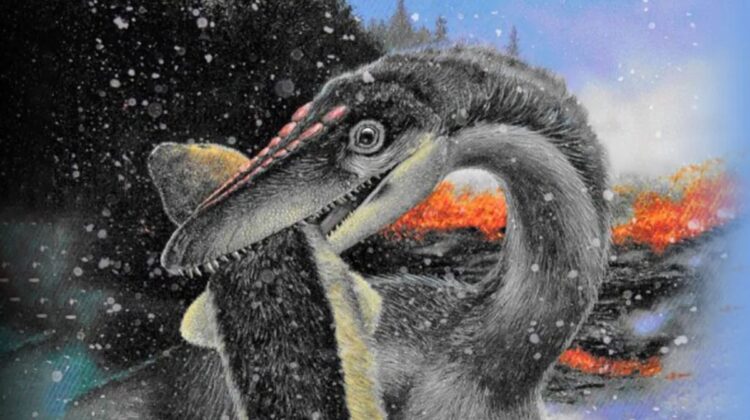
Far from being a late developments, dinosaurs may have had feathers almost from the beginning, and they may be the reason they survived climate chaos that killed other big reptiles.
There is proof that dinosaurs’ ability to adapt to frigid temperatures helped them to outlast the previously dominating reptiles. If so, feathers were likely a crucial component in their early survival. They could’ve been crucial.
Dinosaurs were but one reptile family among many, and by far not the largest one, thus a visitor to Earth in the Late Triassic may have paid them little notice. However, a cataclysmic extinction that wiped off the majority of the competitors happened 202 million years ago. After everything was over, dinosaurs started to appear all around.
Major volcanic eruptions in the Central Atlantic Magmatic Province are hypothesized to have contributed to the end-Triassic extinction by spewing greenhouse gases and heating the globe. The ability of dinosaurs to tolerate these brief periods of intense cold, according to a recent research in Science Advances, is what set them apart from their competitors. Feather insulation was undoubtedly a significant factor in this.
Due to a combination of a carbon dioxide-rich atmosphere and a configuration of the continents that resulted in less sunlight being reflected back into space, the earth was significantly warmer than it is today for the most of the time that dinosaurs ruled the planet. This has influenced how we think of dinosaurs.
The majority of the Triassic dinosaur fossils we have came from high latitudes, according to Dr. Dennis Kent of Columbia University and co-authors, indicating that they were initially less adapted to equatorial conditions than nondinosaurian taxa like phytosaurs and Lagerpetids.

However, being distant from the equator doesn’t automatically imply being chilly. The majority of the Jurassic and Cretaceous periods were marked by rather warm temperatures at these latitudes. The Late Triassic and the early Jurassic are described as one of the only periods in Earth history when there is no proof of polar glacial ice sheets, the report adds.
That does not imply that it was never chilly. According to the article, stones in the Junggar Basin in what is now northwest China appear to have been transported there via ice rafts.
This demonstrates that these regions saw frequent freezing, and the dinosaurs survived unharmed, according to Kent. The Basin was around 71 degrees north at the time. A winter ice sheet north of the Arctic Circle would be typical now, but it is more surprising that this happened during the super greenhouse era.
The same volcanoes that produce carbon dioxide are also responsible for the aerosols that are responsible for the freezing, according to the authors. Such particles refract the sun’s rays, first cooling the globe more than the CO2 they are accompanied by initially warming it. However, compared to CO2, aerosols have a substantially shorter half-life. As a result, the eruptions would cause momentary bursts of intense cold, interspersed with extended stretches of warmth.
According to the study, the end-Triassic mass extinction was caused by “transient but harsh volcanic winters accompanied with huge eruptions and decreased light levels.” With the exception of the dinosaurs, all medium-sized reptiles perished, and they were replaced by mammals 135 million years later.
The authors explain that the insulation of the dinosaurs, which we know as feathers, allowed them to adapt. There is still debate over which dinosaurs didn’t have feathers and whether all dinosaurs did, but if the paper is accurate, feathering was common in the beginning. Bird ancestors didn’t find another purpose for their winter coverings until much later.
Many of the extinctions of large, naked, unfeathered animals appear to have happened in the tropics, where severe wintery occurrences during volcanic eruptions may have brought freezing temperatures. “In contrast, our feathery pals that had adapted to colder climates in higher latitudes did well.”
Leave a Reply