• Skip to main content
  • Skip to primary sidebar
  • Skip to footer
  • Home
  • About Us
  • Copyright Report
  • Submit Content
  • Terms
  • Privacy Policy
  • Legal Disclaimer

Hasan Jasim

Hasan Jasim is a place where you may get entertainment, viral videos, trending material, and breaking news. For a social generation, we are the largest community on the planet.

ESA Orbiter Spots “Sign Of Spiders” On Mars

by Hasan Jasim Editorial Team Leave a Comment

ShareTweet

It’s when they move that you have to worry.

The European Space Agency’s (ESA) ExoMars Trace Gas Orbiter has spotted what they are calling “signs of spiders from Mars”.

The images, taken of the southern polar region of the Red Planet, show what look like giant spiders on the planet’s surface. They aren’t of course, but are features created in the ice as Martian winter turns to Martian spring.

“These small, dark features form when spring sunshine falls on layers of carbon dioxide deposited over the dark winter months,” ESA explains. “The sunlight causes carbon dioxide ice at the bottom of the layer to turn into gas, which subsequently builds up and breaks through slabs of overlying ice. The gas bursts free in Martian springtime, dragging dark material up to the surface as it goes and shattering layers of ice up to a meter thick.”
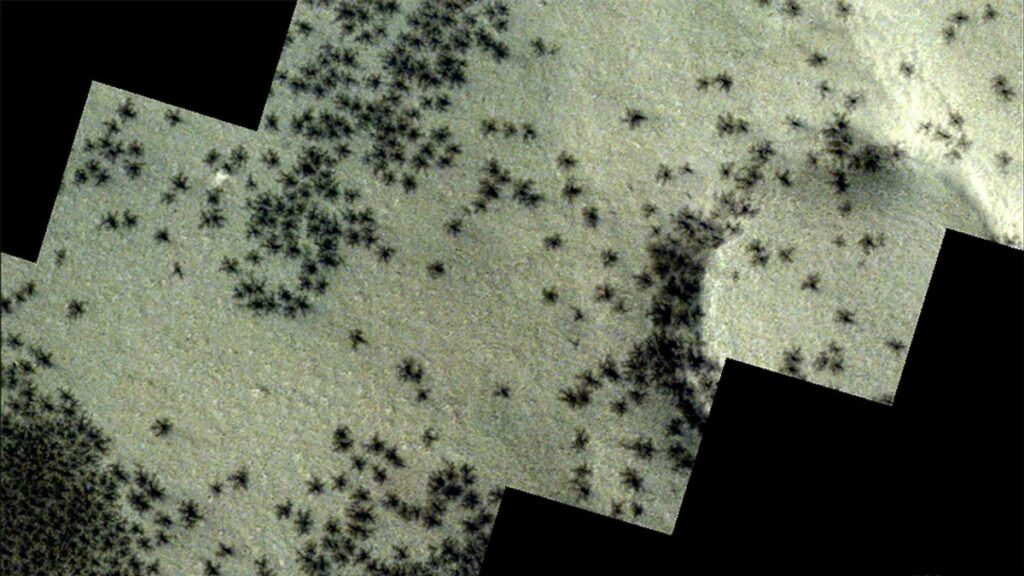
Thankfully, these are static. Image credit: ESA/TGO/CaSSIS

As the gas emerges, pushing dust and sand up as it goes, it creates giant fountains that then fall back down to the planet. As it settles, it creates the dark patches seen in the image, between 45 meters (150 feet) and 1 kilometer (0.6 miles) across.

So, why do we see these patterns, really a combination of dust and the cracks in the ice, as spiders? The phenomenon of seeing familiar patterns in objects is called pareidolia. In terms of our evolution, it makes sense that we spot patterns that could be a danger to us (e.g. a snake or a hungry bear) as quickly as we possibly can. It’s why we see faces where faces definitely don’t belong.

Carl Sagan explained in his book The Demon-Haunted World: Science as a Candle in the Dark, that the ability to identify threats was incredibly important to our own survival.

Early humans that ran away from what they thought was a lion hiding in the bushes survived. Those who couldn’t spot this lion “pattern” would be eaten by it. The lion, not the pattern, that is. And if they ran away but it turned out that the lion was in fact just a rock, that’s fine; those humans survived either way and passed on their genes to the next generation.

“Our brain is constantly trying to make sense of the outside world. One way the brain accomplishes this goal is by detecting and learning patterns, which are essentially statistical regularities in the environment, because these patterns help the brain decide how to react or behave in order to survive,” Dr Jess Taubert, from the University of Queensland, previously told IFLScience.

As Sagan pointed out, finding patterns (where patterns exist or not) was a vital precautionary survival skill, but could lead to the misinterpretation of random images or patterns of light as faces and familiar objects. In this case, seeing scattered debris as giant Martian spiders.

Filed Under: Trends Worldwide Tagged With: mars, orbiter, sign, spiders, spots, trends, worldwide

Reader Interactions

Leave a Reply Cancel reply

Your email address will not be published. Required fields are marked *

Primary Sidebar

More to See

According to Statistics, China Nurtured a Plant on The Moon, and it Produced Two Leaves

By Hasan Jasim Editorial Team

A King’s Last Breath: Heartbreaking Photos of a Lion’s Final Moments

By Hasan Jasim Editorial Team

The Best Photos of the Great American Eclipse

By Hasan Jasim Editorial Team

If Your Cat Wants to Sleep in Your Bed, the Reason Might Surprise You

By Hasan Jasim Editorial Team

Why Pigeons Are Terrible at Building Nests: A Deep Dive into Their Lazy Yet Adaptive Nature

By Hasan Jasim Editorial Team

The First Known Animal That Does Not Require Breathing Has Been Discovered Inside Salmon

By Hasan Jasim Editorial Team

Captures from Trail Cameras The First Howls Of A Cute Little Wolf Puppy

By Hasan Jasim Editorial Team

Footer

ABOUT HASANJASIM.ONLINE

Hasanjasim.online is a digital platform dedicated to publishing well-researched articles about the animal kingdom, nature, and the environment. Our editorial team works to source stories from credible outlets, scientific research, and verified reports, aiming to inform as much as we entertain. From wildlife conservation and animal behavior to natural wonders and environmental science, we cover the topics that help readers better understand and appreciate the natural world. Whether you're a lifelong nature lover or simply curious about the planet we share, Hasanjasim.online aims to be a trustworthy destination for stories worth reading — and worth citing.

Recent

  • A Mystery Animal Has Been Randomly Attacking People in New Hampshire — Here’s What We Know
  • A Woman Was Filmed Sharing Her Ice Cream With Her Dog — Here’s What Vets Actually Say About It
  • Dolphin Calf Incident in Ceuta Sparks Outrage After Disturbing Beach Footage Emerges
  • Lactuca Serriola Root: Traditional Uses of Prickly Lettuce (Wild Lettuce) Root
  • The Puppy a Firefighter Couldn’t Leave Behind — and the Story Didn’t End There
  • A Mother Dog Dove Into Floodwater Again and Again — Until All 7 of Her Puppies Were Safe
  • Man shares wife’s last heartbreaking words before she vanished in Nepal floods

Search