A widely held theory regarding the ancestry of Native Americans has been substantially challenged by groundbreaking genetic analysis of ancient teeth, suggesting that the ancient inhabitants of what we now call America might not be who we assumed them to be.
The prevailing theory, predominantly built upon archaeological findings at Native American sites, has long asserted that the First Peoples arrived on the continent from Japan approximately 15,000 years ago. This belief draws from the remarkable resemblance between stone tools and artifacts used by Native Americans and those attributed to the Jōmon people, a diverse hunter-gatherer society that thrived in ancient Japan between roughly 14,000 and 300 BCE.
This theory further suggests that Native Americans embarked on their journey across the northern expanse of the Pacific Ocean, traversing the Bering Land Bridge – a landmass that once bridged Siberia and Alaska during the last ice age – before ultimately reaching the northwest coast of North America.
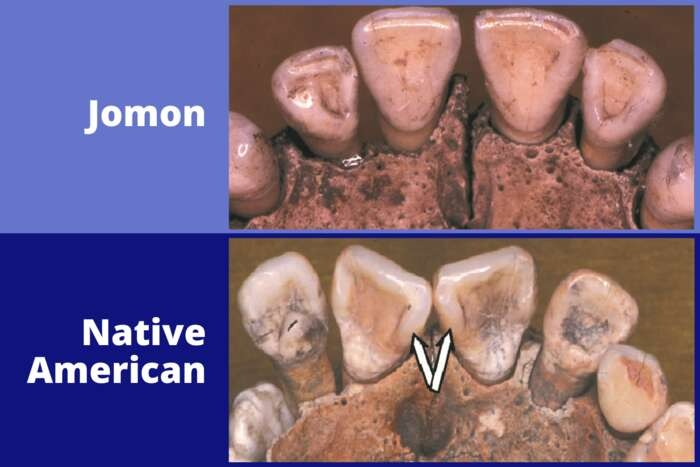
While parts of this narrative may still hold true, a recent study published in the journal PaleoAmerica has cast doubt on the notion that Native Americans are descendants of the Jōmon people of Japan. The research, led by Professor Richard Scott from the University of Nevada-Reno, centered on the analysis of ancient teeth found in the Americas, Asia, and the Pacific. The teeth of Native Americans exhibited scant genetic connection to those of the Jōmon people, with subsequent genetic testing reaffirming this conclusion.
Professor Scott commented on the findings, stating, “We found that the human biology simply doesn’t match up with the archaeological theory. We do not dispute the idea that ancient Native Americans arrived via the Northwest Pacific coast – only the theory that they originated with the Jōmon people in Japan.”
With a mere 7 percent of teeth samples from the Jōmon population demonstrating a link to non-Arctic Native Americans, supported by genetic evidence, it appears increasingly likely that the ancestral origins of Native Americans lie elsewhere.
Scott added, “These people (the Jomon) who lived in Japan 15,000 years ago are an unlikely source for Indigenous Americans. Neither the skeletal biology nor the genetics indicate a connection between Japan and the Americas. The most likely source of the Native American population appears to be Siberia.”
While the research team remains confident in their findings, it is important to acknowledge the study’s limitations. The teeth and DNA samples obtained from the Jōmon people are less than 10,000 years old, which is after the presumed arrival of the first Native Americans on the continent. Nonetheless, the team contends that these samples serve as “valid proxies” for the Jōmon population that had resided in Japan for 5-6,000 years prior.
Further contributing to the mounting evidence that the First Americans did not originate from Japan is the discovery of ancient footprints at a prehistoric lakebed, now known as White Sands National Park in New Mexico. These footprints date back to a period between 23,000 and 21,000 years ago, significantly earlier than previously believed human arrival on the continent.
Dr. Sally Reynolds, a co-author of the team that confirmed the prints as human-made, shared her insights: “In the light of the findings, this means the earliest migrations would have come via Asia, over the Bering Land Bridge, and into Alaska. We previously thought that they would move south after around 16,000 years ago when the ice sheets melted and a migration corridor opened, but the earlier date from White Sands shows that humans were already in the Americas. This means that humans migrated into the Americas much earlier, but still via the same route.”
While it remains to be determined if these footprints conclusively link to Native Americans, it appears that the conventional theory positing Native American migration from Japan has been significantly challenged.
Dr. Scott concludes, “The Incipient Jomon population represents one of the least likely sources for Native American peoples of any of the non-African populations.” These findings compel us to reevaluate our understanding of the intricate tapestry of human migration and the origins of Native Americans, inviting us to delve deeper into the rich and complex history of the First Peoples of the Americas.
Leave a Reply