• Skip to main content
  • Skip to primary sidebar
  • Skip to footer
  • Home
  • About Us
  • Copyright Report
  • Submit Content
  • Terms
  • Privacy Policy
  • Legal Disclaimer

Hasan Jasim

Hasan Jasim is a place where you may get entertainment, viral videos, trending material, and breaking news. For a social generation, we are the largest community on the planet.

New Zealand’s Amazing Moeraki Boulders Have Grown for 60 Million Years To Look Like This

by Hasan Jasim Editorial Team Leave a Comment

ShareTweet

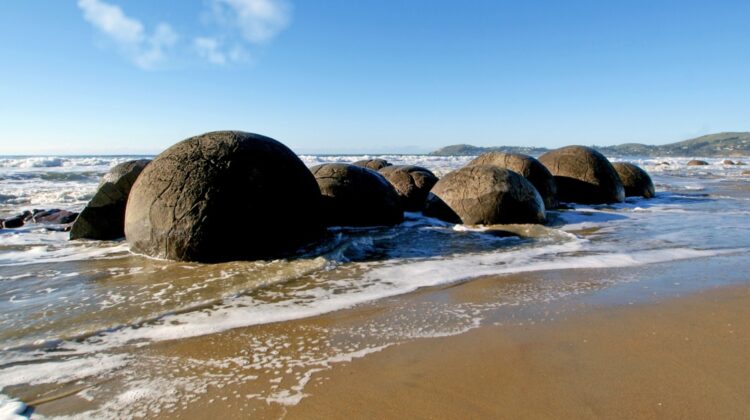
These enigmatic spherical rock formations scattered along the New Zealand coastline captivate scientists and curious wanderers alike.

The Moeraki Boulders in New Zealand. Photo: Bernard Spragg

If you are looking for a unique and amazing natural attraction in New Zealand, you should definitely visit the Moeraki Boulders on the Otago coast. These are huge round stones that lie on the Koekohe Beach, between the towns of Moeraki and Hampden, and look like giant marbles or dinosaur eggs left on the sand by some mysterious force.

The Moeraki Boulders are not ordinary rocks, but concretions. Concretions are masses of minerals that form around a nucleus, such as a shell or a bone, in sedimentary rocks. Over millions of years, the sedimentary rocks around the concretions erode away, leaving them exposed on the surface.
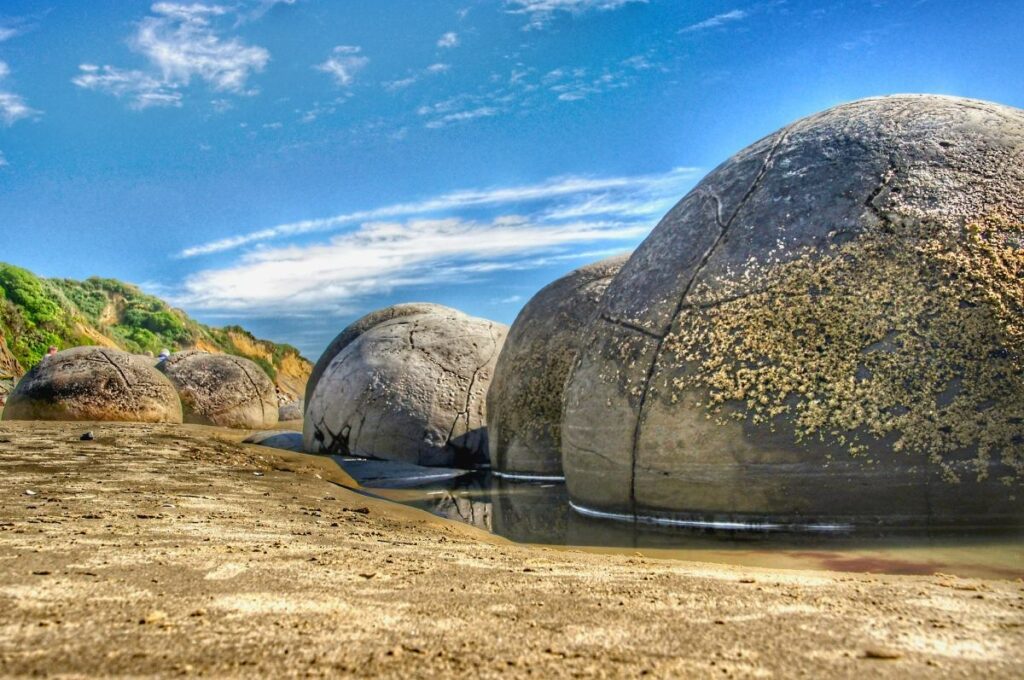
Photo: Bernard Spragg

The boulders started forming about 60 million years ago in ancient sea floor sediments. Calcite gradually accumulated around organic nuclei, such as shells and plants, creating “growing” spherical nodules characterized by tougher outer layers. They grew slowly, layer by layer, until they reached their current size. Some of them are over 2 meters in diameter and weigh several tons.
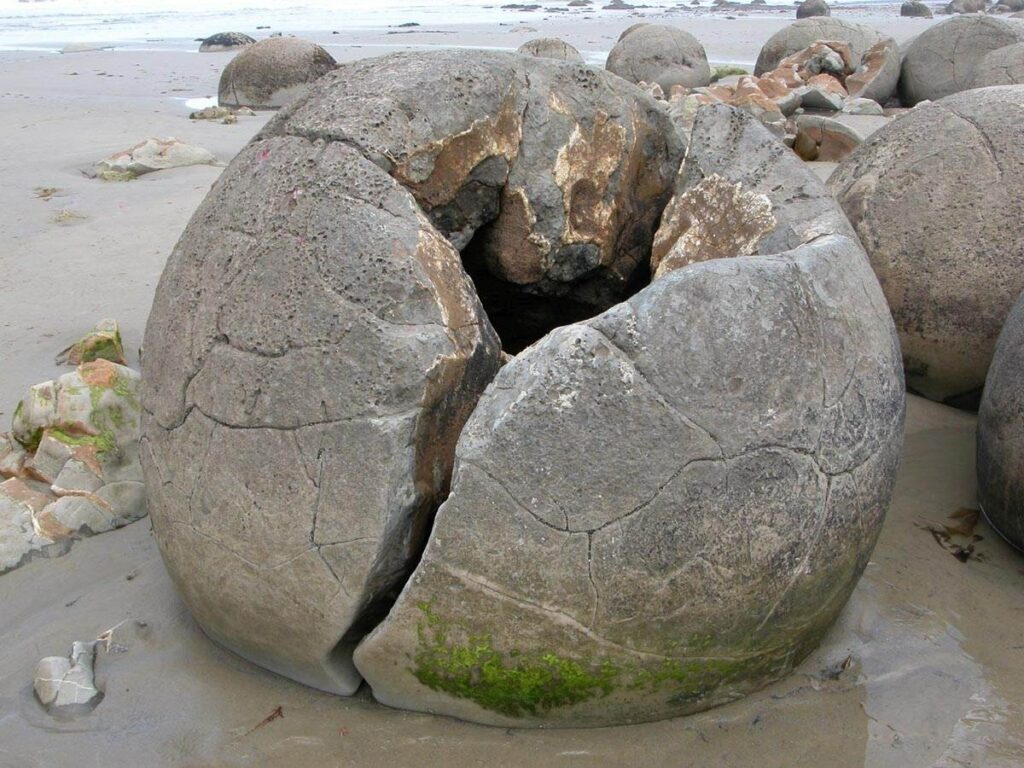
A cracked Moeraki boulder displaying its hollow interior. Photo: William M. Connolley

Meanwhile, the inner substance of the boulders underwent dehydration, resulting in radial cracks extending outward to the rim from their hollow cores. These cracks are filled with calcite crystals that that look like honeycombs and sparkle in the sun.

The boulders have different degrees of hardness and cementation, which make them more or less resistant to weathering and erosion. Some of them are broken or split open, revealing their inner structure.
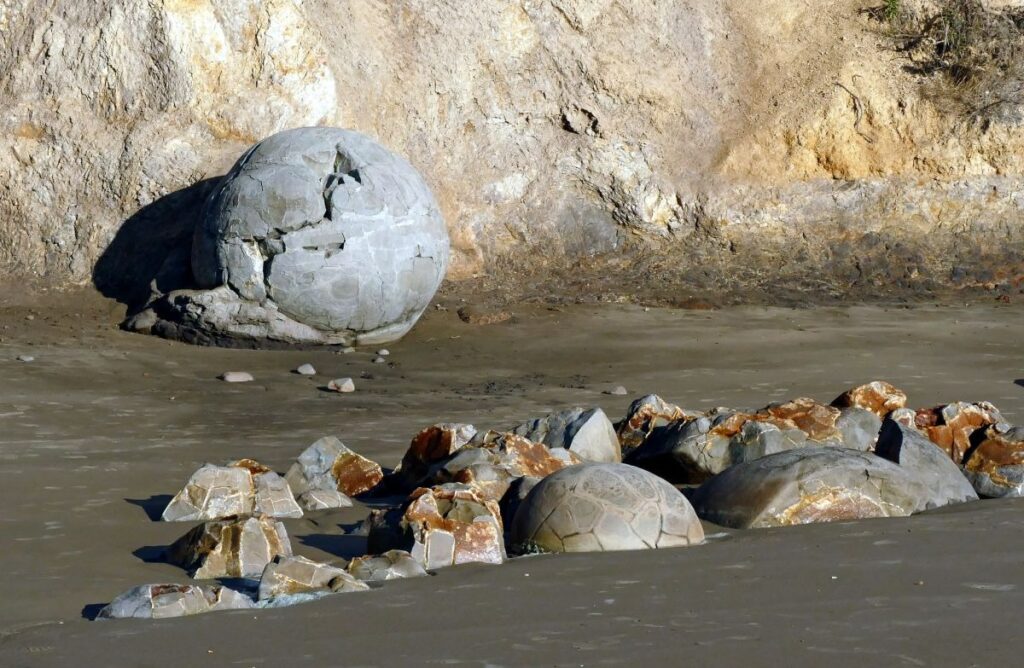
These boulders have submitted to erosion, reveling their insides with honeycomb-like calcite crystals that sparkle in the sun. Photo: Bernard Spragg

The Moeraki Boulders have a special significance for the local Maori people. According to their legend, the boulders are the remains of food baskets, gourds and eels that washed ashore from a wrecked canoe called Araiteuru. The canoe was carrying the ancestors of the Ngai Tahu tribe from their homeland of Hawaiki to New Zealand. The boulders are considered as taonga (treasures) and have spiritual and cultural value.

The Moeraki Boulders are a popular tourist destination and a photographer’s dream. They are best seen at low tide, when they are fully exposed on the beach. They look especially beautiful at sunrise and sunset, when they reflect the colors of the sky. They also create a stunning contrast with the waves and the clouds. The boulders are protected by a scientific reserve and visitors are asked to respect them and not to damage them.
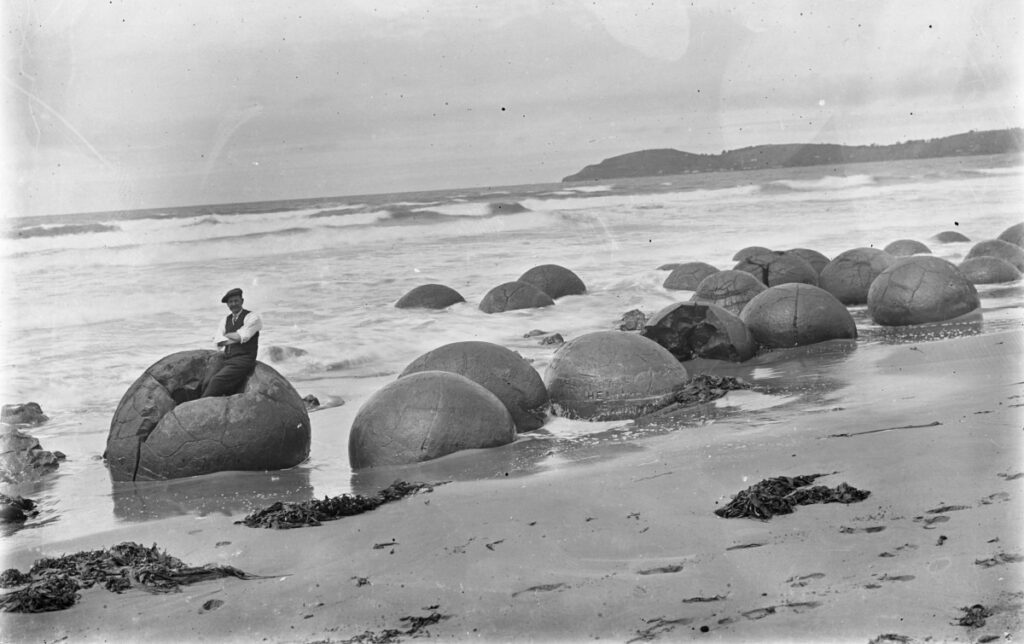
View of Moeraki Beach and boulders. A sense of scale is given by photographer Albert Percy Godber, who is seated on one. Photograph taken by Albert Percy Godber circa 1925.

Similar boulder-size concretions, known as Katiki Boulders, are located on the north-facing shoreline of Shag Point, approximately 19 kilometers (12 mi) south of the Moeraki Boulders. These concretions manifest in various forms, including spherical cannonball concretions, as well as flat, disk-shaped, or oval concretions. In contrast to the Moeraki boulders, certain Katiki Boulders contain the remains of mosasaurs and plesiosaurs.

You can even take a bath in some of the Katiki Boulders. Watch out for mosasaurs and plesiosaurs though! Photo: nzfrenzysouth

The Moeraki Boulders (and the nearby Katiki Boulders) are one of the most fascinating and spectacular geological wonders in New Zealand. They are a testament to the power and beauty of nature and a reminder of the ancient history of this land.

Filed Under: Trends Worldwide Tagged With: amazing, boulders, grown, have, like, look, million, moeraki, this, trends, worldwide, years, zealand’s

Reader Interactions

Leave a Reply Cancel reply

Your email address will not be published. Required fields are marked *

Primary Sidebar

More to See

After being rescued, a dog stranded on a highway gives the rescuer the biggest hug.

By Hasan Jasim Editorial Team

Hurricane Milton Doubling In Size, Set To Be One Of The Most Destructive Atlantic Storms

By Hasan Jasim Editorial Team

Poland Builds World’s Largest Snow Maze That’s Bigger Than 10 Tennis Courts

By Hasan Jasim Editorial Team

Divers find mysterious dolphin – then a miracle happens

By Hasan Jasim Editorial Team

This may be one of the clearest visual reconstructions of a human cell ever created

By Hasan Jasim Editorial Team

If you find ticks inside your home, here’s what you should know

By Hasan Jasim Editorial Team

Are 2012 honda civics good cars?

By Hasan Jasim Editorial Team

Footer

About hasanjasim.online

Hasanjasim.online is a digital platform dedicated to publishing diverse articles and content, with a strong focus on topics related to the animal kingdom, nature, and the environment. The website offers engaging stories and visual content aimed at raising awareness about animal welfare and showcasing the wonders of the natural world, making it a great destination for nature lovers and curious readers alike.

Recent

  • When Her Nonverbal Son’s Communication Device Died at Dinner, This Mom Found a Backup That Never Runs Out of Battery
  • Lamb’s Quarters: The Wild “Weed” That Outperforms Spinach in Nutrition
  • A Restaurant Put Up One Simple Sign for Its Teenage Staff — and It Says Everything We Forget to Say
  • Bees Can Smell 50 Times Better Than Dogs — Here’s How
  • Elderly Mushroom Picker Dies in Suspected Bear Attack in Japanese Forest
  • Don’t Throw Away Those Watermelon Rinds: Make Crunchy Homemade Pickles
  • Under an Active Volcano: The Ancient Art of Sun-Drying Tomatoes at Mount Etna

Search