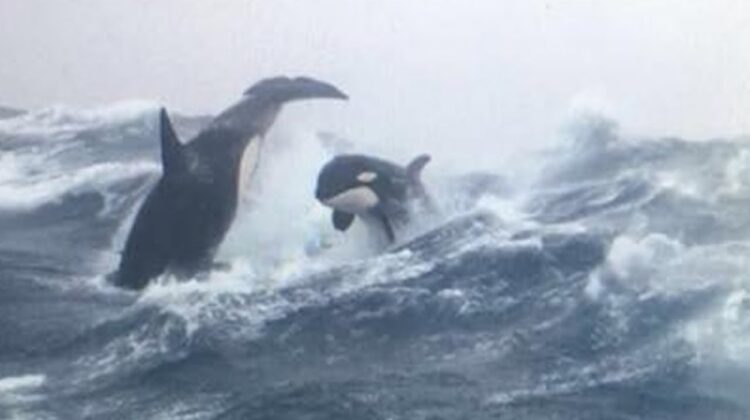
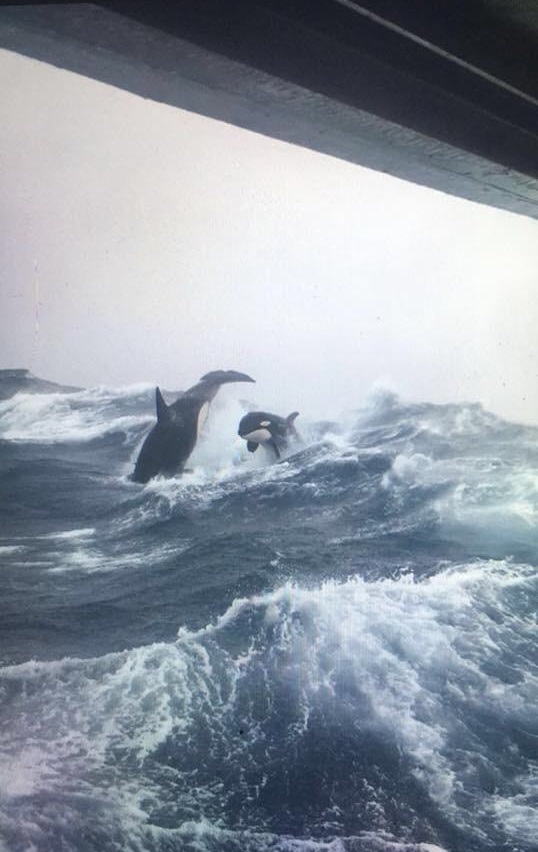
A widely shared photograph shows two orcas breaching together in heavy, storm-tossed seas, framed beneath the stern of a boat. The image — dark water churning into whitecaps, one orca fully airborne beside a smaller companion breaking the surface — has circulated online for years as a striking example of just how powerful these animals are, even in conditions rough enough to challenge most vessels.
What the Photo Shows
The two orcas appear mid-breach, launching clear of the water at nearly the same moment. One is captured at the peak of its jump, body arched and tail still trailing spray; the other is emerging just behind it, head and dorsal fin visible through the whitewater. The rough, gray-green swell and overcast sky give the image a dramatic, almost cinematic quality — a reminder that orcas hunt, travel, and surface in conditions far harsher than the calm waters typically shown in wildlife photography.
Why Orcas Breach in the First Place
Breaching — propelling most or all of the body out of the water — is one of the most recognizable orca behaviors, but researchers still don’t agree on a single reason for it. The leading theories include:
- Communication — the impact of a breach creates both an underwater and above-water sound that may travel long distances to other pod members
- Parasite removal — repeated breaching may help dislodge skin irritants like barnacles or sea lice
- Play and social bonding — especially common in younger orcas, who are often observed breaching repeatedly with no obvious practical purpose
- Hunting strategy — in some documented cases, breaching has been linked to disorienting or herding prey
Multiple theories likely apply simultaneously, since breaching shows up across very different contexts and age groups within pods.
Why Rough-Water Breaches Stand Out
Orcas are capable swimmers in conditions that would be genuinely hazardous for most other marine life to surface in in a controlled way. A breach captured in heavy swell tends to draw more attention than calm-water footage simply because of the visual contrast: a six-ton animal launching cleanly out of chaotic, wind-whipped water underscores both its strength and its control, even when the environment around it looks anything but calm.
The Species Behind the Image
Orcas, or killer whales, are the largest members of the dolphin family and are found in every ocean on Earth, from polar waters to the tropics. They are apex predators, hunting fish, seals, sea lions, and — in some populations — other whale species, often working cooperatively within tight-knit family pods. Despite the name, they are not classified as “true” whales.
Frequently Asked Questions
How can you tell orcas apart from other whale or dolphin species in a photo?
Orcas have a distinctive black-and-white pattern, a tall dorsal fin (especially prominent in adult males), and a rounded head without the elongated beak seen in many dolphin species.
Is it dangerous for boats to be near breaching orcas?
Orcas are generally not a threat to vessels, but most regions with resident orca populations have legal minimum-distance guidelines for boats, both to avoid disturbing the animals and to keep observers safe from unpredictable movement in rough seas.
Do orcas breach more often in certain weather or sea conditions?
There’s no strong scientific consensus that rough seas specifically trigger more breaching — the behavior occurs across calm and turbulent water alike — but breaches in dramatic conditions tend to be more visually memorable and more likely to be photographed and shared.
Are photos like this common, or is this a rare capture?
Breaching itself is a regularly observed behavior in orca populations worldwide, but catching two animals breaching simultaneously in heavy seas, framed clearly in a single photo, is a comparatively rare and difficult shot to get.
Sources: General marine biology research on cetacean behavior and orca breaching, including publicly available research from NOAA Fisheries and marine mammal research organizations.
Leave a Reply