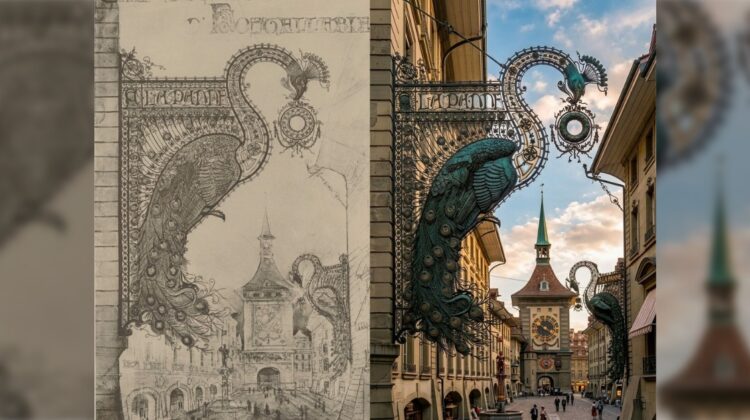
A simple shop sign once transformed the streets of Paris into a living work of art.
In the bustling streets of early 1900s Paris, something unusual was happening above people’s heads.
Amid the noise of the Industrial Revolution — factories, machines, and mass production — a quieter, more elegant revolution was taking shape.
It wasn’t in galleries or museums.
It was on the streets.
One shop sign, created by Henry de Bosset, would come to symbolize this artistic movement in an unexpected way.
The sign, designed for a shop known as “Prix Godeboeuf,” was not just a piece of advertising.
It was a statement.
At a time when industrialization was making everything faster, cheaper, and more uniform, many artists feared that craftsmanship was disappearing.
Shop signs, once handcrafted and full of personality, were becoming flat, mechanical, and lifeless.
But de Bosset refused to follow that trend.
He believed that public spaces should inspire people — not bore them.
To him, the street itself was an open-air museum.
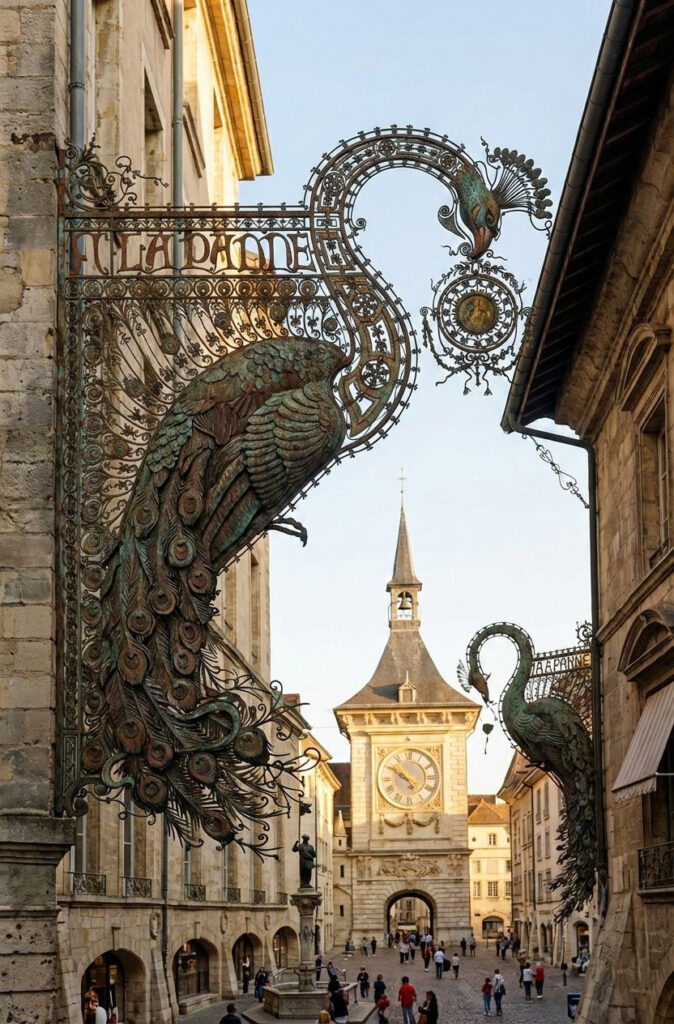
Instead of creating a simple sign, he designed something bold, detailed, and impossible to ignore.
And at the center of it all was a striking symbol.
A peacock.
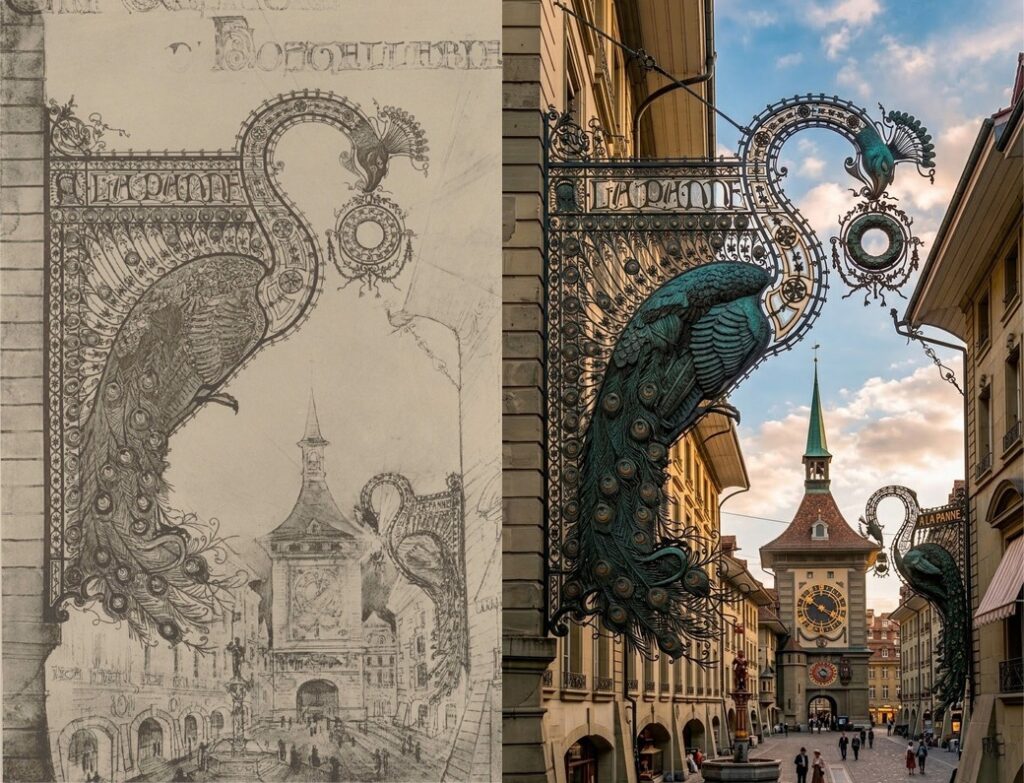
The intricate design of the bird became the soul of the piece.
Its flowing feathers curved elegantly, reflecting the organic, natural lines of the Art Nouveau movement that was sweeping across Europe at the time.
Unlike the rigid, geometric designs of industrial architecture, the peacock’s form felt alive — fluid, expressive, and full of motion.
But the choice of the peacock was not just about beauty.
It carried meaning.
In the early 20th century, the bird symbolized luxury, elegance, and exotic appeal. By placing it above a storefront, the message was clear before anyone even stepped inside.
This was a place of quality.
A place of refinement.
The craftsmanship behind the sign was just as impressive as its design.
Made from carefully shaped metalwork, every detail reflected hours of skilled labor. It stood in sharp contrast to the mass-produced signs that were beginning to dominate the streets.
People didn’t just glance at it.
They stopped and looked.
Over time, the “Prix Godeboeuf” sign became more than a business marker.
It became a landmark.
A symbol of a time when art and everyday life were deeply connected.
Today, historians look back at creations like this as part of a “golden age” — a period when even something as ordinary as a shop sign could carry the soul of an artist.
It was proof that beauty didn’t belong only in museums.
It belonged everywhere.
Even on a street corner.
And perhaps most importantly, it served as a reminder of something many still struggle to balance today.
Progress should never come at the cost of beauty.
Urban design and architectural aesthetics continue to play a major role in shaping modern cities and commercial spaces. Today, businesses invest in branding design services, architectural signage solutions, custom metal fabrication, visual identity development, and commercial design consulting to create visually striking environments that attract customers and enhance brand recognition.
Leave a Reply