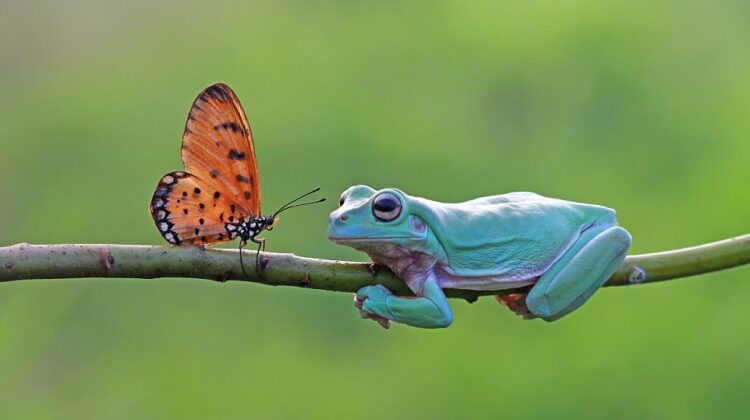
Freelance photographer Kurit Afsheen didn’t expect much when he set up outside his home in Tangerang, West Java, Indonesia, to photograph a dumpy tree frog resting on a branch. He spent about an hour photographing the frog — until, unexpectedly, a bright yellow African queen butterfly landed nearby and turned the shoot into something else entirely.
An Unlikely Ten Minutes

According to Afsheen’s own account of the encounter, the butterfly crawled slowly toward the frog, appearing to make direct contact near its face — close enough that the resulting images have been widely described as the butterfly “kissing” the frog. It didn’t stop there: the butterfly climbed onto the frog’s back, and eventually settled on top of its head, resting there for several minutes before flying off.
“I think this is the story of a butterfly who wants to make friends with frogs,” Afsheen said of the encounter. “I was surprised when a butterfly landed and crawled on the frog for about ten minutes. I think the image was very cute.”

Throughout the encounter, the frog stayed remarkably still — shifting its position slightly at points but never attempting to shake the butterfly off or move away.
What Was Actually Going On, Biologically Speaking
As charming as the “friendship” framing is, there’s a more grounded explanation for what was likely happening. Butterflies are frequently drawn to salt and moisture on other animals’ skin — a well-documented behavior called “puddling,” normally seen when butterflies cluster around mud puddles, sweat, or even tears to absorb minerals like sodium that aren’t available from nectar alone. A frog’s moist skin is a plausible source of exactly that.

The frog’s stillness is easier to explain too: dumpy tree frogs (also known as White’s tree frogs), native to Indonesia and Australia, are naturally slow-moving, sedentary animals that spend long stretches motionless on branches — a butterfly briefly investigating its skin likely didn’t register as a significant threat worth expending energy to escape.
About the Species Involved

The African queen butterfly (also known as the plain tiger, Danaus chrysippus) is a widespread species found across Africa, Asia, and parts of Australia, known for the bright orange-and-black coloring that warns predators of its unpalatability — a defense it gets from toxins absorbed as a caterpillar. Dumpy tree frogs, meanwhile, are one of the most commonly kept frog species in captivity worldwide thanks to their calm temperament, though the animal photographed here was wild.

Frequently Asked Questions
Was the butterfly actually being affectionate toward the frog? Almost certainly not in the way “kiss” or “friendship” implies — the leading explanation among naturalists for this kind of behavior is that the butterfly was drawn to moisture or salts on the frog’s skin, a documented feeding behavior rather than social bonding.
Could the frog have eaten the butterfly? It’s biologically possible, since tree frogs do eat insects, but in this case the frog showed no attempt to strike or capture it, possibly because the butterfly’s bright warning coloration signals toxicity that many predators learn to avoid.
Are dumpy tree frogs found outside Indonesia? Yes — they’re native to Indonesia and Australia and are also widely kept as pets internationally due to their docile nature and simple care requirements.
Leave a Reply