• Skip to main content
  • Skip to primary sidebar
  • Skip to footer
  • Home
  • About Us
  • Copyright Report
  • Submit Content
  • Terms
  • Privacy Policy
  • Legal Disclaimer

Hasan Jasim

Hasan Jasim is a place where you may get entertainment, viral videos, trending material, and breaking news. For a social generation, we are the largest community on the planet.

Zombie Fungus rides again!

by Hasan Jasim Editorial Team 3 Comments

ShareTweet

A female Carolina leafroller cricket, Camptonotus carolinensis, emerged from its lair and exploring leaves at night. I made this image last year in a southern Ohio forest. While these exceptionally long-antennae’d crickets are not rare, they are furtive and secretive. During the day, they hole up within rolled up leaves, hence the name. Come nightfall, they roam about on lower-lying foliage, and are quick to hop away with tremendous leaps if disturbed.

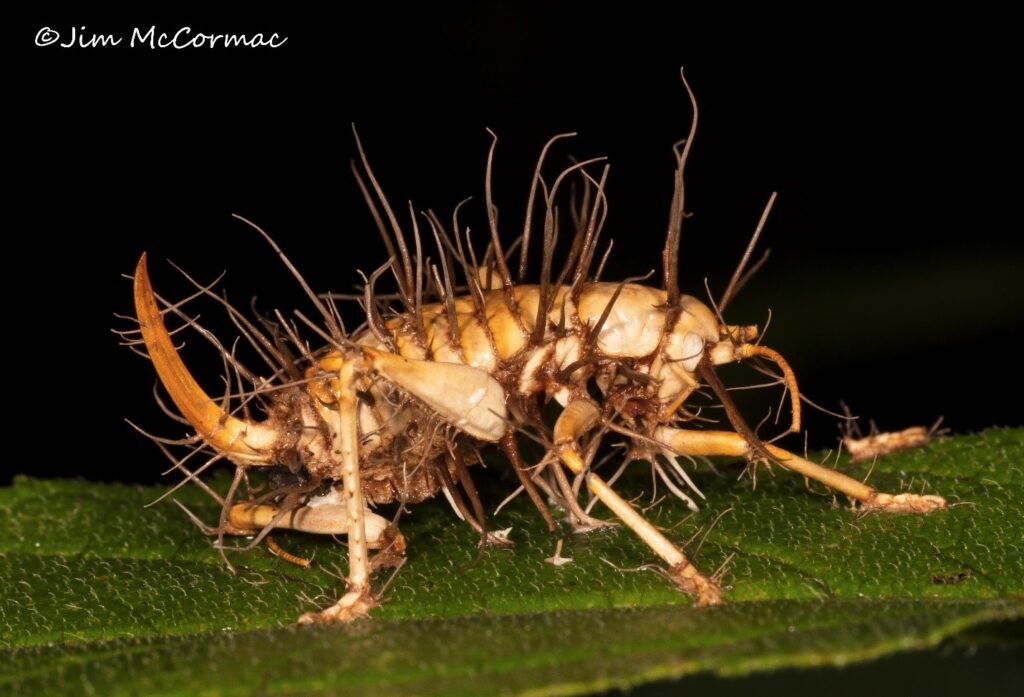
Here we have another female Carolina leafroller, but things have not gone swimmingly for the beast. Indeed, one of the worst possible fates imaginable has befallen the cute little cricket.

Laura Hughes, I believe, spotted the zombified orthopteran on a field trip to an Adams County, Ohio hotspot last Saturday. Never one to miss a chance to photo-document an attack of the zombie fungus, I took the opportunity to shoot some images of this fine example of a fate worse than death.

We look into the dead white eyes of the cricket, which bristles with emergent fungal hyphae. Cordyceps fungus, at least certain strains/species, attacks various small arthropods, eventually causing the demise of the host organism. I have seen it infecting other orthopterans, spiders, caterpillars, and other critters.

Apparently fungal spores land on and gain a beachhead on a suitable host, and then the fun begins. Fungal strands worm their way into the victim’s core, and rapidly grow throughout the body, consuming the soft parts. Cleverly keeping the host alive as long as possible – if a fungus can be considered clever – the fungal siege grows in intensity. In a last hurrah, the fungus somehow rewires the cricket’s brain to force it to act in an entirely unnatural way that is to the fungus’s benefit.

Chemical commands from the fungus direct the cricket to climb to a prominent exposed perch, and once it’s into a space exposed to breezes, the cricket – or whatever victim it may be – tightly seizes the substrate. In a horrifying grand finale, the fungal hyphae kills the cricket and caps its homicidal performance by shooting conspicuously elongate strands of hyphae from the host’s body. Spores are released from pores at the summits of these hyphae and waft off on the wind. Some of these will find their way to other hosts and begin the zombification process anew.

I suppose we humans should be glad this sort of fungal attack has not yet made its way to Homo sapiens.

Filed Under: Trends Worldwide Tagged With: Arthropod Parasites, Camptonotus carolinensis, Carolina leafroller cricket, Cordyceps, Cordyceps Fungus, fungal infection, Fungal Infection in Insects, insect behavior, macro photography, nature photography, Nature's Parasites, parasitic fungus, zombie fungus

Reader Interactions

Comments

  1. Florence says

    February 2, 2023 at 5:56 pm

    As interesting as this is, I cant deny that all my mind keeps coming back to is 2 things. #1
    The pain suffering confusion & ultimately the death of the cricket or any critter this fungus infects. #2 the fascinating fact that this fungi can or must be able to think to be able to control the victim for example making it go against all its instinct and climb against its will or instincts bc the fungi can communicate where to go what to do. Fascinating.

    Reply
  2. Rose Russ says

    February 3, 2023 at 12:10 am

    Oh my gosh ..thats wild! That how cordyceps is formed!

    Reply
  3. John Thomas says

    February 8, 2023 at 2:30 pm

    Thats exactly how they infect young naive minds with the fungus of liberalism at our Colleges and Universities.

    Reply

Leave a Reply Cancel reply

Your email address will not be published. Required fields are marked *

Primary Sidebar

More to See

Biologist’s Cactus Planter Switches To “Bathing Lady” Role, Sprouting Blossoming Penis

By Hasan Jasim Editorial Team

Dog Dad Disrupts Maternity Shoot at Shelter to Be With His Pregnant Girlfriend

By Hasan Jasim Editorial Team

One Of World’s Biggest Snakes Found Dead In Amazon Just Weeks After Its Discovery

By Hasan Jasim Editorial Team

South Korea Passes Law To End Sale And Slaughter Of Dog Meat By 2027

By Hasan Jasim Editorial Team

Take a Look Inside the Batagaika Crater, the Largest Scar on Earth

By Hasan Jasim Editorial Team

The World’s Tallest Sea Stack Is Home to the World’s Rarest Insect, Which Exhibits a Highly Unusual Behavior

By Hasan Jasim Editorial Team

This Cute Dragon Is Actually A Bird

By Hasan Jasim Editorial Team

Footer

ABOUT HASANJASIM.ONLINE

Hasanjasim.online is a digital platform dedicated to publishing well-researched articles about the animal kingdom, nature, and the environment. Our editorial team works to source stories from credible outlets, scientific research, and verified reports, aiming to inform as much as we entertain. From wildlife conservation and animal behavior to natural wonders and environmental science, we cover the topics that help readers better understand and appreciate the natural world. Whether you're a lifelong nature lover or simply curious about the planet we share, Hasanjasim.online aims to be a trustworthy destination for stories worth reading — and worth citing.

Recent

  • Blood-Soaked California Poachers Arrested After Cops Make Horrifying Discovery
  • The Moment an Emu Wrestled a Man to the Ground — Then Turned the Tables
  • Why didn’t anyone tell me there’s an animal that smells exactly like hot, buttered popcorn?
  • I Never Liked the Caribbean—But This Island With Waterfalls, Hot Springs, and Rainforests Won Me Over
  • He Was a Magnificent 17-Point Buck — Now His Life Is Over
  • Man Rescues Lone Wolf Caught In A Trap — And What He Did Next Left The Internet In Awe
  • Why Lotus Seed Pods End Up Looking Like They’re Pulling Faces

Search