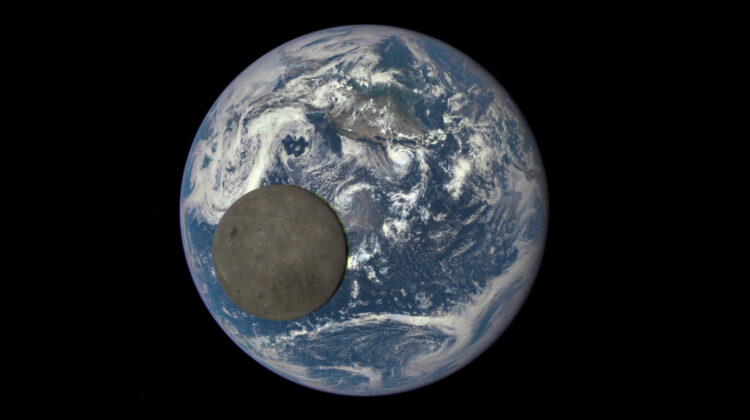
This gif of the Moon transiting Earth seems like a CGI animation, but it’s not. What’s more amazing is the side of the Moon that can be seen in the images. It was taken in 2015 by a camera on NASA’s Deep Space Climate Observatory (DSCOVR) satellite, and it depicts the Moon’s enigmatic “dark side.”

Though it seems dark from Earth, owing to the satellite’s strategic position, this side of the moon, as shown in the animation, is fully lighted and visible. The DSCOVR satellite, which is still functioning, circles Earth at a distance of one million miles. Its major function is to measure real-time solar wind for the National Oceanic and Atmospheric Administration, and it is located between the Sun and the Earth (NOAA).
NASA’s Earth Polychromatic Imaging Camera has made this magnificent sequence of photographs available to the public (EPIC). DSCOVR’s four-megapixel camera and telescope are focused toward a fully lighted Earth, keeping a close eye on it as it revolves.
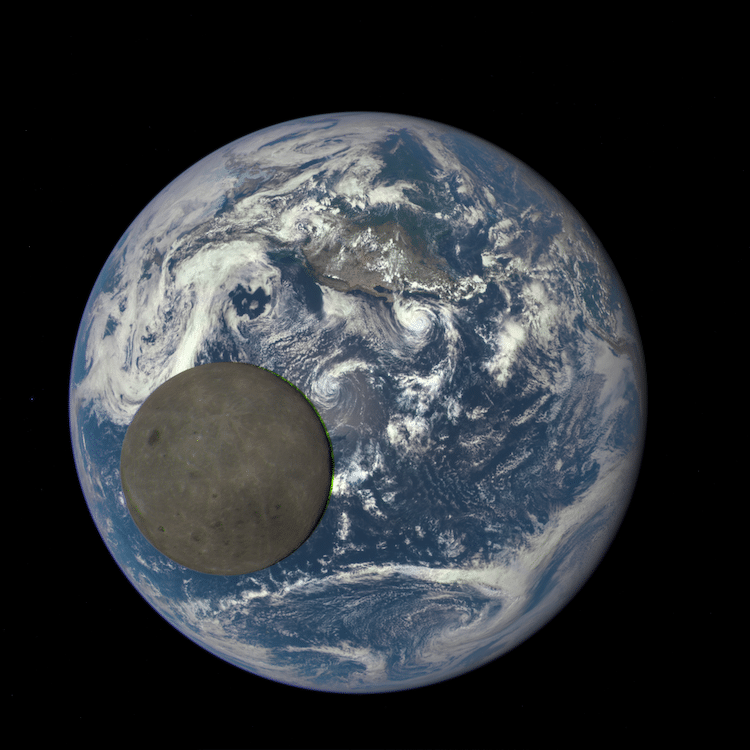
EPIC observes an occurrence that is unquestionably “epic” twice a year, when the Moon transits Earth. The Moon passes over the Pacific Ocean in this animation, which was captured over the period of roughly five hours. A faint green line may be seen on the righthand side of the Moon as it passes across the Earth. Because EPIC combines three different monochrome exposures obtained by the camera in fast succession, the photographs it generates have “natural hues.”
EPIC really captures ten photos with the use of specific filters such as ultraviolet and near-infrared. The red, green, and blue channel pictures are utilized for color images. Because the Earth moves slightly between each exposure, there is a little offset when they are combined, which is most noticeable in the Moon.
This magnificent image of the Moon’s “black side” is unusual, but not unprecedented. The Soviet Luna 3 spacecraft, which gave the first photos in 1959, deserves this accolade. The far side of the Moon, sometimes known as the dark side, is actually not that much darker than the side of the Moon that faces Earth. In actuality, it receives two weeks of sunshine followed by two weeks of darkness, just like the Moon’s near side. “Dark” in this usage refers to the unknown rather than a lack of light.
NOAA offers libraries of excellent satellite imagery that are constantly updated if you want to see more.
The EPIC camera on the DSCOVR spacecraft photographs the Moon passing Earth twice a year.
All images via NASA/NOAA.