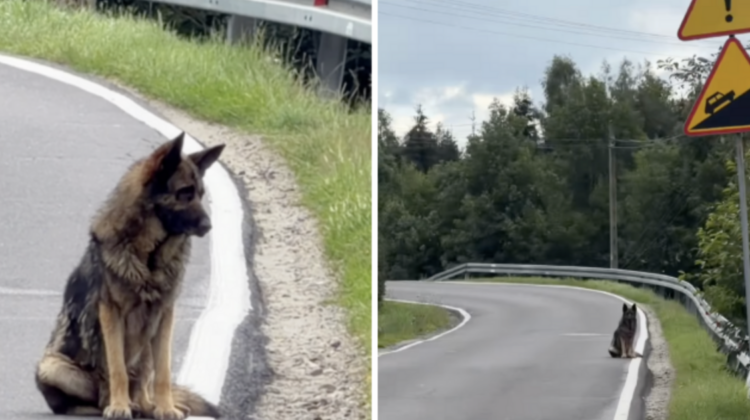
For two weeks, a German Shepherd stood watch at the same street corner in a small Polish village, studying every passing car as though one of them might finally bring his family back.
A Double Take On A Busy Street
Travel content creator Eva zu Beck was driving through the village when she spotted the dog wandering near traffic. At first, she did a double take — she owns a German Shepherd herself and briefly wondered if her own dog had somehow gotten loose. A closer look told a different story: this dog was starved, severely matted, and clearly in distress.

After speaking with local residents, Eva learned what had happened. Two weeks earlier, someone had abandoned the dog on the side of the road, reportedly deciding he’d become too much of a “hassle.”
The dog — whom Eva later named Atlas — hadn’t moved on. For two straight weeks, he stayed rooted to that same corner, disoriented and terrified, sniffing at every car that slowed down, apparently still convinced his family would return.
Earning A Terrified Dog’s Trust
Local authorities had reportedly tried for days to catch him, but Atlas was too frightened to let anyone close, repeatedly bolting into nearby woods whenever people approached. Eva decided to try a slower approach herself.
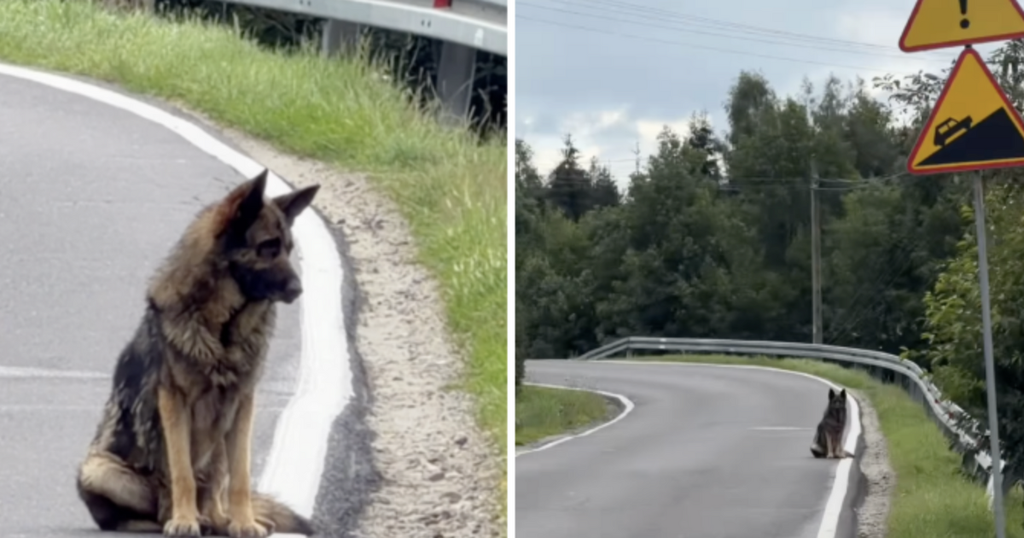
Over the following days, she returned to his corner repeatedly, bringing strong-smelling, appealing food each time to gradually wear down his fear. Eventually, Atlas trusted her enough to eat directly from her hand.
With the help of a tranquilizer to ensure a safe capture, Eva was finally able to get him into her vehicle and take him straight to a veterinarian before bringing him home.
A Different Dog Once He Felt Safe
Once Atlas was in a secure, calm environment, his behavior shifted dramatically from the terrified, bolting dog he’d been on the street. He turned out to be a large, playful dog who genuinely enjoyed human affection.
Since Eva already had a German Shepherd of her own, she decided Atlas would do better in a home where he could get more individual attention — and reportedly already had an adopter lined up for him.
What Atlas’s Turnaround Can Teach Rescuers
Atlas’s shift from a terrified runner to an affectionate companion is a textbook example of what rescue workers call the decompression phase. Dogs that have been abandoned or lived on the street are often flooded with stress hormones simply to survive day to day — and that stress doesn’t disappear the moment they’re brought somewhere safe.
Some rescue organizations use an informal “3-3-3 rule” as a rough guideline for newly adopted rescue dogs: roughly three days to begin decompressing, three weeks to settle into a routine, and three months to more fully adjust. It isn’t a strict scientific timeline, and every dog moves through it differently.
Rushing a fearful dog — with too much handling, loud environments, or too many new people at once — can easily overwhelm them. A quiet, predictable space, a consistent feeding schedule, and strongly scented treats, similar to what Eva used with Atlas, tend to be far more effective at building trust gradually.
A Cruel Beginning, A Better Ending
Atlas spent two weeks waiting for a family that had already decided he wasn’t worth keeping. Instead, he found a stranger willing to spend days earning his trust, and a community of people determined to see him safe.
He’s now settling in, growing more confident by the day, and on his way to a home where — as his story makes clear — he’ll never be treated as a “hassle” again.
Frequently Asked Questions
Why did the dog keep returning to the same street corner? According to the account, Atlas had been abandoned there by his previous owner and appeared to still be waiting for his family to return, watching each passing car for two straight weeks before he was rescued.
Why was it so difficult to catch him? Atlas was extremely fearful of people and would run into nearby woods whenever anyone approached. Rescuers had to slowly build his trust over several days using food before a safe capture, aided by a tranquilizer, was possible.
What is the “decompression phase” in rescue dogs? It refers to the period after a stressed or abandoned dog is brought into a safe environment, during which elevated stress hormones gradually decrease. Behavior during this period can look very different from how the dog behaves once fully settled.
What is the “3-3-3 rule” mentioned in the story? It’s an informal guideline some rescuers use: roughly three days for a newly adopted dog to begin decompressing, three weeks to settle into a routine, and three months to more fully adjust. It’s not a strict scientific rule, and timelines vary by individual dog.
What happened to Atlas after his rescue? He was taken to a veterinarian and then brought into a safe environment, where his personality reportedly changed dramatically for the better. Because his rescuer already had a German Shepherd of her own, an adopter was arranged to give him a home with more individual attention.
Sources: Account shared by travel content creator Eva zu Beck regarding the rescue of “Atlas,” cited above.
Leave a Reply