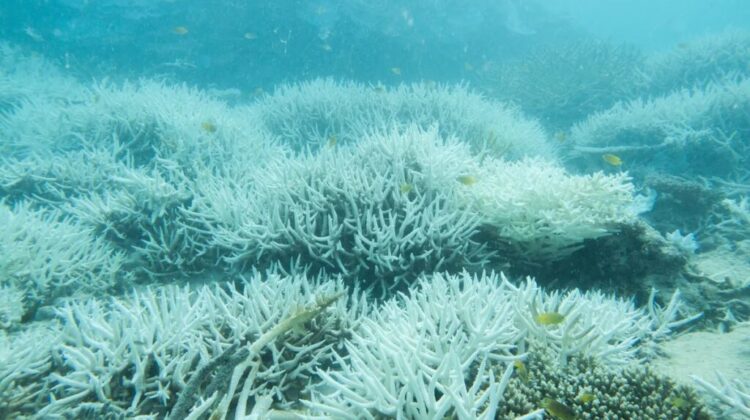
Recent findings from coral samples have provided a stark revelation about ocean temperatures in the Coral Sea, underscoring the urgent need for the Great Barrier Reef (GBR) to be officially listed as “in danger.” The evidence, spanning back 400 years, reveals that current conditions are unprecedented in the recorded history of the region.
Coral reefs, including the GBR, thrive within a narrow temperature range. When summer temperatures soar, it triggers extensive coral bleaching—a precursor to coral death if sustained. This phenomenon has been a significant factor in global coral decline. Despite the agreement on these facts, debate persists about corals’ ability to adapt to rising temperatures.
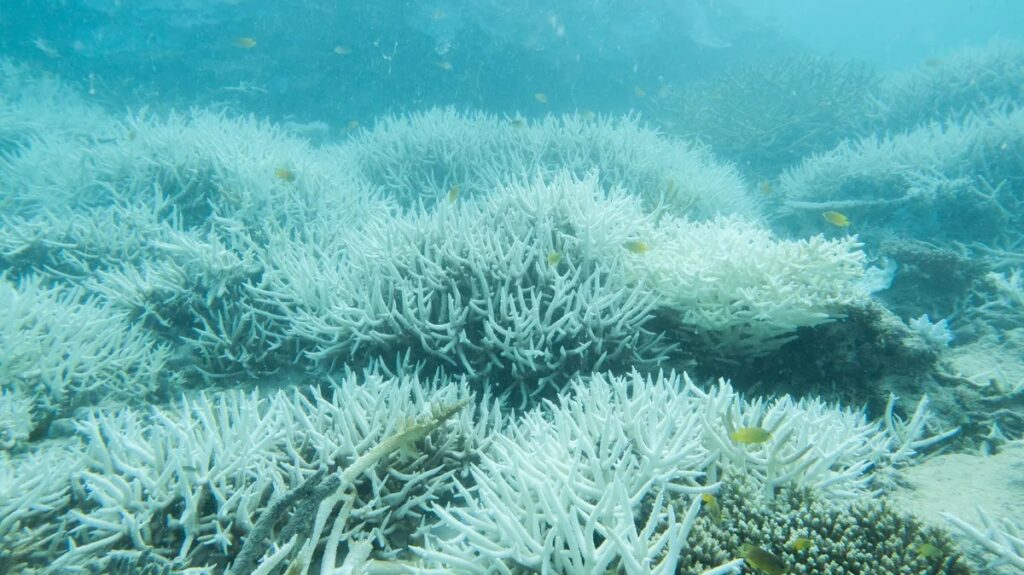
Image credit: Ove Hoegh-Guldberg, [email protected]
Dr. Benjamin Henley from the University of Wollongong and his team utilized the growth layers in corals, similar to tree rings, to reconstruct historical ocean temperatures. These layers provide a detailed record of past temperatures and salinity, particularly during the summer months. With some corals dating back 400 years, the data offers a glimpse into ocean conditions from the early 17th century onward.
Before the late 19th century, there were no direct temperature measurements for the GBR’s waters. This lack of historical data has allowed some to downplay the severity of current conditions, suggesting that the reef might have endured similar temperatures in the past. However, studies based on coral cores from central GBR locations, although providing some support to this notion, indicate that temperatures and bleaching have worsened over time. Notably, previous studies averaged temperatures over five-year periods for limited areas, which may not capture the full extent of the issue.
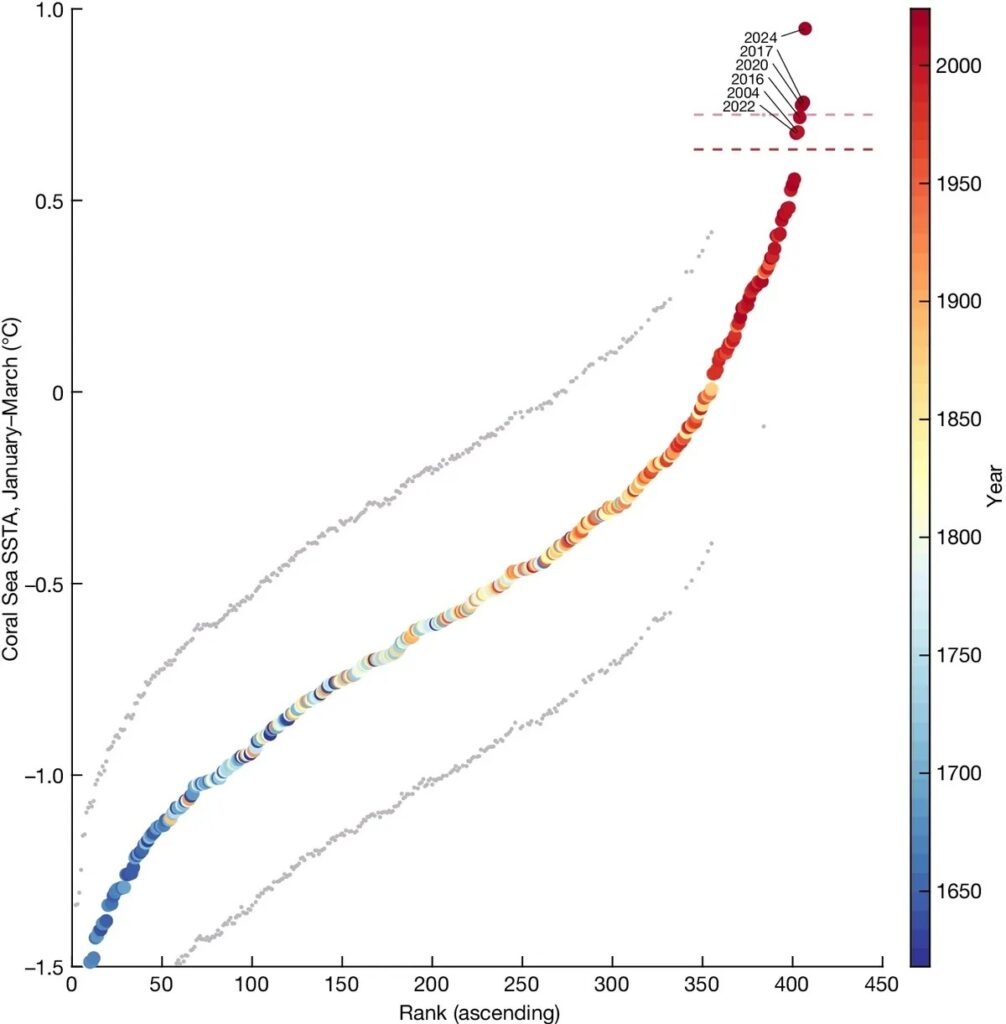
Henley and his colleagues analyzed coral cores from 1900 onward, correlating them with instrumental records. They reconstructed summer temperatures annually back to 1618, using modern techniques and larger sample sizes. Their findings reveal a pattern of warming and cooling cycles over decades, but none of the summers from the past 400 years approached the extreme temperatures of 2016, which caused widespread bleaching. Since then, three additional summers have exceeded the 2016 heat levels, with 2024 setting new records.
The data also shows that temperatures across the Coral Sea, not just the GBR, are higher than in previous centuries, with almost all sampled locations setting new records. Modeling the causes of this warming indicates a strong human influence on global climate, making the current trends almost impossible to attribute to natural variations alone.

Image credit: Anne Hoggett, Lizard Island Research Station; copyright holder: Tom DeCarlo, [email protected]
Henley expressed disbelief at the record-breaking temperatures of 2024, noting that mass coral bleaching has occurred again this year. “When I plotted the 2024 data point, I had to triple-check my calculations—it was off the charts, far above the previous record high in 2017. Tragically, mass coral bleaching has occurred yet again this year,” Henley stated.
The authors point out that even if the Paris Agreement’s goal of limiting global warming to 1.5°C (2.7°F) above preindustrial levels is achieved, 70-90 percent of the region’s corals could still die. Although introducing more heat-adapted corals from elsewhere might help, it is not a comprehensive solution.
In light of these findings, the authors criticize UNESCO’s recent decision not to list the GBR as “in danger,” despite it being included in the draft. “The inevitability of the impacts on the reef in the coming years is what really gets to me,” Henley remarked. Co-author Professor Helen McGregor concurred, emphasizing the unprecedented nature of the current temperatures. “The Great Barrier Reef is facing catastrophe if anthropogenic climate change is not immediately addressed,” she said. “The very corals that have lived for hundreds of years and provided us with the data for our study are themselves under serious threat.”
Henley remains hopeful, despite the dire situation. “We can never lose hope. Every fraction of a degree of warming we avoid will lead to a better future for the human and natural systems of our planet,” he urged. “We hope that our study equips policymakers with more evidence to pursue deeper cuts in greenhouse gas emissions internationally.”
Leave a Reply