
Right now, your eyes are sending your brain far more than you’re aware of. A new study suggests the brain may be sorting that flood with a startlingly fast rhythm.
The Old Search for a “Consciousness Spot”
For decades, neuroscientists have tried to find where in the brain conscious experience begins. Researchers compared brain activity when people noticed something with activity when they didn’t. The trouble is that many of the same regions react to things we never consciously perceive.
A team led by neuroscientist Janis Hesse and Doris Tsao at the University of California, Berkeley, asked a different question: what if consciousness depends less on where the brain is active and more on when? Their preprint, posted on bioRxiv in October 2026, has not yet been peer reviewed.
Two Images, One Winner
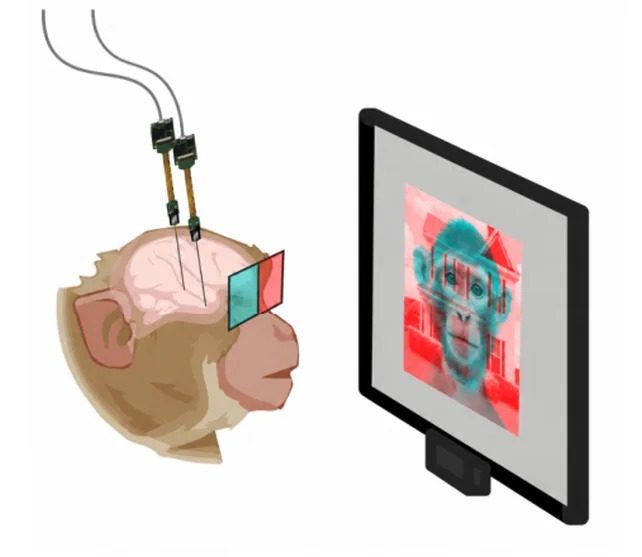
The team used a classic technique called binocular flash suppression. First, one image is shown to one eye. Then a different image is suddenly flashed to the other eye. Instead of seeing both, we tend to perceive only the newer one. The first image is still reaching the brain, but it drops out of awareness.

In the experiment, two rhesus macaques viewed competing faces this way while ultra-thin Neuropixels probes recorded from thousands of neurons. The probes covered face-selective regions of the inferotemporal cortex, as well as the prefrontal cortex.
A Flicker Every 60 Milliseconds
Researchers expected the neurons to lock onto the face the monkey consciously perceived. Instead, activity kept switching. Within a single stretch of viewing, the neural pattern rapidly alternated between the visible face and the suppressed one, roughly 15 times per second, or about every 60 milliseconds. That is far faster than the slow perceptual flips of about one every couple of seconds seen in ordinary binocular rivalry studies.
During the “conscious” moments, the brain’s activity was clear enough that the face the animal was actually seeing could be reconstructed from it. Tsao, a neuroscientist at UC Berkeley, described the finding as “a pure correlate of conscious awareness” when she announced the work on X.
Why the Brain Might Do This
The study does not yet explain how the brain decides which information becomes conscious. One possibility researchers raise is that rapid alternation lets the brain keep other interpretations of the scene in play without changing what you do or perceive at that moment. The abstract concludes that conscious access requires “temporal selection beyond localization,” meaning timing, not just location, is part of the story.
What the Study Can’t Tell Us Yet
The result is intriguing but early. The study involved only two macaques, and animals can’t report what they see, so their experience was inferred from human tests of the same technique. The recordings also focused on specific visual and prefrontal areas rather than the entire brain. Independent teams will need to repeat the work, and peer review comes next.
Curious About the Mind? Keep Exploring
Stories like this one have made brain science one of the most popular subjects to study and read about. If it sparks your curiosity, options include:
- Learning. Compare online neuroscience degrees, psychology degrees online and cognitive science courses.
- Reading and listening. Browse neuroscience books, science podcasts and educational streaming subscriptions.
- Vision care. Schedule eye exams, and compare vision insurance plans and prescription glasses.
- Attention and wellbeing. Try meditation apps and mindfulness courses.
- Hands-on science. Explore optical illusion kits and science experiment kits for classrooms.
Frequently Asked Questions
What does the study claim? It suggests that in macaques, brain activity alternates about 15 times a second between representing what the animal consciously sees and what is suppressed from awareness.
Who conducted the research? A team led by Janis Hesse and Doris Tsao at the University of California, Berkeley, with colleagues including Frank Lanfranchi, Conor McGrory, Yuelin Shi and Tatiana Engel.
Does this mean I’m switching between two realities? No. You don’t feel any flicker, and the study describes a pattern of neural activity, not two separate worlds. It suggests the brain keeps tracking information outside your awareness while you perceive one coherent scene.
Has the study been peer reviewed? Not yet. It’s a preprint on bioRxiv, so other scientists are still evaluating it.
What is binocular flash suppression? It’s a technique where one image is shown to one eye and a different image is flashed to the other, causing the second image to dominate awareness while the first is suppressed.
Sources: OfficeChai, GlitchWire, and The Unfinishable Map, all covering the October 2026 bioRxiv preprint by Janis Hesse, Doris Tsao and colleagues on how the brain alternates between conscious and suppressed visual information about 15 times a second.
Leave a Reply