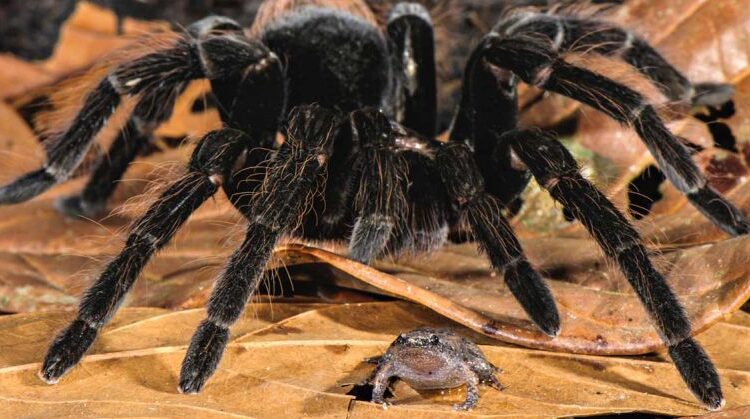
It may appear counterintuitive that an 8-inch wide defensive tarantula would choose to share its life and burrow with a half-inch slimy frog, yet nature permits the most beneficial relationships to evolve between the most unexpected species.
Several types of interesting biological interactions occur between different species in nature, although the most common ones are predation, where one organism typically feeds on another, and competition, where the organisms involved struggle for limited resources, commonly seen in plants. However, symbiosis occurs when two species live together for a large part of their lives and may share one of three relationships: mutualism, where both organisms benefit from each other; commensalism, where one organism benefits and the other neither benefits nor is harmed; parasitism, where organism benefits and the other is harmed.
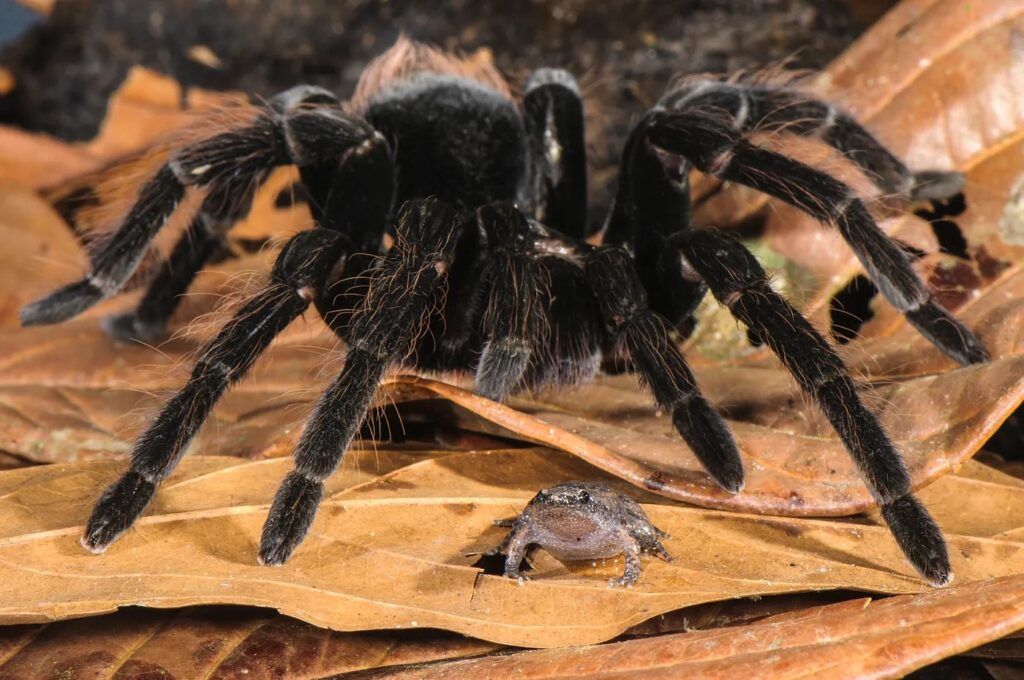
A tarantula and a frog: One of nature’s weirdest relationships
The relationship between the Colombian lesserblack tarantula (Xenesthis immanis) and the Dotted Humming frog from the microhylids family (Chiasmocleis ventrimaculata) was initially assumed to be a commensal interaction. In fact, many old and recent papers writing on the relationship would still describe the interaction as commensalism because the spider’s gain wasn’t immediately observed. However, it was later discovered to be a mutually beneficial type of symbiosis where the frog benefits by feeding on the ants attracted by the spider’s leftovers while for the spiders, their eggs are believed to be protected when the frogs eat the bugs. While this relationship is still subject to extensive study and research, the species are believed to look out for each other in the wild.
The interaction was first reported in 1989 by two researchers, Reginald Cocroft and Keith Hambler in southwestern Peru. The union has also been observed in Sri Lanka and India.
Cocroft and Hambler discovered that the giant tarantulas (which can grow up to 3 inches in length) were sharing tree holes with the tiny frogs. Both species are nocturnal and the researchers observed that when the tarantulas come out of their holes at dusk to hunt for prey, the tiny frogs would follow, exiting the same burrows without being harmed in any way. Sometimes, a spider might shift one of its numerous legs out of the way for the frog to pass through, showing a high level of safe interaction between the species.
This unique relationship is thought to have evolved due to the strongly unpalatable skin of the frogs which makes it impossible to eat them. The scientists observed how powerfully instinctual the interaction is when one of the younger spiders would occasionally pounce on a frog, examine it thoroughly, and finally let it go unharmed.
Possibly more than one species of tarantulas
In an unpublished report from 2002, a researcher named Jolene Csakany reported that Crocraft & Hambler’s (1989) identification of X. immanis as the tarantula might have been wrong since the species was originally thought to be absent from Peru. She also observed the frog-spider relationship occurring between the same species of microhylids frog but with two other species of tarantulas. However, it’s possible that the Dotted Humming frog shares this relationship with several species aside from the immanis.
Csakany tested the theory by taking the skin from a Dotted Humming frog and placed it on other species of frogs that would have ordinarily been eaten by the spiders. She observed that the spider would pick up or entrap the frog, and after examining the skin, it would move away and leave the frog unharmed. This confirms the hypothesis that the spider uses chemical compounds and toxins present on the frog’s skin to identify its partner.
Mutualism at its weirdest
One stump of any of the tarantula’s legs could easily squash the frog and turn it into a meal, but they prefer to share the same living spaces with the bitter-tasting amphibians.
Researchers immediately observed that the frogs would eat up the bugs drawn into the tree holes from the spider’s leftovers. The Dotted Humming frogs have a healthy appetite for ants and would often eat up as many critters as possible. Frogs are also prey to several other predators such as snakes, lizards, and even birds. The tarantula protects the frog and guards it against any predator that may try to scavenge the tree hole.
What does the spider gain? Researchers believe the frogs protect the spider’s eggs. Where the frogs have an appetite for ants, ants have an appetite for spider eggs and would often attack the younglings before they hatch. The tarantulas are too large to spot or destroy the ants, so they may rely on the frogs to protect their eggs.
Nature is one intensely creative mastermind. We humans can learn from these vastly different species just how much better and stronger we are when we stick together, and how essential it is to see beyond all classifications for the greater good.
Leave a Reply