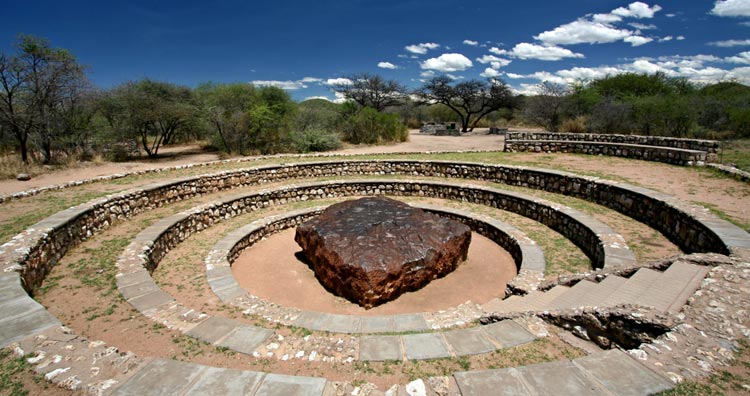
The locals call it “Ghantsiis,” the “fallen star,” and believe it possesses supernatural powers. Even if that’s not the case, the Hoba meteorite does have features that make scientists scratch their heads.
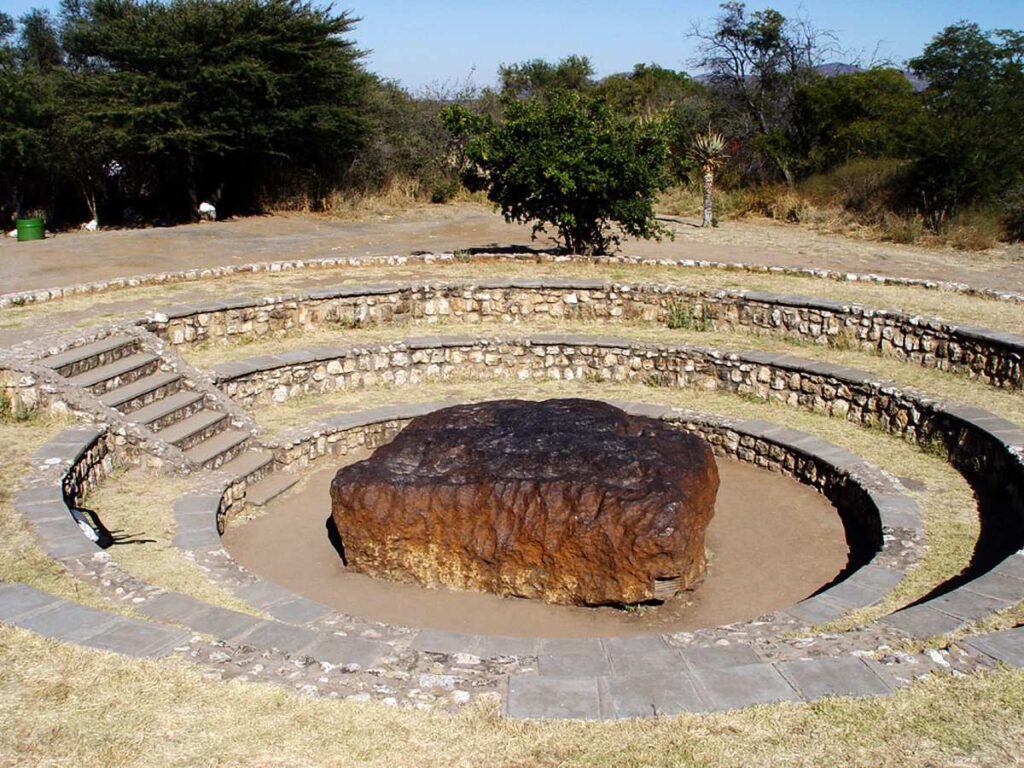
Imagine a giant, anvil-shaped rock falling from space. Most of us would expect a colossal crater, a scene straight out of a sci-fi movie. But what if this space rock landed with barely a whisper? That’s the strange story of the Hoba meteorite, the largest naturally occurring piece of iron ever found on Earth.
Discovered by farmers in 1920, the Hoba meteorite rests in Namibia, Africa, and weighs an estimated 60 tonnes, which makes it also the largest known intact (single-piece) meteorite on Earth. Unlike most meteorites that burn up while entering Earth’s atmosphere, the Hoba meteorite’s unusual composition, rich in iron and nickel, allowed it to survive the fiery descent – which also might have had to do with its speed, as we’ll see later.
But the real mystery lies beneath the Hoba meteorite. Despite its immense size, there’s no crater in sight. Space rocks of this size tend to swiftly penetrate the atmosphere and collide with Earth with ample momentum to create a significant crater. But Hoba didn’t leave one, or, to be precise, probably only a small one about 66 feet (20 meters) in diameter and about 16 feet (5 meters) deep, which quickly eroded away.

While the exact cause of its soft landing remains debated, geologists believe the Hoba meteorite entered the atmosphere at a shallow angle and at a much slower speed compared to most meteorites (less than a thousand feet or several hundred meters per second). This low velocity, combined with its tabular shape (it measures about nine feet – 2.7 meters – long, nine feet wide and about three feet – 1 meter – thick) might explain the lack of a notable impact crater.
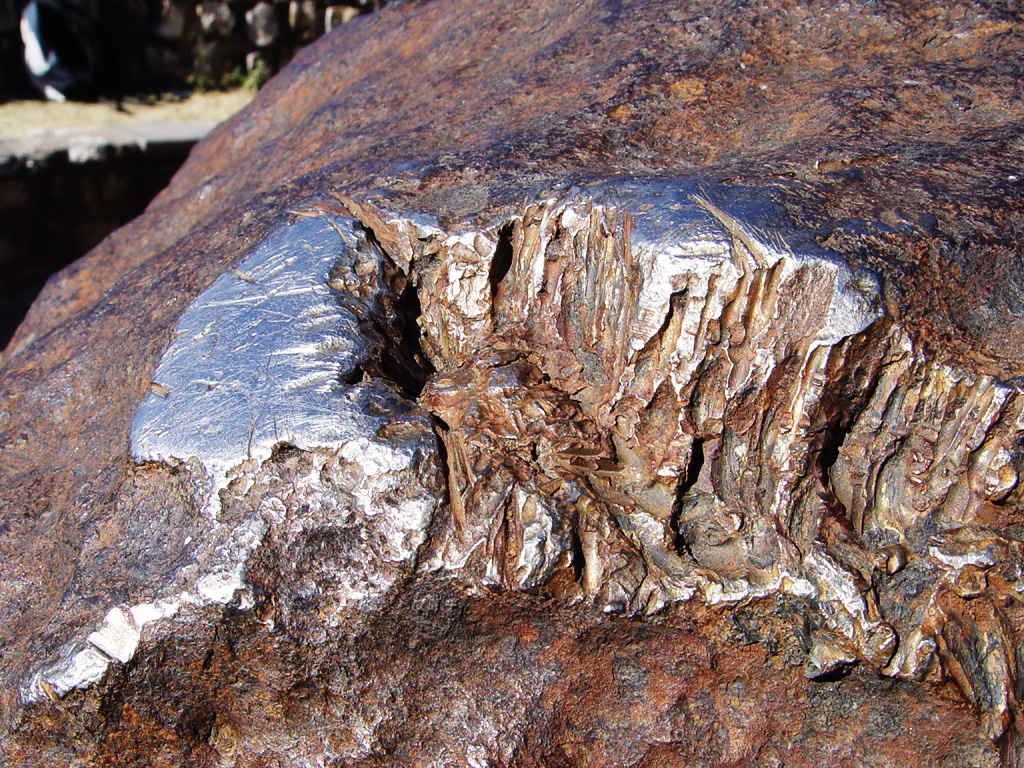
Hoba, likely originating from the asteroid belt between Mars and Jupiter, formed from material in the proto-planetary disk around the young Sun over 4.5 billion years ago. Composed mainly of iron (about 84%) and nickel (16%), it was likely dislodged from the asteroid belt by an event like a collision, landing on Earth around 80,000 years ago. Its atypically shallow descent, combined with its preservation, offers scientists a unique opportunity to study the early solar system’s conditions.
Located on private farmland 15 miles (24 kilometers) east of Grootfontein, Namibia, the Hoba Meteorite is accessible by car via gravel roads. If you’re familiar with the area and don’t mind a more than 4-hour drive, you can rent a car and self-drive from Windhoek to Grootfontein. Alternatively, regional bus services link Windhoek to Grootfontein and the Hoba Meteorite site if you prefer not to drive.
The landowner charges a small entrance fee, and basic amenities like restrooms and a souvenir kiosk are available. While there’s no on-site accommodation, there is a Meteorite Rest Camp situated just 2 miles (3 km) away, and guesthouses and lodges can be found in Grootfontein.
Leave a Reply