• Skip to main content
  • Skip to primary sidebar
  • Skip to footer
  • Home
  • About Us
  • Copyright Report
  • Submit Content
  • Terms
  • Privacy Policy
  • Legal Disclaimer

Hasan Jasim

Hasan Jasim is a place where you may get entertainment, viral videos, trending material, and breaking news. For a social generation, we are the largest community on the planet.

A population of hard-to-eradicate ‘super pigs’ in Canada is threatening to invade the US

by Hasan Jasim Editorial Team Leave a Comment

ShareTweet

A concerning ecological threat is brewing in the expansive wilds of Canada, and its implications are reaching across the border into the United States. A burgeoning population of hard-to-eradicate “super pigs” is menacing the northern states, with Minnesota, North Dakota, and Montana scrambling to prevent their invasion.

The term “super pigs” refers to a hybrid breed found in Alberta, Saskatchewan, and Manitoba, combining the survival instincts of wild Eurasian boars with the size and prolific breeding capabilities of domestic swine. This unholy alliance has given rise to a resilient and rapidly multiplying species, triggering alarm bells among researchers and conservationists.

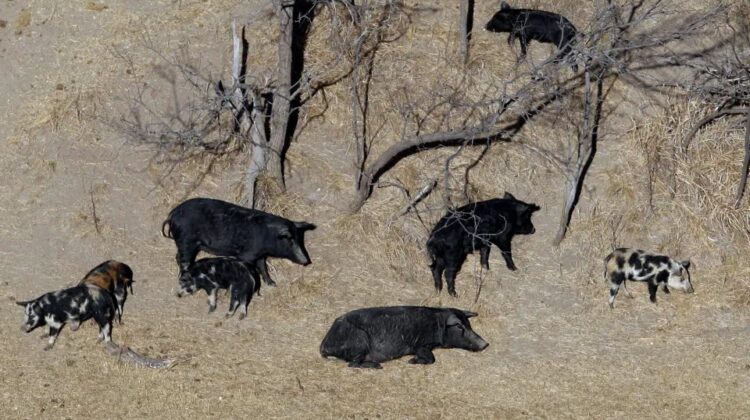
 In this Feb. 18, 2009 file photo, feral pigs roam near a Mertzon, Texas ranch. Minnesota, North Dakota and Montana and other northern states are making preparations to stop a threatened invasion from Canada. Wild pigs already cause around $2.5 billion in damage to U.S. crops every year, mostly in southern states like Texas. But the exploding population of feral swine on the prairies of western Canada is threatening spill south. (AP Photo/Eric Gay, File)ASSOCIATED PRESS

Ryan Brook, a professor at the University of Saskatchewan and a leading authority on the issue, labels feral swine as “the most invasive animal on the planet” and likens them to an “ecological train wreck.” The roots of this problem can be traced back to the 1980s when Canadian farmers were encouraged to raise wild boars. However, when the market collapsed in 2001, some farmers released the pigs into the wild by cutting their fences.

The “super pigs” turned out to be highly adaptable to the Canadian environment, particularly excelling in surviving harsh winters. Smart, furry, and resourceful, these creatures pose a significant threat by devouring crops, tearing up land in search of food, and even spreading diseases to hog farms, such as the dreaded African swine fever. Their rapid reproduction rate, with a sow capable of producing two litters per year, exacerbates the problem.

In this June 17, 2014, file photo, a wildlife trapper, walks past damage from feral hogs that happened overnight while foraging near one of his traps in New Orleans. An exploding population of hard-to-eradicate “super pigs” in Canada is threatening to spill south of the border, and northern states like Minnesota, North Dakota, Montana are taking steps to stop the invasion. (AP Photo/Gerald Herbert, File)ASSOCIATED PRESS

Despite efforts to control the population through hunting, the success rate is alarmingly low, ranging from 2% to 3%. Moreover, hunting makes the pigs more elusive and nocturnal, complicating eradication efforts. Already causing around $2.5 billion in annual damage to U.S. crops, particularly in southern states like Texas, wild pigs are not just an economic threat but can also be aggressive towards humans, with fatal incidents reported.

The situation is dire in Manitoba and Saskatchewan, where eradication is deemed impossible. However, some U.S. states are taking proactive measures. Montana, for instance, has banned the raising and transporting of wild pigs within the state. Dr. Brook emphasizes the need for aggressive strategies, combining various tools, including large ground traps like the “BoarBuster” and net guns fired from helicopters.
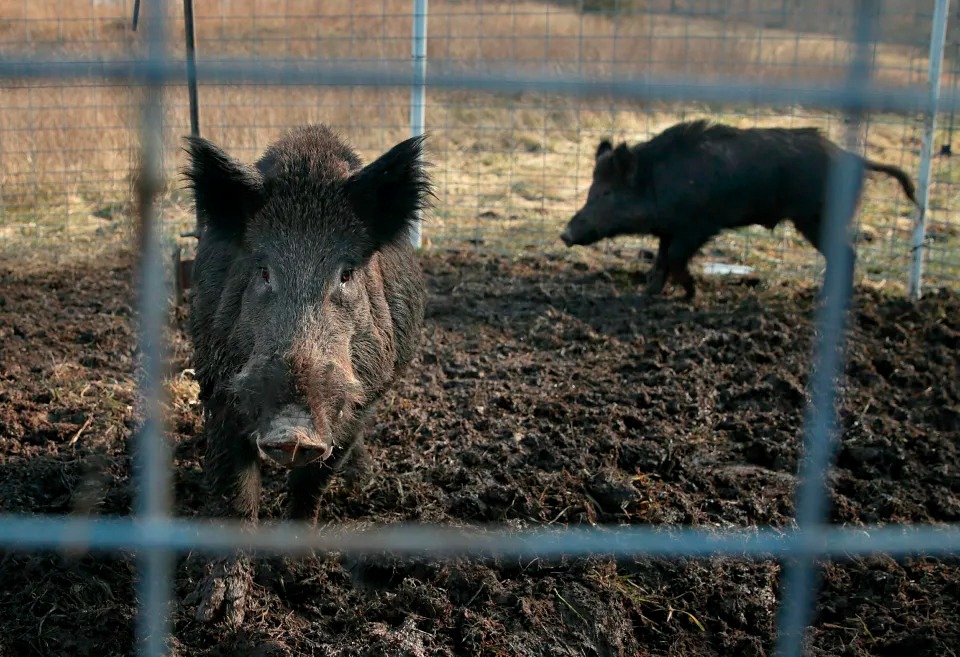
Two feral hogs are caught in a trap on a farm in rural Washington County, Mo., Jan. 27, 2019. Minnesota, North Dakota and Montana and other northern states are making preparations to stop a threatened invasion from Canada. Wild pigs already cause around $2.5 billion in damage to U.S. crops every year, mostly in southern states like Texas. But the exploding population of feral swine on the prairies of western Canada is threatening spill south. (David Carson/St. Louis Post-Dispatch via AP, file)ASSOCIATED PRESS

In Minnesota, the Department of Natural Resources is set to release a report in February addressing gaps in its management plan and proposing new preventive measures. Simultaneously, the U.S. Department of Agriculture is utilizing aircraft and drones to enhance surveillance along the northern border.

While the eradication of wild pigs seems unattainable in the near future, efforts by the USDA, such as the National Feral Swine Management Program, have shown success in states with smaller populations. The goal is to limit their expansion and mitigate damage in regions where they are already established. The battle against these “super pigs” is ongoing, emphasizing the necessity for a collaborative and proactive approach to safeguard ecosystems and agricultural livelihoods from this invasive menace.

Filed Under: Trends Worldwide Tagged With: Canada, hard-to-eradicate, invade, pigs, population, super, threatening, trends, worldwide

Reader Interactions

Leave a Reply Cancel reply

Your email address will not be published. Required fields are marked *

Primary Sidebar

More to See

Tired polar bear covers her ears with her paws as her adorable cub causes mischief

By Hasan Jasim Editorial Team

The Fascinating Ability of Woodpeckers to Avoid Brain Injury

By Hasan Jasim Editorial Team

Valonia Ventricosa: Unveiling the World’s Largest Unicellular Marvel

By Hasan Jasim Editorial Team

Remembering Betty Reid Soskin, the iconic National Park Service ranger

By Hasan Jasim Editorial Team

Inside ‘dystopian’ apartment block where its 20,000 residents never need to go outside

By Hasan Jasim Editorial Team

Cat lost in Maui wildfires reunites with family: “the happy news we need in these uncertain times”

By Hasan Jasim Editorial Team

In a Contentious Study, Scientists Implanted a Human Brain Gene Into Monkeys

By Hasan Jasim Editorial Team

Footer

About hasanjasim.online

Hasanjasim.online is a digital platform dedicated to publishing diverse articles and content, with a strong focus on topics related to the animal kingdom, nature, and the environment. The website offers engaging stories and visual content aimed at raising awareness about animal welfare and showcasing the wonders of the natural world, making it a great destination for nature lovers and curious readers alike.

Recent

  • Scientists Are Warning Influencers to Stop Chasing Shark Selfies After a String of Attacks
  • The 10-Year-Old Whose Backyard Butterfly Experiment Caught a Georgetown Scientist’s Attention
  • When Her Nonverbal Son’s Communication Device Died at Dinner, This Mom Found a Backup That Never Runs Out of Battery
  • Lamb’s Quarters: The Wild “Weed” That Outperforms Spinach in Nutrition
  • A Restaurant Put Up One Simple Sign for Its Teenage Staff — and It Says Everything We Forget to Say
  • Bees Can Smell 50 Times Better Than Dogs — Here’s How
  • Elderly Mushroom Picker Dies in Suspected Bear Attack in Japanese Forest

Search