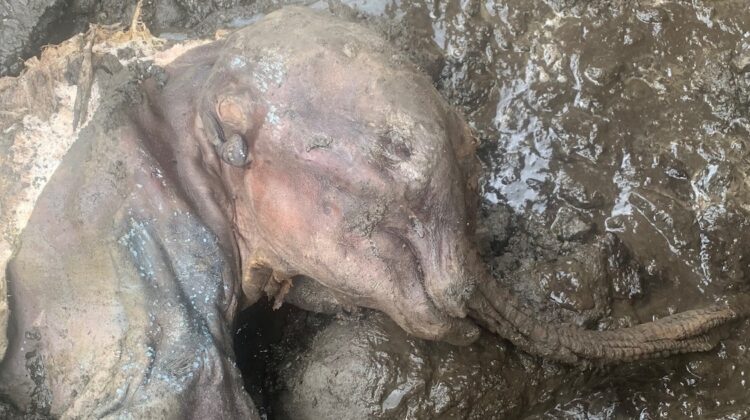
On June 21, 2022 — National Indigenous Peoples Day in the Yukon — a miner running a front loader through permafrost muck in Canada’s Klondike gold fields hit something that wasn’t gold. He stopped immediately and called his boss.
A Discovery Made in the Nick of Time
Treadstone Mining owner Brian McCaughan took one look and shut down the entire operation. The frozen animal in the muck at Eureka Creek, on Tr’ondëk Hwëch’in traditional territory near Dawson City, was a nearly complete mummified baby woolly mammoth — the first ever found in North America, and among the best preserved anywhere in the world.
Grant Zazula, the Yukon government’s paleontologist, was about six hours away in Whitehorse when the photo landed in his inbox. “She’s beautiful, one of the most incredible mummified Ice Age animals ever discovered in the world,” he said. With it being a statutory holiday, Zazula scrambled to find anyone nearby who could help — eventually reaching two geologists, one from the Yukon Geological Survey and one from the University of Calgary, who recovered her from the site.
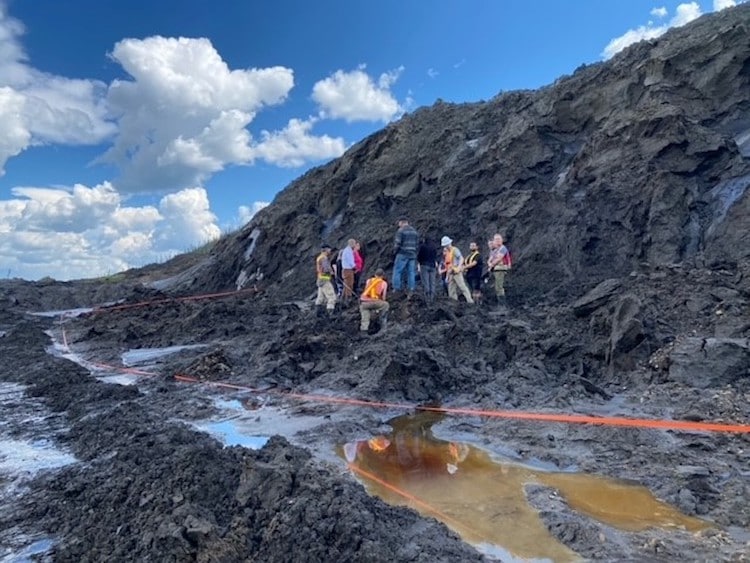
They got her out with almost no time to spare. “Within an hour of them being there to do the work, the sky opened up, it turned black, lightning started striking and rain started pouring in,” Zazula told CBC. “So if she wasn’t recovered at that time, she would have been lost in the storm.”
What Survived 35,000 Years in the Ground
The preservation is what makes this find genuinely extraordinary. Nun cho ga still has her skin, tufts of fur, her toenails, her tail, small tusk nubs, and a complete, still-malleable trunk with its prehensile tip intact — features that are exceptionally rare even among well-preserved mammoth specimens. At roughly 140 centimeters long, she’s slightly longer than Lyuba, the famous Siberian baby mammoth mummy found in 2007.
Zazula estimates she was only about 30 to 35 days old when she died, and that based on the site’s geology, her death occurred somewhere between 35,000 and 40,000 years ago, during the last ice age.
Her Final Moments, Preserved in Her Gut
Geologists recovering the body noticed something small but revealing: a piece of intestine containing grass. “So that’s telling us what she did the last moments of her life,” Zazula said. His reconstruction is that the calf, grazing and drinking just a few steps from her mother, wandered slightly too far and became trapped in mud. “And that event, from getting trapped in the mud to burial was very, very quick,” he said — which is precisely why she’s preserved as completely as she is.
A Naming Ceremony, and a Long Silence
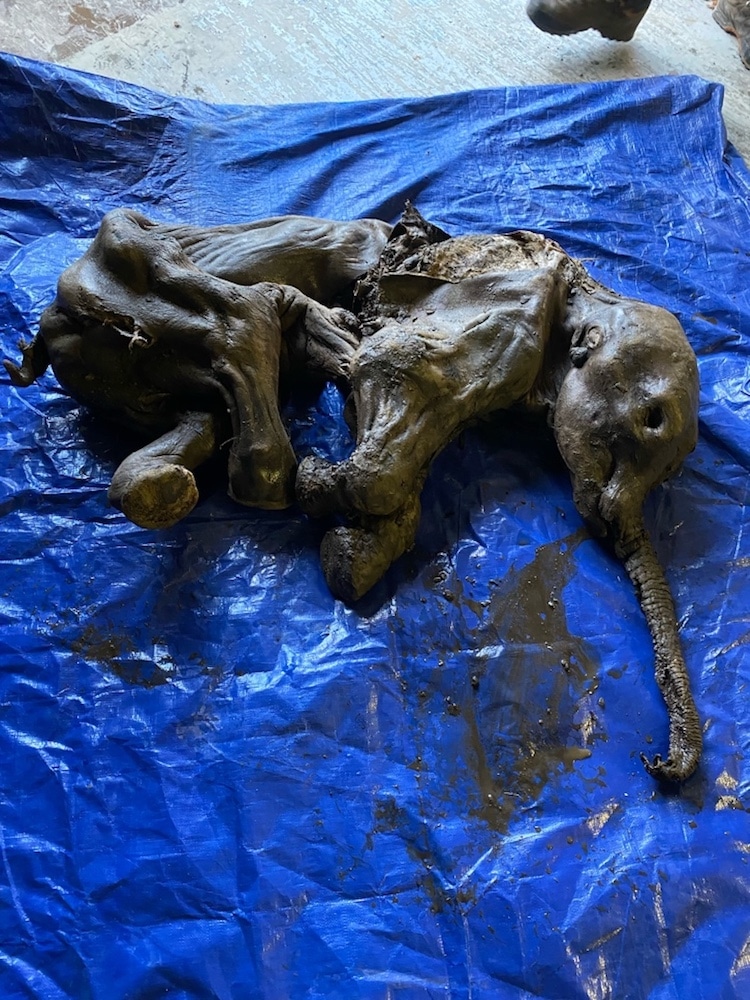
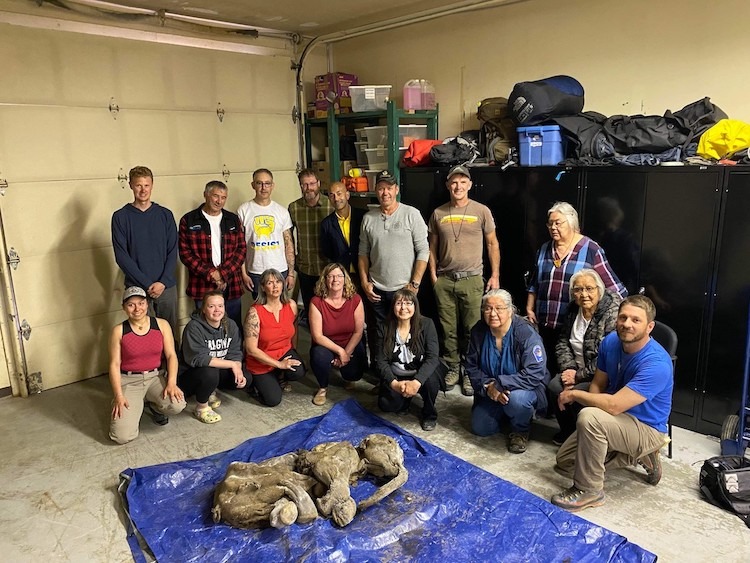
After recovery, Nun cho ga was brought to a nearby site for a ceremony led by Tr’ondëk Hwëch’in elders, attended by around 15 to 16 people including First Nation members, scientists, miners, and local officials. Gathered in a circle, the elders prayed and blessed her, and gave her the name Nun cho ga — “big baby animal” in the Hän language.
Debbie Nagano, heritage director of the Tr’ondëk Hwëch’in Government, described the moment the tarp came off: “We had a circle with the Elders and presented it to them. And we opened the tarp, and there was just no words for about 5-6 minutes. And that’s LONG.”
Elder Peggy Kormendy’s response has been widely quoted since: “It’s amazing. It took my breath away when they removed the tarp. We must all treat it with respect. When that happens, it is going to be powerful and we will heal.”
For McCaughan, whose operation surfaced her, the moment carried its own finality: “There will be one thing that stands out in a person’s entire life, and I can guarantee you this is my one thing.”
A Partnership, Not Just a Specimen
Tr’ondëk Hwëch’in Chief Roberta Joseph framed the find as a shared responsibility rather than a scientific prize: “This is a remarkable recovery for our First Nation, and we look forward to collaborating with the Yukon government on the next steps in the process for moving forward with these remains in a way that honours our traditions, culture, and laws. We are committed to respectfully handling Nun cho ga as she has chosen now to reveal herself to all of us.”
University of Alberta paleontologist Michael Caldwell, who wasn’t present at the ceremony, summed up the scientific reaction: “It’s a miracle of sorts preserved into the present, a scientific gold mine and simply a beautiful thing.”
Frequently Asked Questions
How is Nun cho ga different from other mammoth finds in North America? Other woolly mammoth remains have been found across North America, but Nun cho ga is the first near-complete, mummified specimen — meaning skin, hair, and soft tissue survived, which is exceptionally rare outside of Siberian permafrost.
Why did the storm matter so much to the recovery? The heavy rain and lightning that arrived within an hour of her extraction would likely have washed away or destroyed the exposed remains, meaning the timing of the recovery effort was genuinely decisive to whether she survived at all as a specimen.
Who has authority over the remains now? The Tr’ondëk Hwëch’in First Nation and the Yukon government are working together on how to study and care for Nun cho ga, with the First Nation explicitly framing the process around its own traditions, culture, and laws rather than treating the find as purely a scientific asset.
Sources: CBC News, Smithsonian Magazine, Gizmodo, CBS News, and the Government of Yukon’s official statements, cited above.
Any plans to collect DNA?
What an a m zing discovery. So glad it will have a blessing ceremony and be treated with dignity. We can learn much from her.