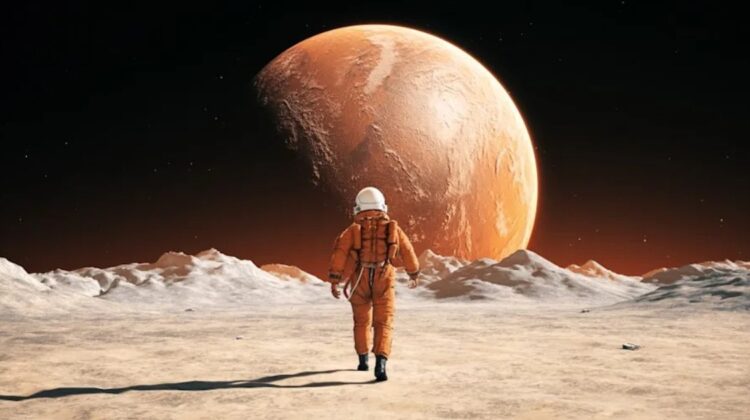
Water, not power, turns out to be the resource that could keep humans off the moon for good — or at least keep them from building anything bigger than a small town.
The Study Behind the Claim
A paper published 14 September 2026 in Frontiers in Space Technologies, titled “No Cities on the Moon: A Billion Tons of Water Is Not Enough for Sustainability,” was written by Martin Elvis, an astrophysicist at the Center for Astrophysics, Harvard and Smithsonian, and Jonathan McDowell of Durham University’s Space Research Centre.
Their starting point is generous: roughly one billion tons of water ice, the upper-end estimate for what’s trapped inside the moon’s permanently shadowed polar craters — regions that, because the moon has almost no axial tilt, have stayed in darkness for billions of years. Even taking that figure at face value, the math doesn’t favor a big lunar population.
Power Isn’t the Problem — Water Is
Elvis and McDowell found that energy generation isn’t the binding constraint. The rims of those same polar craters receive nearly constant sunlight, and the authors calculate that kilometer-high towers lined with solar panels — potentially built from lunar silicon — could generate on the order of three gigawatts, enough to support industry, fuel production and, per Elvis, even data centers.
Water is a different story. Once exposed to sunlight, lunar ice doesn’t melt — it sublimates almost instantly in the vacuum, which is exactly why it has survived only in permanent shadow. That scarcity, combined with how much a population actually consumes, is what caps how many people the moon can support.
Running the Numbers
Using the International Space Station’s water-recycling system as the benchmark — currently around 98% efficient, a rate reached only in 2023 — the authors calculate that a city of one million people would exhaust a full billion tons of lunar water in just over a century. At the ISS’s earlier 94% efficiency, that same city would run dry in about 40 years.
The estimate assumes the most optimistic water figure available. Elvis has said current best estimates put the real supply well below that billion-ton ceiling — by his account, roughly 30 times smaller — which would shrink even a modest settlement’s runway to a matter of years rather than decades.
The authors conclude that without a roughly tenfold improvement in recycling technology, or the discovery of substantially larger water reserves, large-scale, long-term lunar cities aren’t realistic with current or near-future technology.
Smaller Settlements Look More Realistic
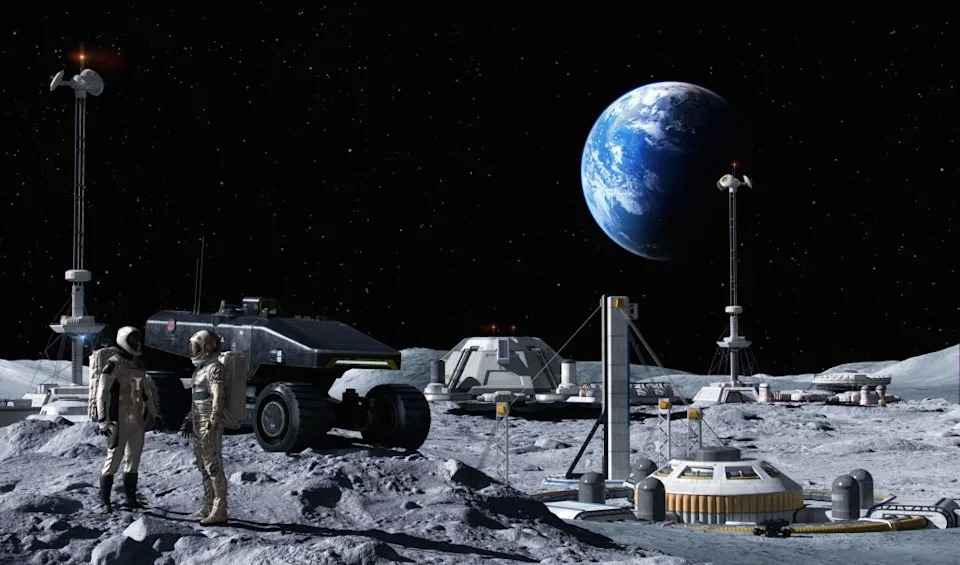
The picture changes at smaller scales. The study suggests a “Moon Village” of around 1,000 people — comparable to the winter population of Antarctica’s research stations — could use lunar water relatively freely and remain sustainable for centuries. A town of roughly 10,000 also looks workable long-term. It’s only once population estimates climb toward 100,000 and beyond that water management becomes the defining constraint, with a million-person city landing squarely in unsustainable territory under current technology.
Life Underground
Even a modest settlement would likely need to be built below the surface. Hao Chen, an assistant professor at Stevens Institute of Technology who studies space-based construction, told Newsweek that lower lunar gravity — about one-sixth of Earth’s — allows for larger enclosed volumes with fewer structural constraints than buildings on Earth face. But he pointed to the tradeoffs: radiation, micrometeorite impacts, extreme thermal swings, and the fine, abrasive lunar dust that any structure would need to withstand.
Nathan Silvernail, a former SpaceX engineer who worked on Crew Dragon’s life-support systems, told Newsweek those same hazards make it likely that “a civilization on the moon will most likely be subterranean.” Chen envisions future lunar communities built around natural lava tubes, with housing, food production, recycling and manufacturing spread across multiple underground levels.
Frequently Asked Questions
How much water is actually on the moon? Estimates range widely. The study’s upper-bound figure is roughly one billion tons trapped in permanently shadowed polar craters, but the paper’s authors say current best estimates suggest the real figure is considerably smaller.
Could better technology change the outlook? Yes — the researchers say a roughly tenfold improvement in water-recycling efficiency, or a comparably larger confirmed water supply, would be enough to make large-scale lunar settlement realistic.
Does this rule out permanent lunar bases entirely? No. The study specifically finds that small settlements — a village of about 1,000 people or a town of around 10,000 — could be sustainable for centuries. It’s cities in the hundreds of thousands to millions that the current water estimates can’t support.
Sources: Frontiers in Space Technologies (Elvis & McDowell, 2026); Newsweek; Universe Today; Phys.org.
Leave a Reply