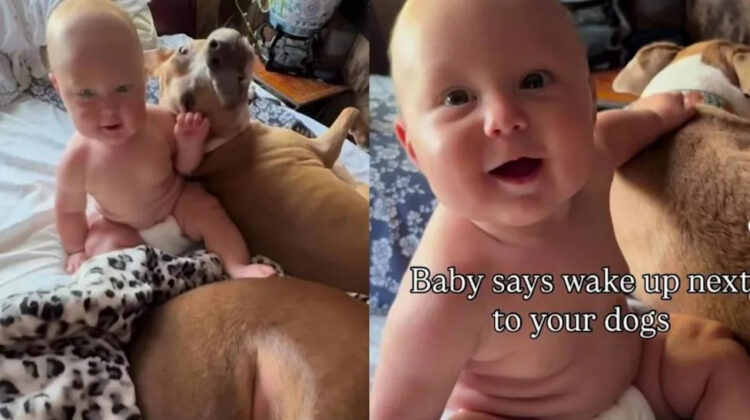
Most babies wake up hungry, cranky, or both. The one in this clip wakes up looking for company — and finds it on either side of him.
A Morning That Starts With a Head Pat
The video opens on a bed, mid-morning light, a baby propped up between two large dogs the account describes as pit bull–type mixes. One is stretched out behind him, half asleep. The other is sprawled nearby, in no hurry to move. The arrangement looks less like a pet-and-owner setup and more like a pile of siblings who all went to bed in the same spot.
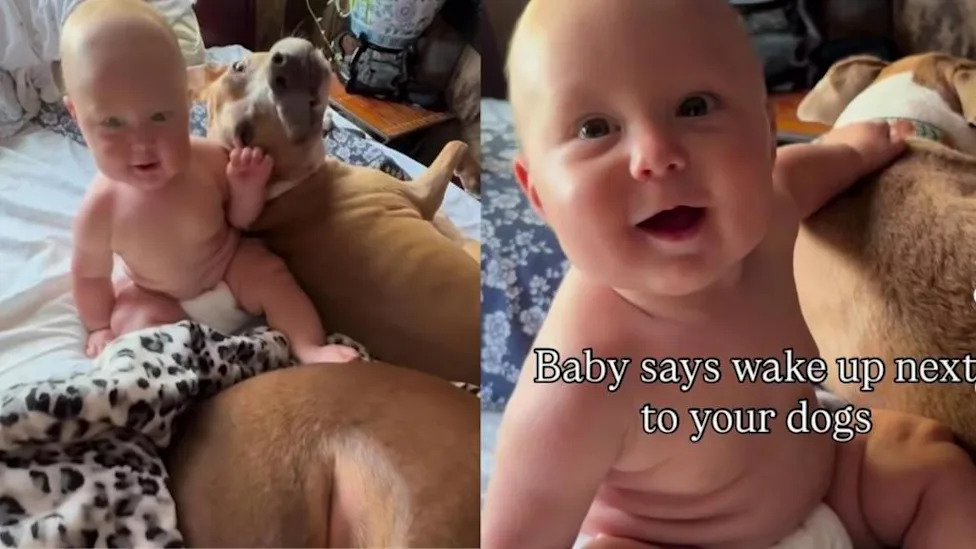
The baby doesn’t reach for anything to play with. He twists backward, finds fur, and starts patting. Text across the clip frames it as the whole point: wake up next to your dogs.
The account’s caption says much the same — that he loves waking up and petting them. The grin on his face makes the caption feel redundant.
The Part Everyone Replays
A few seconds in, one of the dogs decides a head pat deserves a response. It leans in and licks the baby around the nose and cheek — slowly, the way dogs greet their own, not the frantic face-washing that makes parents nervous. He lights up, glances at the camera as if checking that someone is seeing this, then turns straight back to the dogs.
That’s the whole clip. No stunt, no punchline. Pets, a lick, and three creatures deciding the day can start later.
Why This Kind of Bond Isn’t Unusual
Pit bull–type dogs are, as a group, strongly people-oriented. Many of them prefer physical contact to distance and settle best when they’re touching someone they trust — which is exactly what the video shows. That said, temperament is an individual trait, not a breed guarantee, and “pit bull” isn’t even a single breed; it’s an umbrella label covering several breeds and countless mixes that happen to share a head shape.
What’s visible here is two relaxed dogs: loose bodies, slow movements, no stiffness, no attempt to leave. That’s a good sign. It isn’t a substitute for supervision.
The Safety Part That Deserves More Than a Footnote
Videos like this one travel far, and they quietly teach people that dogs and infants can simply be left together. They can’t — not any dog, not any breed, not even the sweetest one in the house.
A few things veterinary behaviorists consistently recommend:
- An adult stays within arm’s reach, every time, without exception. “In the same room” isn’t close enough.
- Give the dog an exit. A pet who can walk away from an unwanted grab almost never needs to communicate in stronger terms.
- Learn the quiet stress signals — lip licking, turning the head away, whale eye, a sudden yawn. These come long before a growl, and a growl is information, not misbehavior.
- Babies grab, pull, and poke without meaning to. That’s on the adults to intercept, not on the dog to tolerate.
None of that takes away from the clip. It just belongs next to it.
How Viewers Responded
The comments filled with the predictable, entirely sincere reaction: people delighted by the baby, charmed by the dogs, and convinced the affection runs both ways. A recurring theme was that the dog’s careful licking looked like grooming a family member rather than investigating a snack — though plenty of commenters joked about the second possibility too.
Frequently Asked Questions
Is it safe to let a baby sleep next to dogs? Co-sleeping with pets isn’t advised for infants. Shared naps and morning cuddles with an adult present and awake are a different situation from leaving a baby and a dog on a bed unsupervised.
Are pit bull–type dogs good with children? Individual temperament, socialization, and training matter far more than breed label. Many are affectionate with kids; that still doesn’t change the supervision rules, which apply to every dog of every size.
Why do dogs lick babies? Licking usually signals affection and social bonding, the same way dogs groom each other. It can also be simple curiosity about smells or food traces on the skin. Gentle licking is normal; it’s still worth redirecting around the face.
Leave a Reply