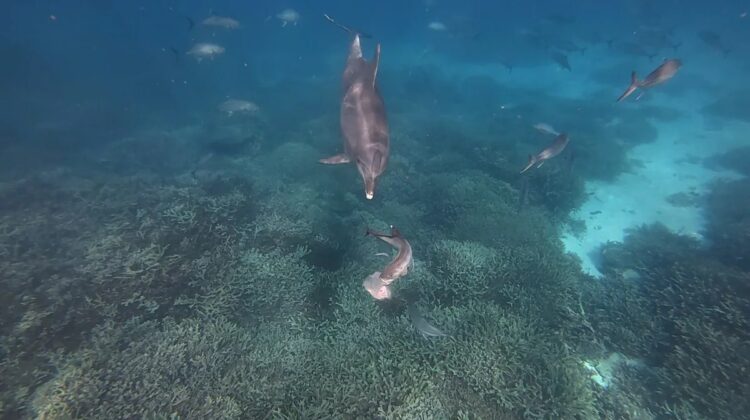
Not every dolphin hunts the same way — and one bottlenose dolphin off Australia’s Great Barrier Reef has developed a technique researchers had never formally documented in any cetacean before: chasing a fish until it throws up, then eating what comes back out.
Meet Bubbles
Staff and researchers at Lady Elliot Island Eco Resort, on the southern Great Barrier Reef, have known this particular male bottlenose dolphin since 2017, identifiable by a notched dorsal fin and a scar along his right side. They nicknamed him Bubbles. Between June 2021 and October 2025, researchers and divers documented 20 separate encounters between Bubbles and schools of bigeye trevally — 11 of which ended in a successful “feeding event.”
How the Hunt Actually Works
According to the study, published September 13 in the journal Ecology and Evolution, Bubbles begins by scanning a school of bigeye trevally, moving his head side to side while using echolocation. Once he identifies a target, he isolates that individual fish from the group and mirrors its movements at close range, pursuing it until it vomits from the stress of the chase — at which point Bubbles quickly eats the expelled food, or occasionally the fish itself, while the trevally swims off.
He doesn’t do this once and stop. In a single session, Bubbles has been observed performing up to 10 chases within 30 minutes.
The Sounds That Might Be Making It Work
While hunting, Bubbles produces two distinct types of vocalization: sharp echolocation click trains, and low-frequency tonal sounds lasting roughly a third of a second to just over two seconds. Researchers have two working hypotheses about what these sounds are doing — though they stress neither is confirmed yet, since the audio analysis came from a single recorded encounter. The low tones may add to the targeted fish’s stress response, making regurgitation more likely; the echolocation clicks, meanwhile, may help Bubbles assess a fish’s body condition before he even starts the chase.
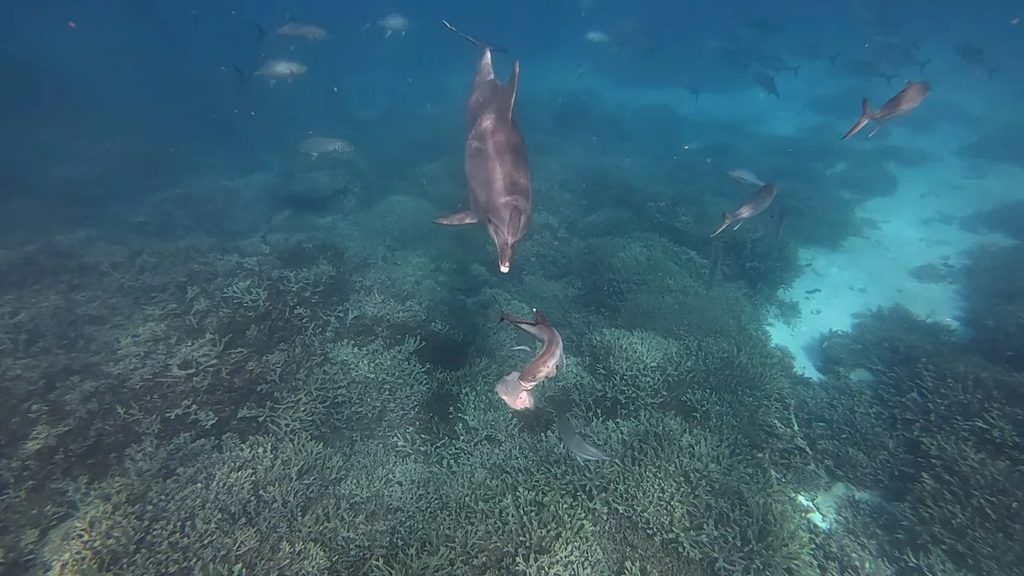
“Echolocation does allow dolphins to discriminate small differences in their targets’ shape, size and structure, so the dolphin potentially uses echolocation to decide which fish to target to get the best reward,” said Dr. Asia Armstrong (also referred to as Asia Haines in some reporting), a marine scientist at the University of the Sunshine Coast and the study’s co-author. Fellow co-author and PhD candidate Romney Edwards-Francis added: “We observed him repeating this behavior over several years which suggests he may have learnt to target the fish with the fullest bellies, providing the most rewarding meals.”
A Solo Act, Which Is Unusual on Its Own
Common bottlenose dolphins typically hunt socially, coordinating with other members of a pod. Bubbles doesn’t. Researchers noted that every documented chase was a solo effort — even in instances when other dolphins were nearby, he didn’t recruit or share the technique with them in the moment.
Kleptoparasitism: Common in Nature, Rare to Document Underwater
Stealing food captured or gathered by another animal — a behavior called kleptoparasitism — is far from unique to dolphins; seagulls swiping food mid-air and various fish and reptiles pulling similar tricks are well documented. What made Bubbles’ case scientifically significant wasn’t the concept itself, but the detail and repetition researchers were able to capture underwater, in a habitat that’s notoriously difficult to monitor continuously.
Outside experts have urged some caution about over-interpreting the findings. “It makes it compelling evidence that this was more than simply opportunistic feeding,” said Jason Bruck, a dolphin behavioral scientist at Stephen F. Austin State University who wasn’t involved in the research. “I would be cautious, though, about assigning intention. We can’t yet say the dolphin is pursuing the fish because it expects it to regurgitate.” Bruck also noted the inherent limits of underwater observation: “A dolphin can perform a complex feeding behavior several meters underwater, and we may never know exactly what happened.”
Part of a Longer-Running Research Effort
The discovery emerged from the University of the Sunshine Coast’s long-term ecological monitoring project around Lady Elliot Island, known as Leaf to Reef, supported by the Great Barrier Reef Foundation’s Reef Islands Initiative. Researchers say behaviors like Bubbles’ are likely underreported across dolphin and whale species generally, simply because sustained underwater observation of wild cetaceans is logistically difficult — though combining emerging tools like drones with traditional underwater surveys may help close that gap going forward.
“It’s very possible that other species use this tactic,” Armstrong said. “Dolphins and whales use a variety of unique foraging tactics, which is reflective of their intelligence, adaptability and ability to learn and pass information to one another socially.”
Frequently Asked Questions
Did Bubbles invent this hunting technique himself, or learn it from other dolphins? It’s currently unknown — researchers haven’t determined whether Bubbles developed the behavior independently or picked it up socially, and it also remains unclear how widespread this kind of food theft might be among other dolphins or whales that simply haven’t been observed doing it.
Is this considered harmful or cruel to the fish involved? The behavior causes real, if brief, physiological stress to the targeted trevally, but the fish generally survives and swims away afterward — researchers frame it as a genuine predator-prey interaction rather than gratuitous harassment, similar to how a chase-based hunt would be described in other predator species.
Why is this discovery considered scientifically significant if food-stealing is common in nature? Kleptoparasitism is well documented in many animals, but this is considered the most detailed documented case in any cetacean specifically, largely because underwater observation of wild dolphins over multiple years is logistically rare and difficult to sustain.
Sources: Edwards-Francis et al., “Repeated Observations Suggesting Kleptoparasitism by a Common Bottlenose Dolphin,” Ecology and Evolution (2026); Scientific American; Phys.org; and StudyFinds, cited above.
Leave a Reply